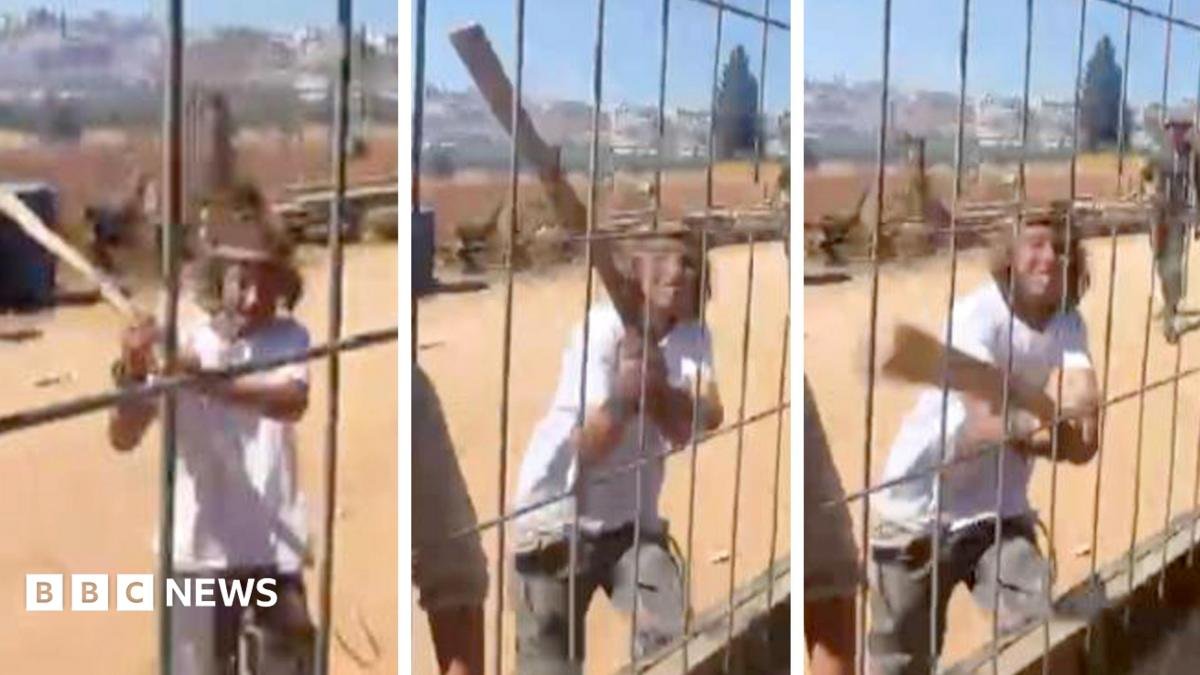
ByLucy WilliamsonMiddle East correspondent, Reporting fromAl-Mughayyir, in the occupied West Bank The large, bolted gate of the Abu Alia family compound in al-Mughayyir village held firm against the teenage settlers; its thin metal bars ringing with each blow, as they smashed it again and again with their clubs.
But the insults hurled by both sides that day passed freely through the bars.
One offensive slur - almost identical in both Hebrew and Arabic - delivered with nonchalant contempt by the Israeli boys bashing at the gate; and with fear and frustration by the Palestinian man inches away from them on the other side, filming the encounter on his phone.
This gate, on the edge of al-Mughayyir, has become a weekly frontline in the battle for the occupied West Bank.
And this kind of attack by settlers on Palestinian homes, a weekly routine in villages across the territory.
Image caption, Clouds of tear gas fired by Israeli troops rise from the streets of al-Mughayyir When we arrived in al-Mughayyir that day, the confrontation at the Abu Alia compound had already begun.
The Israeli army and border police were already moving through the streets, and residents were running from their vehicles - soldiers, like settlers, are seen as the enemy here.
Some young men rolled rocks into the road to block it, as the sound of gunshots cracked over the village.
On the hill above them, the local mosque was calling on people to help the family trapped by the settlers.
But slipping past Israeli soldiers has become a dangerous gamble.
Residents, medical workers and journalists have all been shot during Israeli military operations in the West Bank.
This is what passes for a normal weekend now in al-Mughayyir, and in villages across the West Bank, but it rarely breaks beyond the local news.
We spent a week around al-Mughayyir, and its neighbouring village, Khirbet Abu Falah, to see what life was like here for a single community, or a single family.
What we found shows how quickly control of this landscape is changing, and how local attacks by settlers here are the tip of a national project to bring West Bank land under Israeli control.
Image caption, Palestinian residents of al-Mughayyir confront Israeli settlers and troops Since occupying the West Bank during the 1967 Middle East war, Israel has built more than 100 settlements housing more than half a million Jews on land Palestinians want for a future state.
Some Israeli settlers have also established hundreds of wildcat outposts - often starting with a single tent or caravan on a hilltop, and often very close to Palestinian homes.
Both Israel's official settlements and its outposts are illegal under international law.
Israeli Prime Minister Benjamin Netanyahu has described those carrying out settler attacks as a handful of misguided young people: "150 juvenile delinquents", he's called them, or "70 teenagers from broken homes".
The settlers smashing the Abu Alia gate that Saturday in al-Mughayyir seemed to be mainly teenagers, but earlier that day, a settler group had put out a call on social media to "expel the enemy", including a quote from the Torah.
"If you do not drive out the inhabitants of the land from before you, those you leave will become spikes in your eyes and thorns in your sides," it says.
And behind the young faces at the gate in al-Mughayyir were much older settlers - at least one of them armed - standing with Israeli soldiers not far from the house.
There is a widespread belief among Palestinians in the West Bank that Israeli soldiers support settlers during these attacks.
Image caption, Footage appeared to show Israeli soldiers making no attempt detain the settlers who attacked the Abu Alia compound or confiscate their clubs Footage of the confrontation at the gate, filmed by the Abu Alia family, shows soldiers strolling up to the teenagers who are attacking it, and making gentle moves to guide them away.
It is not effective: the teenagers return again and again to smash their clubs against the gate, as a woman inside screams at them to get away.
The soldiers standing with them at the gate make no attempt to question or detain the attackers, or even confiscate their clubs.
Footage, also filmed from the Abu Alia compound, appears to show young settlers breaking fencing around the property, as soldiers stand by a short distance away, helmets off, phones out.
In one photo, there appears to be an angle-grinder or similar power tool lying on a log behind them.
We later photographed it in the hands of soldiers, then in the hands of settlers, then with soldiers again at the Abu Alias' fence.
We asked the Israel Defence Forces (IDF) about these incidents.
It gave no explanation for the events, but said in a general response that it was investigating claims of damage to property.
Image caption, A power tool is visible in footage showing the attack on the Abu Alia compound Rafeeq Abu Alia, who was one of the family members in the house that day, told me the attack had followed a familiar pattern.
"First thing this morning, they came...
There were four settlers and they were armed.
Then more settlers came and laid siege to the house, insulting and provoking us," he said.
"They came with the army.
The soldiers entered, followed by the settlers.
The army beat people inside the house." We filmed soldiers trying to break down the Abu Alias' gate that day, while settlers stood beside them.
And later saw workers fixing the broken entrance.
Medics told us they had treated several Palestinians for tear gas and beating injuries, and that another person had been taken to hospital with a gunshot wound.
Image caption, Rafeeq Abu Alia said the attack on his family's home followed a familiar pattern The IDF told us its forces had been in al-Mughayyir that day, responding to reports of a confrontation between Palestinians and Israeli civilians.
It said soldiers had entered a house in the village to search for suspects throwing stones, and separately, that they had detained one person taking part in what it called a "violent riot".
It said it was investigating allegations of violence by soldiers.
It also said masked Palestinians had used slings to hurl stones at soldiers, that its forces fired to remove the threat, and that "a hit was identified", meaning someone was shot.
The rules of engagement for Israeli forces in the West Bank were loosened to allow soldiers to use live fire against Palestinians throwing stones, after the Hamas-led attacks on Israel on 7 October 2023 that triggered the Gaza war.
Our repeated requests to film with the IDF on patrol in the West Bank this year have so far gone unanswered.
As Israeli forces fired live rounds, stun grenades and tear-gas canisters into al-Mughayyir that day, we walked down a largely empty road towards the Abu Alia compound, to see the situation first-hand.
Two soldiers appeared in front of us, metres away.
Our local Palestinian producer was the first to notice them.
We were still filming as one raised his weapon, pointing towards us.
We headed up to a nearby roof for safety - the army vehicle and soldiers visible right below us.
Within seconds of our arrival, they motioned for us to stop filming.
One raised a tear-gas launcher towards us.
We moved back from the edge of the roof.
He never fired.
Access to stories like this is getting harder here, even for journalists with official Israeli government accreditation.
Palestinian paramedics say they are also routinely blocked.
An ambulance worker with the Palestinian Red Crescent told me that while he was responding to a call from al-Mughayyir that week during another settler attack, Israeli soldiers took the keys to his ambulance, after telling him to turn off the engine.
"If they tell us to stay there, we have to stay and wait, regardless of the situation," he said.
"It's something we face all the time." Image caption, 'The army is the settlers, but their clothes are green,' says village councillor Abu Waheed Al-Mughayyir is an isolated village, surrounded by areas which were temporarily left under full Israeli control during the Oslo peace process 30 years ago.
That peace process later collapsed.
In the past few years, Israeli settlement outposts - illegal under both Israeli and international law - have mushroomed around it.
A member of the village council, a man known as Abu Waheed, told me that settlers came into al-Mughayyir every day, and that when the settlers told soldiers to do something, the soldiers did it.
"[They come] with the army, and with the cars of the army," he said.
"Here and here and here.
The army is the settlers, but their clothes are green." Many Israeli soldiers serving here are settlers themselves and see the West Bank as land given to them by God.
Thousands of settlers were also directly recruited into local security squads here after the 7 October Hamas attacks, and given weapons, with minimal vetting or training.
Army figures say most of those squads have now been disbanded, following multiple reports of abuse against Palestinian residents.
Image caption, The Israeli military said its troops shot a Palestinian who used a sling to hurl stones at them None of the outposts we approached around al-Mughayyir responded to our request for an interview.
But one settler in a nearby outpost recently spoke to an Israeli documentary team about his work in a security squad.
"We are the residents, and we are carrying out a conquest here," Adar Lafair told the Kan 11 documentary team.
"We're settling on land that years ago we couldn't have walked on.
We wouldn't have dared to walk on.
Arabs controlled this area.
But today, we're here." His wife Rivka said she dreamed of the squads being allowed to "conquer" a nearby Palestinian village.
Describing the creation of her outpost by Israeli settlers, she said control of the area was taken by "a group of 17-year-old kids with no weapons, with nothing".
"They simply got into fights over the land.
They just showed who was in charge.
And we're the ones in charge of this land," she said.
"It shouldn't be that teenagers go up onto a hilltop and safeguard the security of the entire people of Israel by doing that.
It should be the army that clears the way." Image source, AFP Image caption, A metal Star of David outside the Malachei HaShalom settler outpost near al-Mughayyir One Israeli soldier who served in the West Bank recently told me that extremist settlers saw him as the enemy for not supporting their attacks.
He asked us to hide his identity.
"There are teenagers there who look at you with hate," he said.
"There was one who told us, 'I will put a bullet in your head.'" He said it was clear that the attacks were not the work of just a few radical teenagers.
"There are bodies that equip them with this ideology, with food and water, and logistical support, and also guidance on how to do this." Asked about claims by some settlers that Palestinian attacks on them go unreported, he said that claim did not match the reality he had seen on the ground.
"In the Palestinian faces, I saw only fear," he said.
"I never saw any fear on any Jew that lived there.
They feel there is no law.
They feel that they can attack in the middle of the day, and nothing will happen." Image caption, At least 231 settler outposts have been established since Israel's government took office in December 2022 In the week we were there, the UN counted 45 Palestinians injured by Israeli settlers in attacks across the West Bank, including 12 children.
It says injuries linked to settler attacks have risen sharply, to more than three per day since the start of this year.
Settler attacks have risen as the number of settler outposts has grown.
These outposts are officially illegal under Israeli law, but that has not stopped Israel supporting them with roads and electricity, or legalising dozens of them after they appear.
The Israeli organisation Peace Now, which monitors settlements, says at least 231 new outposts have so far been created under this Israeli government.
Some, used as settler shepherding farms, now effectively control 18% of the West Bank, it says, driving out more than 100 Palestinian communities.
At a conference of settler leaders in July, the IDF commander for the West Bank, Maj Gen Avi Bluth, said farm outposts "align well" with Israel's security concept, "provided that this is also reflected in operational conduct, as well as ethical conduct, and in accordance with the law".
"All of this greatly strengthens security," he said.
Israel's current government has so far provided 19bn shekels ($6.2bn) to expanding settlements in the West Bank, and is now seeking another 600m shekels ($196m) for settlement programmes, according to Peace Now.
The government, which includes religious-nationalist settlers among its cabinet ministers, has also lifted a 20-year ban on Israelis settling in areas around the Palestinian city of Jenin in the far north of the territory.
It is pushing ahead with construction on more than a dozen settlements there, as well as several new military sites, including one next to the refugee camp in Jenin - the first time Israel has seized land for a military site in an area put under total Palestinian control in the Oslo Accords.
Hagit Ofran from Peace Now says the rapid construction in Jenin is part of a wider race by the Israeli government to expand settlements in the West Bank before Israeli elections are held in October.
And, she says, Israel is also finding ways to funnel state money to settler outposts that were illegal under Israeli law, via allocations for roads, "security needs" or the establishment of "temporary sites" in new areas earmarked for settlement.
Image caption, Brahim Hamayel said four new outposts had appeared near Khirbet Abu Falah over the past year In Khirbet Abu Falah, right next door to al-Mughayyir, Brahim Hamayel, an olive farmer I met during a previous settler attack a year ago, told me four new outposts had appeared nearby since then - two of them just in the previous month.
He pointed out one of them on a nearby hill - built, he said, on private Palestinian land, in an area that is supposed to be run by the Palestinian Authority.
And the attacks had increased too, he said, sometimes targeting the village itself at night.
"Since we met last year, the attacks have moved from our farms to our homes," he said.
"All my neighbours have been hurt one way or the other; some had their houses or cars burned down.
We're putting up barbed wire for protection, as if our houses have become prisons." While we were talking, we saw smoke rising from the village fields.
We watched as settlers moved around the smouldering land.
An Israeli army jeep quickly arrived, but it did not stop the settlers starting a second fire, or driving straight past them, back towards one of the new outposts Brahim had pointed out.
This road past their fields, increasingly overlooked by settler outposts, has become a gauntlet for farmers here, to be run at speed in vehicles without stopping or getting out.
It is the only open route between Khirbet Abu Falah and al-Mughayyir.
Twice when we drove along it, we saw an Israeli settler sitting in the empty fields.
Image caption, Fadi al-Nassan, 17, died a week after being shot during the attack in al-Mughayyir witnessed by the BBC One week after the attack in al-Mughayyir, Palestinian residents were still paying the price.
Seventeen-year-old Fadi Hamdallah al-Nassan, shot in the leg that day, had died of his injuries.
A football player with the Palestinian national youth team, he was carried back through the village streets for burial.
The next day, two more Palestinians were killed in another settler attack nearby.
Another routine weekend in the occupied West Bank: roads closed, land taken, villages under siege, families broken.