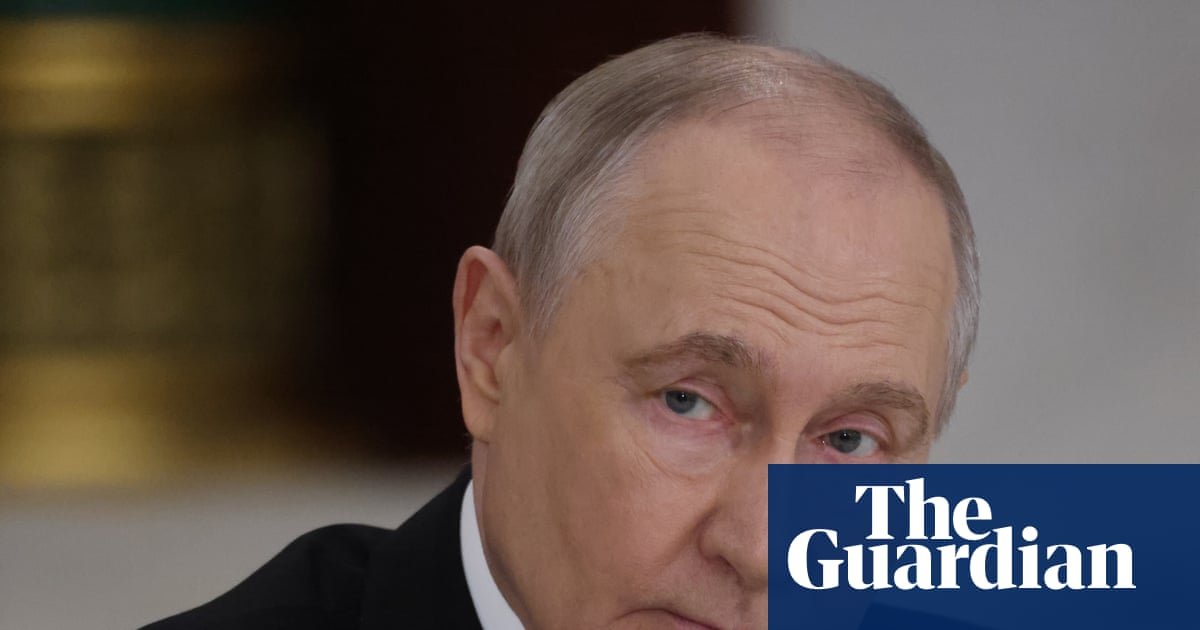
The Russian president, Vladimir Putin, who Jared Kushner described as ‘a grand master of politics’.
Analysis Jared Kushner’s 70-minute interview shows the peril of treating Putin like a corporate rival Patrick Wintour Diplomatic editor Trump’s son-in-law and top negotiator paints Russian invasion of Ukraine as a misunderstanding to be resolved In the space of a 70-minute interview, Jared Kushner – Donald Trump’s son-in-law and a prominent US negotiator in Russia, Gaza and Iran – probably did more to reveal why the world is mired in entrenched conflicts than a thousand geopolitical tomes or seminars.
During the conversation this week with Mathias Döpfner, the chief executive of Axel Springer, Kushner gave a rare insight into his diplomatic technique, offering a string of homilies that veered close to banalities: “You have nothing until you have something”, “diplomacy is like untying knots on a fishing line for his son”, and “you play the ball from where it lands”.
There were also many happy admissions of historical ignorance.
Since taking on the Ukraine brief a year ago, Kushner said, he had to learn “the algorithm of Europe and how complicated that is,” and had to get abreast of “the local issues with Ukraine”.
Jared Kushner, left, stands with the Ukrainian president, Volodymyr Zelenskyy, centre, and the US special envoy, Steve Witkoff, as they speak to the press in Dublin.
“Look at what’s happening in the Middle East with sanctions, with Russia, with Iran.
I think that you have to understand economics in order to understand geopolitics because the two go together very, very closely,” he said.
But the main revelation was how much he believes the Ukraine conflict is not a case of an aggressor and a victim – but is simply a series of misunderstandings and miscommunication.
Indeed, he treated Vladimir Putin as if he was a masterful corporate executive quite willing to close the deal if he were only given the right economic incentives – instead of a man ready to sacrifice hundreds of thousands of Russians to reclaim part of a historical empire.
In the process, Kushner revealed – often inadvertently – that he has largely bought into the Russian narrative of a string of postwar missteps by Europe and the US coming to a head in Nato’s expansion eastwards after 9/11.
That, in turn, has led him to adopt Moscow’s central demand to reshape the European security order to allow Russia, without opprobrium, to retain land it has gained by force.
Shining through his answers was a naive bias towards the aggressor, presented as a mediator’s desire to understand both parties.
Praise veering on awe for the Russian leader flowed.
“Putin – people can like what he has done, they can not like what he has done – [but] he is a grand master of politics.
He is a historic figure,” he said.
Any sense that Putin may have blundered escaped him.
As to the rights and wrongs of invading another country, Kushner was blasé.
“After all, most lines in Europe have changed over time and they are decided through war or peace, or concessions.
It’s not about fairness or who is right or wrong.
It’s about ending the killing,” he said.
He understood too why Putin could not offer a ceasefire: “He has very little confidence that if he stops the war, that he [will] be able to get to a postwar settlement that leads to not having a future war.” To stop the killing, the killing has to go on.
What is more, Kushner was struck by the Russian leader’s self-control.
“So far Putin has shown restraint and he has agreed not to use nuclear weapons and he has reassured us that is his intention.” Donald Trump and Vladimir Putin shake hands during a meeting in China.
Trump was “a strong counter-puncher,” argued Kushner, implying that Zelenskyy had thrown the first punch in a conflict that began with a Russian invasion.
Relations with Ukraine were cooperative, he said before pointedly saying Kyiv needed things from the US, without which “Ukraine will not be safe in the future”.
After noting that “the territorial issue is now a little bit of a deadlock,” his strategic insight was that if a future security architecture for Europe could be agreed, the land question in Donbas would eventually follow.
In essence, he proposed a revival of the Russia-Nato council, one of the bodies eviscerated by Putin’s war.
He also envisioned Ukraine inside the European Union with security guarantees akin to those offered by Nato’s article five.
But it was impossible at this stage to give “more specificity” about these guarantees in the detailed way Ukraine sought, he admitted.
So far neither Moscow or Kyiv have bought this plan, let alone a wary Europe.
Kushner tried to be polite about Europe, insisting it had to be at the negotiating table, but he could not stop himself characterising European military assistance to Ukraine as a “proxy war” against Russia.
As an analysis of why the Ukraine war had not ended inside the 24 hours Donald Trump promised, Kushner showed an alarming belief that the answer lay in granting more concessions to Putin, believing that the misunderstandings and misperceptions would then evaporate.
Explore more on these topicsJared Kushner Russia Ukraine Vladimir Putin Axel Springer analysis Share Reuse this content