Patrick McCabe’s herculean feat shows limits and possibilities of special educational needs and disabilities system
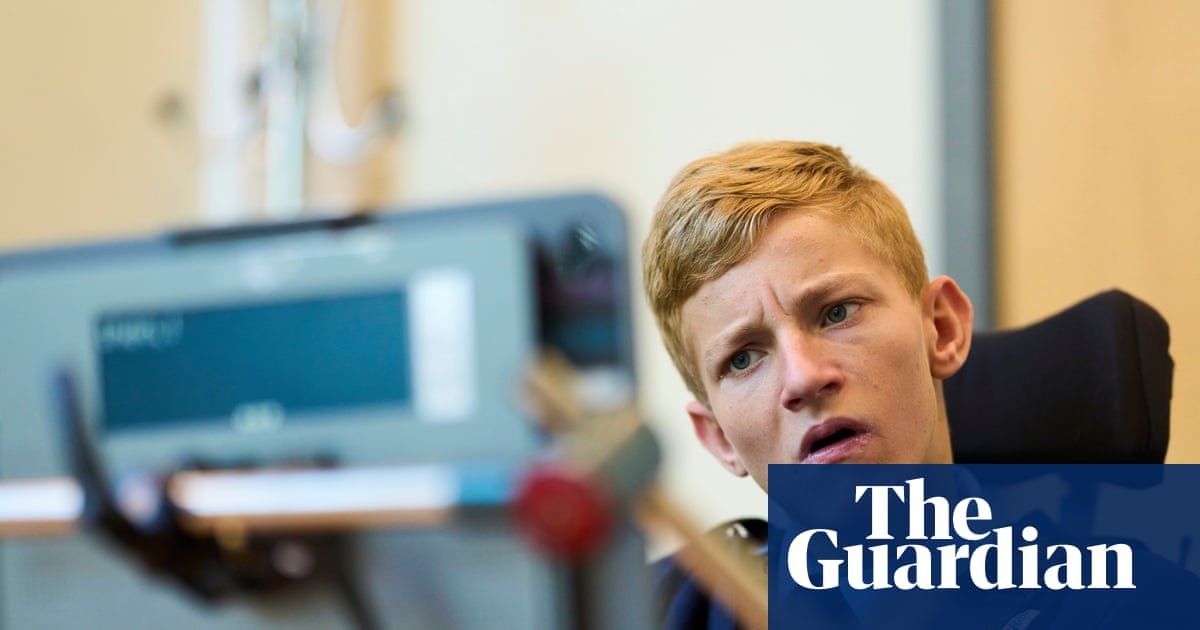
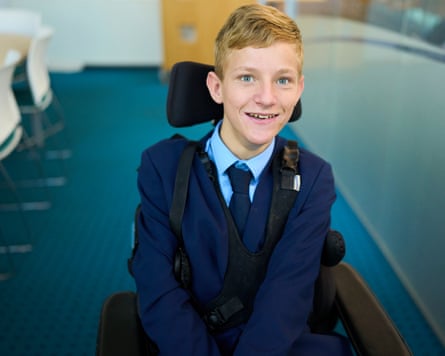
Patrick McCabe is instantly recognisable in the early autumn sunshine, his wheelchair surrounded by fellow pupils at Fallibroome Academy in Macclesfield, Cheshire as they move from lesson to lesson, chatting, laughing and joking around.
His extraordinary GCSE success this summer has become the stuff of legend. The 16-year-old has cerebral palsy and it took four months for him to complete his exams using eye-tracking technology. Now Patrick has started his A-levels – French, business and media studies – and fresh challenges lie ahead.
In person, Patrick is impish, thoughtful, articulate, witty, intelligent and honest. Using his augmentative and alternative communication (AAC) device, he tells the Guardian school has been a good experience overall. Born in Switzerland, his family moved back to England when he was six. Since then, he has gone to local mainstream schools, where he wanted to learn like everyone else.
“The best thing has been that, just like my big brothers, I’ve been able to learn and develop skills and gain knowledge of the world around me,” he said. “Even if some days I didn’t always want to go [to school], I think the opportunity to learn has helped me to grow and develop an independent mind.”
It has not been easy. “The most difficult things have been building meaningful relationships, and communication barriers do exist,” said Patrick. “People are not always familiar with Eyegaze technology and are not always willing or able to give it a chance in terms of friendships.”
In many ways, Patrick epitomises the Labour government’s ambitions for students with special educational needs and disabilities (Send). Forthcoming reforms are built on an inclusive approach, keeping children and young people in local – rather than special – schools with all the necessary expertise and support on hand.
But Patrick’s story also illustrates the scale of change required if education and assessment in England are to be truly inclusive. His experience shows that exams are far from accessible to all, his family and school say vital expertise is not always available and – crucially – funding is never enough.
“All we wanted was for Patrick to have the opportunity to demonstrate his knowledge and be given something resembling a level playing field compared to other students,” said the headteacher, Ross Martland. The school and Patrick’s mother, Jo, battled with the exam boards to try to ensure he was given a fair chance.
In the end, it doesn’t sound very fair at all. While his peers spent the first part of the year revising, Patrick’s exams got under way on 2 February and went on every morning until 5 June. It required a herculean effort from him, which left him exhausted, frustrated and sometimes ill.
A 30-mark question that might form just one element of an exam could take up to six hours. Patrick was supported throughout by CandLE, an organisation that helps students using AAC technology to access education across the UK. That he passed all seven GCSEs and achieved the grades he needed to continue into sixth form is testament to his determination.
“Revising for my GCSEs was very exhausting because it took extra time and effort to revise in the first place,” said Patrick. “I felt I had to work harder to express what I know, even when I understand the subject. This was tiring, both physically and mentally. I needed extra breaks to rest, but I still wanted to do my best to show what I had learned.”
Martland is fully supportive of the government’s Send ambitions. “I think the plans are right. Morally and values-wise, it’s absolutely right.” The issue is funding, he said, adding: “I’m concerned it will add significant pressures to schools if it’s not resourced properly.”
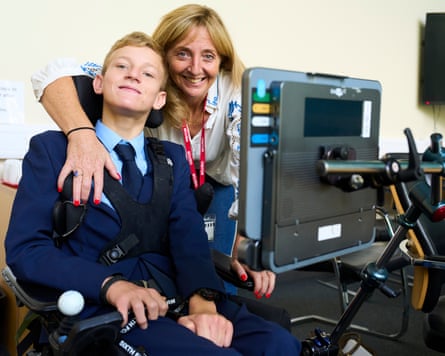
Throughout his time at Fallibroome, Patrick has worked with a devoted team of teaching assistants who support him not only with his learning in class but also his personal care. “We are incredibly proud of Patrick and all of our Send students,” said Rachel Crew, one of the teaching assistants working with him.
Patrick says the transition to sixth form is going well. He’s shed the bottle green uniform in favour of a smart blue suit and he says the school is doing everything it can to support him.
He says his mum has been “amazing” and he thinks students with physical disabilities who use eye-tracking technology should be assessed in a more appropriate way, so they don’t face additional barriers. But it is not only exams that worry him. “My concerns remain around friendships, if I’m honest,” he says.
So what’s Patrick planning next? After A-levels, he wants to study media at university. “I find it interesting and I’d like to go into the industry.” His mum tentatively suggests nearby Salford. Patrick’s looking at Bournemouth, 200 miles away. Is he daunted? No chance. “I feel excited about the experience.”