Indian prime minister wows crowd of 25,000 at Marvel Stadium as he praises role of diaspora in the India-Australia success story
Follow our Australia news live blog for latest updates
Get our breaking news email, free app or daily news podcast
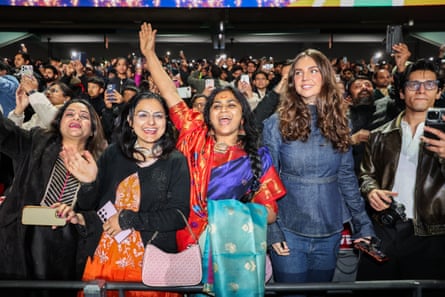
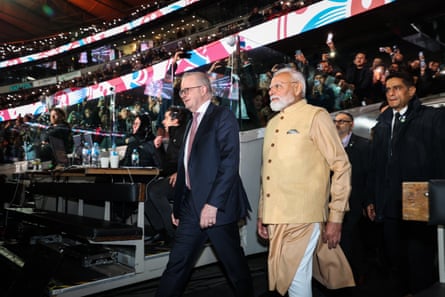
The throb of the drum beats intensified as the crowd of 25,000 Indian Australians prepared to welcome India’s prime minister back to Melbourne after more than a decade.
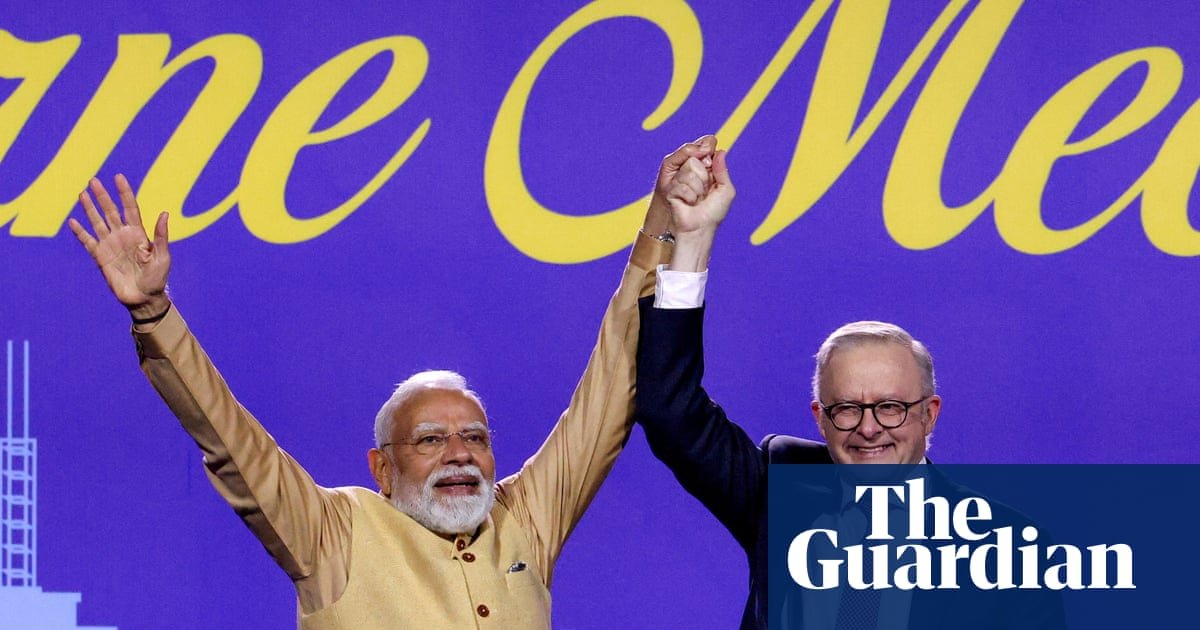
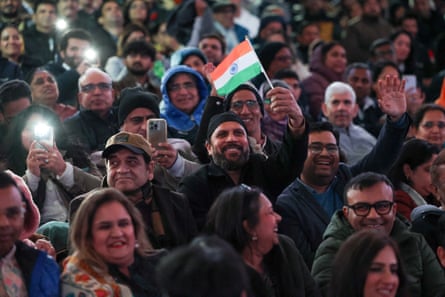
As Narendra Modi and Anthony Albanese stepped onto the red carpet at Marvel Stadium on Thursday night, twinkling phone lights illuminated the feverish audience as they chanted “Modi, Modi, Modi.”
The Indian prime minister’s three-day visit for talks in Melbourne is his first trip to Australia in three years. Ahead of the community event, Albanese and his Indian counterpart announced a major uranium deal and strengthened defence ties.
Speaking to the crowd, Modi hailed the India-Australia relationship.
“Whatever India and Australia do is always auspicious for both countries,” he said.
Modi said his third visit demonstrated the “heights India-Australian relations have reached”.
“The Indian diaspora has played a big role in it,” he said, as the crowd erupted in cheers.
Albanese said the event was about celebrating the bond that united the two countries.
“The energy that we feel in here tonight defines the Australia-India partnership,” he said.
The Victorian premier, Jacinta Allan, said Melbourne had hosted some big events but the “Melbourne Meets Modi” event was “next level.”
Ahead of the leader’s speeches, one of those in the crowd, Dibti Bandal, described Modi as one of the “great prime ministers of India”.
“He’s got India … on a global platform. He’s got India really known and recognised and he’s doing a lot more for India.”
Saloni Bhagat, another watching at Marvel, described Modi as “like a father to us”.
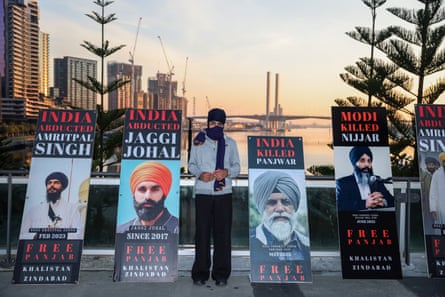
While large swathes of Australia’s Indian community hail Modi for raising the country’s profile on the international stage, his visit has sparked condemnation from human rights groups and some parts of Australia’s Muslim and Sikh communities.
Critics of Modi, who was elected prime minister in 2014, say some of his policies are fundamentally discriminatory, including a citizenship bill which fast-tracked citizenship for refugees from some countries but excluded Muslim countries.
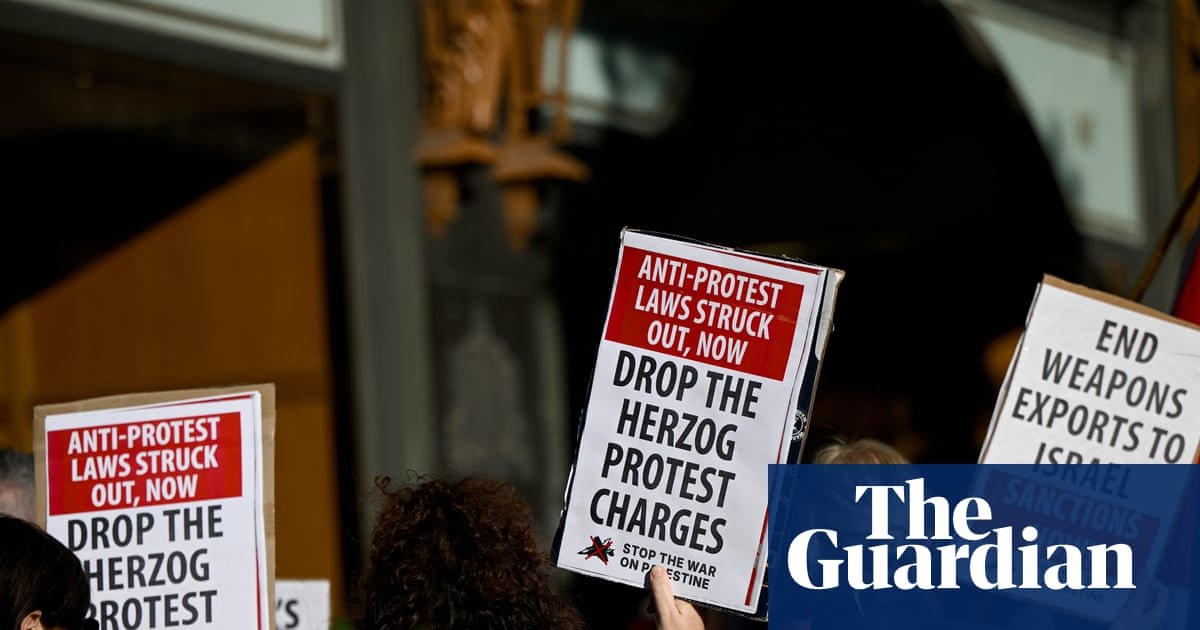
A group of protesters had gathered outside the stadium before the event. One of them, Sachin Sambhus, said the prime minister had destroyed India’s democracy, pointing to minorities becoming “second-class citizens”.
Sambhus said the Albanese government could give a “grand welcome” but had to “ask the right questions”.
Ahead of Modi’s visit, human rights organisation Amnesty International urged the Albanese government to raise India’s human rights record in the bilateral talks, with a statement describing the visit as an “opportunity to reaffirm mutual commitment to human rights, democratic freedoms and the rule of law”.
The statement called for Australia to encourage India to ensure journalists and human rights advocates could work free from intimidation and address discrimination of religious and ethnic minorities.
A Department of Foreign Affairs and Trade spokesperson said the government had a relationship with India that enabled it to “speak directly and respectfully about important issues, including where we disagree”.
“The Australian government has a longstanding commitment to the protection of human rights, and raises issues regularly in our engagements with foreign governments,” the spokesperson said.
Earlier on Thursday, Albanese and Modi met for what was billed as the Australia-India annual leaders’ summit before announcing a major new uranium exports agreement.
The uranium deal could end decades of delays to regular shipments of the nuclear fuel – the Australian prime minister said the agreement would enable uranium exports to flow to India for “peaceful purposes”.
Australia had previously struck a deal with India to sell uranium to the country in 2014, but regular shipments have not occurred due to concerns it could be used for weapons.
Speaking alongside Albanese on Thursday, Modi hailed the new agreement as being vital to help expand his country’s nuclear energy sector. He stressed the importance of the bilateral relationship to “bring peace, stability, freedom of navigation and a rules-based order” across the Indo-Pacific region.
Albanese said Australia’s relationship with India had “never been stronger”.
He said the uranium arrangement would provide an additional market for Australia’s resources sector. He also pointed to a joint declaration on defence and security cooperation to deepen the two countries’ practical partnership as signs of their deepening ties.
“We undertake to consult on defence-related developments in the Indo-Pacific that affect our shared interests,” he said.
Albanese said for all the “broad affection between our peoples” the relationship between the countries was “underdone, under-explored and under-examined”.
With additional reporting by Australian Associated Press