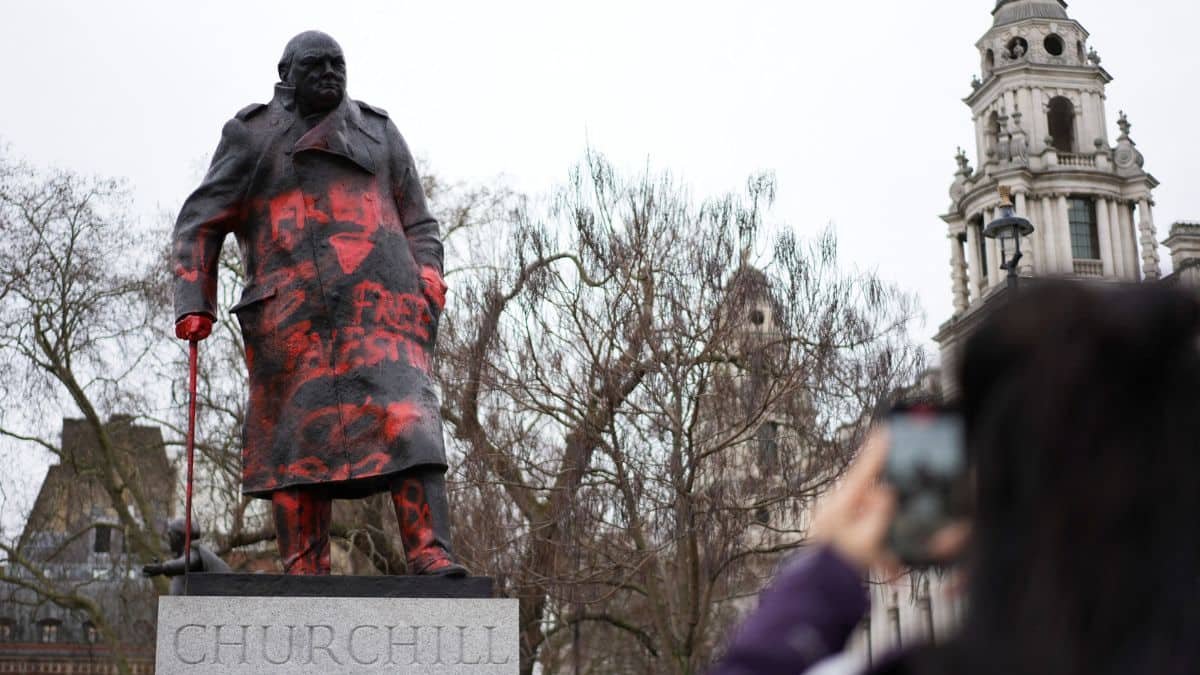
London’s National Portrait Gallery (NPG) has withdrawn a contemporary video installation that criticised former United Kingdom Prime Minister Winston Churchill’s role during the Bengal Famine of 1943 and referred to what the artist described as the “wilful starvation” of Indians under British rule.
What happened at the National Portrait Gallery?
The controversy originated from a temporary exhibition launched by the National Portrait Gallery in September 2025.
The exhibition, titled Artists First: Contemporary Perspectives on Portraiture, was designed as a dialogue between contemporary artists and historical figures represented within the gallery’s collection.
Rather than producing traditional portraits, participating artists were encouraged to respond creatively to individuals whose images hang on the institution’s walls.
Among those invited was Helen Cammock, a prominent British artist who shared the Turner Prize in 2019. Her artistic practice often explores questions of identity, power, race, memory and historical representation.
For the exhibition, Cammock produced a 40-minute film entitled Persistence. The project had reportedly been in development since 2023 and formed part of a wider effort to examine how historical narratives are constructed and whose stories are remembered.
The film featured Cammock’s own narration as she reflected on several historical personalities represented within the gallery’s collection.
For months, the installation remained on display without attracting major public controversy. It was exhibited for approximately ten months and was scheduled to remain available until August this year.
Quick Reads
US pub are adding 20% tips to their bills. The FIFA World Cup 2026 is why
US lifts sanctions on Iranian oil. Why this could be good news for India
The situation changed dramatically after attention focused on one particular section of the film. While discussing Oliver Cromwell and his military campaigns in 17th-century Ireland, Cammock remarked that Cromwell had “starved people, en masse.”
She then drew a comparison with Churchill, stating that this was “a little like the wilful starvation of the Indian population by Winston Churchill.”
Why did a single line trigger such a controversy?
The objection raised by critics was not merely that Churchill’s role in the Bengal Famine was being discussed.
The central issue was the use of the word “wilful.” For critics of the film, the term suggested that Churchill had deliberately used starvation as a policy tool against Indians, implying intentionality rather than negligence, indifference or policy failure.
Many historians who defend Churchill’s wartime record argue that the Bengal Famine was a tragic consequence of multiple overlapping factors, including Japanese military advances in Asia, wartime shipping shortages, market disruptions, hoarding, inflation and administrative failures.
They reject suggestions that Churchill consciously sought the deaths of millions of Indians.
As media coverage escalated, criticism came from several prominent figures. Among the most vocal opponents was historian Lord Andrew Roberts, one of Britain’s best-known Churchill biographers and a former trustee of the National Portrait Gallery.
Roberts reportedly wrote to the gallery’s trustees objecting to the installation and urging action. According to reports, he described the work as an “ideologically motivated rant” and a “barefaced lie.”
Other critics characterised the allegation against Churchill as “foul and vile.”
More than fifty members of the House of Lords reportedly supported the protest against the installation. Those backing the criticism included Nicholas Soames, Churchill’s grandson.
Why was the Bengal famine?
The famine remains among the deadliest humanitarian disasters associated with British colonial rule in India. The crisis unfolded in the province of Bengal between 1943 and 1944, during the height of the Second World War.
At the time, Bengal was part of British India and encompassed territory that today lies in both India and Bangladesh.
The human toll was enormous. Historians continue to debate the precise number of victims, but estimates generally range from approximately 1.5 million to 3.8 million deaths.
Many people succumbed directly to starvation. Others died from diseases that spread rapidly among populations weakened by malnutrition, including malaria, cholera and smallpox.
Images of emaciated men, women and children in Bengal shocked observers and have remained among the most powerful visual reminders of colonial-era suffering. For decades after the tragedy, explanations frequently focused on environmental conditions and population pressures.
Today however, many scholars argue that the famine cannot be explained simply by natural causes and that government policies played a decisive role in worsening the crisis.
Was the famine caused by drought or by policy failures?
For many years, it was commonly assumed that crop failures and environmental factors were primarily responsible.
Recent scholarship paints a different picture.
A study published in 2019 in the scientific journal Geophysical Research Letters examined weather and soil moisture data relating to six major Indian famines between 1873 and 1943.
Researchers found that five of those famines coincided with severe drought conditions.
The Bengal Famine of 1943 stood apart. The study concluded that rainfall levels during the period were normal or even above average.
As a result, researchers argued that the famine was fundamentally different from earlier disasters and could not be attributed primarily to weather-related crop failure.
The same year, researchers from India and the United States concluded that the tragedy represented a “complete policy failure during the British era.” These findings strengthened arguments that administrative decisions rather than environmental catastrophe lay at the heart of the disaster.
How did wartime events push Bengal towards catastrophe?
Although weather was not the principal cause, the famine emerged within the extraordinary circumstances of World War II. A major turning point came in 1942 when Imperial Japan captured Burma.
Burma had long served as a significant supplier of rice to Bengal and other parts of British India. Its loss immediately disrupted food imports and increased pressure on existing supplies.
The Japanese advance also transformed eastern India into a potential frontline region. British authorities feared that Bengal could become the next target of Japanese military operations.
As concern over invasion grew, colonial administrators implemented emergency defensive measures. Those measures would later become some of the most controversial policies associated with the famine.
What were the British ‘denial’ policies?
One of the most debated aspects of the famine concerns the so-called “denial” policies adopted by British authorities. These measures were designed to ensure that invading Japanese forces would be unable to access food and transport infrastructure if they reached Bengal.
The strategy involved two major components. The first was known as the boat denial programme. More than 46,000 boats used throughout Bengal’s extensive river network were confiscated, disabled or destroyed.
This decision had consequences far beyond military planning. Boats were essential for transporting rice, moving goods between communities, supporting fishing livelihoods and maintaining local trade networks.
Their removal severely disrupted the movement of food throughout the region.
The second measure involved rice denial. Authorities purchased, seized or relocated significant rice stocks from vulnerable coastal districts.
The intention was to deny resources to any invading army. However, the policy also weakened local food security and reduced the availability of grain for civilian populations.
Critics argue that these actions accelerated the breakdown of Bengal’s food distribution system at a moment when conditions were already deteriorating.
How did inflation and food distribution worsen the crisis?
The war economy created additional pressures that compounded existing problems. To finance Allied military operations, colonial authorities expanded the money supply.
The resulting inflation had devastating effects on ordinary people. Rice prices surged dramatically, rising by hundreds of percentage points within a relatively short period.
While food became increasingly expensive, wages for many workers failed to keep pace. Agricultural labourers, fishermen, artisans and other vulnerable groups found themselves unable to purchase basic necessities.
The famine therefore became not only a problem of food availability but also one of economic access. This interpretation was later developed by economist Amartya Sen.
Sen argued that Bengal did not experience a complete collapse in food supplies. Instead, millions lost the economic means to obtain food as prices spiralled beyond their reach.
He described this phenomenon as an “entitlement failure.” Government distribution policies also contributed to inequalities.
Available grain supplies were directed toward groups considered essential to the war effort. Military personnel, industrial workers and government employees received priority access.
Meanwhile, many rural communities faced worsening shortages. As a result, those living outside key urban and strategic areas often bore the greatest burden of the crisis.
What role did Churchill play?
Britain’s War Cabinet retained ultimate authority over major decisions affecting colonial India. Many argue that decisions taken in London significantly increased mortality in Bengal.
One recurring point of contention involves requests for emergency food imports. According to historical records, senior officials in India repeatedly sought substantial grain shipments to stabilise food supplies.
Among those appealing for assistance were Viceroy Lord Linlithgow and Secretary of State for India Leo Amery. They requested approximately one million tons of wheat to help address the crisis.
But Churchill’s government repeatedly delayed, reduced or rejected these appeals. Another major criticism concerns Britain’s broader allocation of food resources.
While Bengal was experiencing mass starvation, grain continued to be moved from India to support Allied military requirements elsewhere. At the same time, Britain maintained food reserves in other parts of the empire, including stocks intended for future European needs.
Many argue that more aggressive intervention could have reduced the death toll.
Documents from cabinet discussions, official records and personal diaries reveal several remarks that critics regard as evidence of racial prejudice. Among the most frequently cited comments is Churchill’s statement that Indians were “breeding like rabbits.”
Historical records also indicate that he viewed shortages affecting Europeans as more pressing than those affecting Bengalis.
Another widely discussed episode concerns a reported telegram response in which Churchill allegedly questioned why Mahatma Gandhi had not died if conditions were truly as severe as officials claimed.
Such remarks have supported the fact that racial attitudes influenced the British government’s response to the famine.
Why was the artwork ultimately withdrawn?
According to the gallery, however, the decision was taken by the artist rather than imposed by the institution.
In a statement provided to BBC News, the gallery said, “Today, Helen Cammock decided to remove her film, Persistence, from display at the National Portrait Gallery. We respect her decision, just as we acknowledge the opinions of those who were offended by what was said in the film.”
The gallery also stressed the nature of the project itself. “The aim of this project was to give artists the opportunity to create works as personal and creative responses to our collection. The work was presented as an artistic piece, not a documentary, and the views expressed in the film do not necessarily reflect those of the NPG.”
Cammock has defended both the content of her work and the broader role of artists in questioning accepted narratives. Following the controversy, she expressed concern about what she viewed as growing pressure on artists and cultural institutions.
“There is an incredible pressure on artists and arts institutions to bend to external pressure; to be benign at best and silent at worst.”
“I do not accept this pressure. To question, challenge and explore ideas and histories is vital to a healthy society and art is intrinsic to this.”
She also rejected suggestions that the project should be treated as a historical documentary. Instead, she described the film as an artistic work grounded in academic research and intended to stimulate reflection.
According to Cammock, the installation “asks us to think about who is honoured and valorised and who is not; whose stories are told and whose are not”.
She also argued that audiences should “hear it out” before reaching conclusions.