Resolution Foundation says households outside London are paying hundreds of pounds a year more in council tax than they would be under a fair system
33m agoLondoners in effect get £3bn a year subsidy because structure of council tax biased against north, says thinktank
2h agoHousebuilding starts in England up 20% year on year, figures show
2h agoHome Office says 781 migrants arrived in 10 small boats yesterday - highest daily total for 2026
4h agoBadenoch says Tories could not form pact with Reform UK in part because they're too sleazy, insisting 'it's about character'
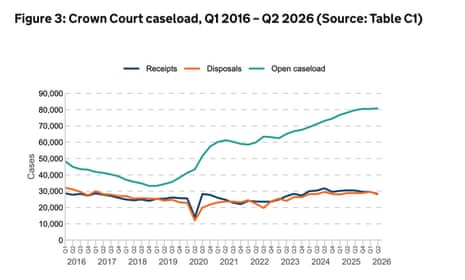
4h agoMoJ figures show crown and magistrates' court backlogs at record high, with 24,000 serious cases held up more than year
5h agoNew vocational GCSEs will be just as rigorous as existing ones, Powell says
5h agoMoJ launches campaign to encourage people to volunteer to serve as magistrates
5h agoNick Clegg plays down fears ‘godlike’ AI could exterminate humanity
6h agoLucy Powell cautious about Burnham's call to lift football alcohol ban, saying good behaviour could be 'at risk'
6h agoFrom idealists to struggling sceptics: how Labour’s majority depends on five progressive voter types – in charts
6h agoTactical voting at next election could push Reform into fourth place, poll finds
7h agoHome Office orders review after two small boats reach Kent without being intercepted by Border Force
8h agoLabour likely to be biggest party in hung parliament, mega poll suggests
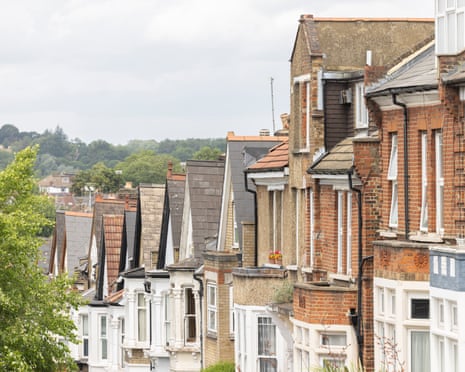
Londoners get a property tax discount equivalent to more than £3bn a year because council tax was structured in a way that ensures people living outside the capital have to pay disproportionately more, a thinktank has said.
The Resolution Foundation has come up with the figure in a report that says, outside London, many households are paying hundreds of pounds a year more in council tax than they would be under a fair system.
The report calls for council tax to be replaced with “a proportional tax charged at 0.7% of property value”. It also says stamp duty should be abolished, but with both changes brought in gradually to make the transition manageable for those losing out.
Andy Burnham has in the past expressed interest in a reform along these lines, althought this is not an idea he has publicly advocated since becoming PM.
Explaning the problem with council tax, the Resolution Foundation report says:
When council tax was established, a deliberate decision was taken to adopt a compressed rate schedule. The value of the property in 1991 determines the council tax band a property sits in and every bill, for every local authority, is a fixed fraction (or multiple) of the band D bill in that area. These so-called ‘multipliers’ set the ratio of bills across the different bands and meant that, when council tax was established, a property in the top band was worth at least eight times as much as one in the bottom band, while their bill was at most only three times larger. This original design flaw has since been compounded by the failure to update the value of properties from their 1991 levels. In the 35 years since, there have been large increases in house prices and – importantly – significant regional divergence … Now, a property at the bottom of the top band in Richmond-upon-Thames has a price 15 times larger than one at the top of the bottom band in Hull, while their council tax bill is only just over double. Alternatively: the resident of Hull is paying over £1,800 more each year than if they faced the same effective tax rate as the resident of Richmond-upon-Thames.
When council tax was established, a deliberate decision was taken to adopt a compressed rate schedule. The value of the property in 1991 determines the council tax band a property sits in and every bill, for every local authority, is a fixed fraction (or multiple) of the band D bill in that area. These so-called ‘multipliers’ set the ratio of bills across the different bands and meant that, when council tax was established, a property in the top band was worth at least eight times as much as one in the bottom band, while their bill was at most only three times larger.
This original design flaw has since been compounded by the failure to update the value of properties from their 1991 levels. In the 35 years since, there have been large increases in house prices and – importantly – significant regional divergence …
Now, a property at the bottom of the top band in Richmond-upon-Thames has a price 15 times larger than one at the top of the bottom band in Hull, while their council tax bill is only just over double. Alternatively: the resident of Hull is paying over £1,800 more each year than if they faced the same effective tax rate as the resident of Richmond-upon-Thames.
The report says this has resulted in the equivalent of a £3bn giveaway for Londoners.
Compared to a system where the relationship between tax revenues and the value of housing was the same across the country, London paid £3.1bn too little in residential property tax in 2024-25, with every other region besides the south-east and east of England overpaying. If the rest of England had paid taxes as a proportion of the value of their homes at a rate as low as that in London, regions outside of London would have paid £12.3bn less in tax.
As a result, most households in England are paying hundreds of pounds a year more than they would be under the proportional property tax system proposed by the thinktank, it says.
By 2030-31, and compared to an alternative of property being taxed at a uniform rate everywhere, 61% of households would be overpaying tax by an average of £430 a year, and 36% of households would be underpaying by an average of £680 a year.
Hannah Aldridge, a senior research and policy analyst at thinktank, said:
The UK raises more tax revenue from the homes we live in than most other advanced economies. Unfortunately, our two main housing taxes – council tax and stamp duty – are terribly designed, grossly unfair and economically harmful. The economic and fairness case for overhauling our housing taxes are clear. But the politics of reform has got hung up on those who lose out – such as those living in gentrified areas of London – even though most households in England would pay less tax. Housing taxes cannot be fixed overnight. But the chancellor should set out a sensible roadmap to reform in the budget next month.
The UK raises more tax revenue from the homes we live in than most other advanced economies. Unfortunately, our two main housing taxes – council tax and stamp duty – are terribly designed, grossly unfair and economically harmful.
The economic and fairness case for overhauling our housing taxes are clear. But the politics of reform has got hung up on those who lose out – such as those living in gentrified areas of London – even though most households in England would pay less tax.
Housing taxes cannot be fixed overnight. But the chancellor should set out a sensible roadmap to reform in the budget next month.
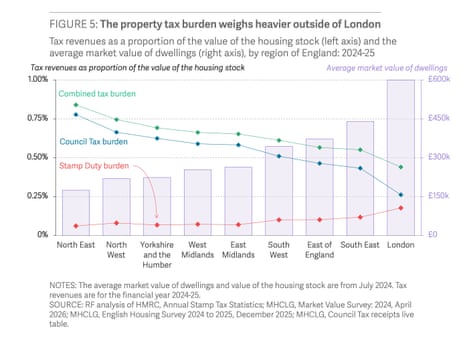
This chart shows how the combined property tax burden – council tax and stamp duty, as a proportion of what houses are worth – is highest in the north of England and lowest in London.
There are from Rob Ford, a politics professor and elections expert, on the YouGov MRP poll published earlier.
He starts by highlighting its finding that “37% of constituencies are decided by margins of five points or less in our central estimate, with this rising to 67% of seats projected to be won by Reform UK.”
This finding underlines why we should not take precise MRP numbers v seriously at this stage - huge numbers of seats are projected to be v close - a small shift in national sentiment or a modest and plausible level of tactical switching could dramatically change seat numbers For example, @yougov.co.uk themselves just published an excellent study of tactical voting motivations yesterday, showing 60% of 2024 LD and Grn voters are now willing to back Labour in order to stop a Reform win yougov.com/en-gb/articl... Given this evident willingness to tactically co-ordinate, which we also see v strongly in recent Westminster by-elections and in local/devolved elections, I just don’t think a result like this projection in Hemel Hemstead is plausible come election time
This finding underlines why we should not take precise MRP numbers v seriously at this stage - huge numbers of seats are projected to be v close - a small shift in national sentiment or a modest and plausible level of tactical switching could dramatically change seat numbers
For example, @yougov.co.uk themselves just published an excellent study of tactical voting motivations yesterday, showing 60% of 2024 LD and Grn voters are now willing to back Labour in order to stop a Reform win yougov.com/en-gb/articl...
Given this evident willingness to tactically co-ordinate, which we also see v strongly in recent Westminster by-elections and in local/devolved elections, I just don’t think a result like this projection in Hemel Hemstead is plausible come election time
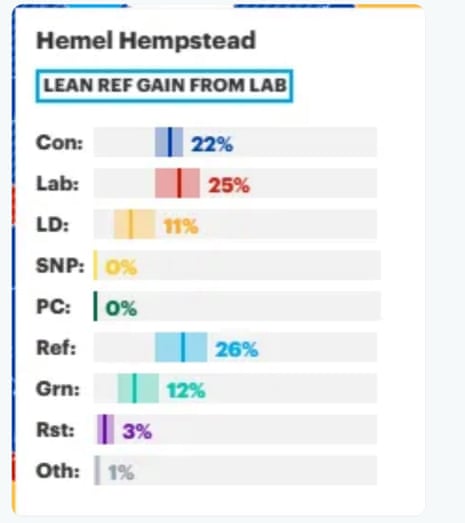
Those 12% saying Green and 11% saying Lib Dem are not currently thinking about a possible Reform win (or indeed a possible Tory win) in their seat when answering YouGov’s question. Once decision time approaches, they will, and then those numbers will change. Many such cases!
I don’t want to throw the baby out with the bathwater tho - MRPs like this are a very useful exercise for getting finer grained sense of current geography of support. Just don’t get hung up on exact numbers. “Everything to play for” & “many close seats” are the big lessons here
Also, credit where it is due - YouGov do their best to convey the uncertainty of the exercise in all their maps and charts - I particularly like the “lean” and “likely” categories, tho personally I would have a (in this case large) “too close to call” category
With the Labour party conference starting at the weekend, the Guardian has published a good long read by Hettie O’Brien about “Manchesterism”, the political philosophy driving Andy Burnham’s politics, and the thinkers in his circle who are promoting it.
Here’s an extract.
It’s possible to discern three distinct camps seeking to influence Burnham. The first, which is closer to [energy secretary Miatta] Fahnbulleh and [foreign secretary Ed] Miliband, draws on the more radical ideas of thinkers such as Lawrence and includes organisations such as Common Wealth and the NEF. Its central argument is that the privatisation of life’s essentials, including energy and social care, has created an affordability crisis that is driving up inflation, and that many of these assets should therefore be publicly owned. The second camp is closer to Burnham’s powerful ally the first secretary of state, Louise Haigh, her adviser Nick Williams, and Josh Simons, the former Makerfield MP. It includes thinktanks such as the newly founded Centre for British Progress and the Good Growth Foundation. For this more centrist camp, the problem with Thatcherism has less to do with privatisation than the erosion of state capacity that resulted from it. “We rely on an army of consultants, lawyers and third-party providers”, because Britain has “forgotten how to build”, wrote David Lawrence, the co-founder of the Centre for British Progress, in a recent essay. The answer to Britain’s economic problems, according to this school of thought, lies in winnowing down the vast apparatus of regulations, particularly planning policies, that protect large and established companies, prevent startups from emerging, and are holding back a potential abundance of new homes and power plants. Finally, there is a third, older camp of thinkers who might be called the communitarians; they have more power than either of the other two camps, since they hold key positions in No 10. Among them is James Purnell, Burnham’s chief of staff and one of his most trusted friends, and Purnell’s close friend Graeme Cooke, a former director of the IPPR, who is now director of Burnham’s No 10 policy unit. Newcomers to the Burnham government have been reading a 2010 essay that Purnell and Cooke wrote during a period of soul-searching after Gordon Brown lost the general election. They argued that New Labour had failed to develop a philosophy for what a good society looked like, one that rejected the paternalism of the state and put people in charge of their lives.
It’s possible to discern three distinct camps seeking to influence Burnham. The first, which is closer to [energy secretary Miatta] Fahnbulleh and [foreign secretary Ed] Miliband, draws on the more radical ideas of thinkers such as Lawrence and includes organisations such as Common Wealth and the NEF. Its central argument is that the privatisation of life’s essentials, including energy and social care, has created an affordability crisis that is driving up inflation, and that many of these assets should therefore be publicly owned.
The second camp is closer to Burnham’s powerful ally the first secretary of state, Louise Haigh, her adviser Nick Williams, and Josh Simons, the former Makerfield MP. It includes thinktanks such as the newly founded Centre for British Progress and the Good Growth Foundation. For this more centrist camp, the problem with Thatcherism has less to do with privatisation than the erosion of state capacity that resulted from it. “We rely on an army of consultants, lawyers and third-party providers”, because Britain has “forgotten how to build”, wrote David Lawrence, the co-founder of the Centre for British Progress, in a recent essay. The answer to Britain’s economic problems, according to this school of thought, lies in winnowing down the vast apparatus of regulations, particularly planning policies, that protect large and established companies, prevent startups from emerging, and are holding back a potential abundance of new homes and power plants.
Finally, there is a third, older camp of thinkers who might be called the communitarians; they have more power than either of the other two camps, since they hold key positions in No 10. Among them is James Purnell, Burnham’s chief of staff and one of his most trusted friends, and Purnell’s close friend Graeme Cooke, a former director of the IPPR, who is now director of Burnham’s No 10 policy unit. Newcomers to the Burnham government have been reading a 2010 essay that Purnell and Cooke wrote during a period of soul-searching after Gordon Brown lost the general election. They argued that New Labour had failed to develop a philosophy for what a good society looked like, one that rejected the paternalism of the state and put people in charge of their lives.
And here is the full article.
Matthew Pennycook, the housing minister, says in a post on social media that housebuilding figures out today show “welcome signs of progress”.
These are tough times for housebuilding in England, but new housing statistics released this morning show welcome signs of progress: ✅Housing starts in Q2 of this year were up 6% on the previous quarter (a 20% increase on the same quarter last year). ✅London saw the biggest increase with starts up a phenomenal 298% on last year. ✅Units within outline residential applications are up 41% from a year earlier. ✅Permission in principle decisions on brownfield register sites more than doubled (a 79% increase on the same quarter last year). Over the past 26 months, we’ve undertaken the most rapid, holistic and radical overhaul of the housing and planning system in decades. Despite the strong headwinds, we are going to stay the course and ensure the country enjoys high and sustainable rates of housebuilding in the years ahead.
These are tough times for housebuilding in England, but new housing statistics released this morning show welcome signs of progress:
✅Housing starts in Q2 of this year were up 6% on the previous quarter (a 20% increase on the same quarter last year).
✅London saw the biggest increase with starts up a phenomenal 298% on last year.
✅Units within outline residential applications are up 41% from a year earlier.
✅Permission in principle decisions on brownfield register sites more than doubled (a 79% increase on the same quarter last year).
Over the past 26 months, we’ve undertaken the most rapid, holistic and radical overhaul of the housing and planning system in decades. Despite the strong headwinds, we are going to stay the course and ensure the country enjoys high and sustainable rates of housebuilding in the years ahead.
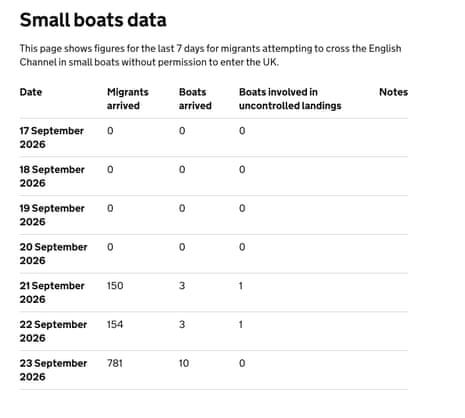
More than 700 migrants arrived in the UK on Wednesday – the highest number for a single day so far this year, the Press Assocation reports. PA says:
It comes after a cabinet minister said not every migrant boat can be intercepted in the wake of two boats landing undetected on British shores within two days. [See 9.35am.] The Home Office recorded 781 arrivals in 10 boats on Wednesday, suggesting an average of 78 people per boat. This takes the provisional total for Channel crossings for the year so far to 18,565. This is down 42% on this time last year (32,188), and 26% below the figure at this stage in 2024 (25,165).
It comes after a cabinet minister said not every migrant boat can be intercepted in the wake of two boats landing undetected on British shores within two days. [See 9.35am.]
The Home Office recorded 781 arrivals in 10 boats on Wednesday, suggesting an average of 78 people per boat.
This takes the provisional total for Channel crossings for the year so far to 18,565.
This is down 42% on this time last year (32,188), and 26% below the figure at this stage in 2024 (25,165).
Here are the Home Office weekly figures.
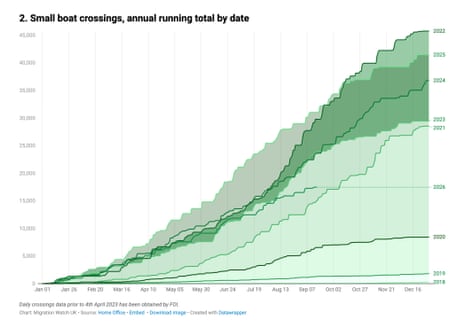
As this chart from Migration Watch UK shows, small boat arrivals at this point in the year are at their lowest level since 2021.
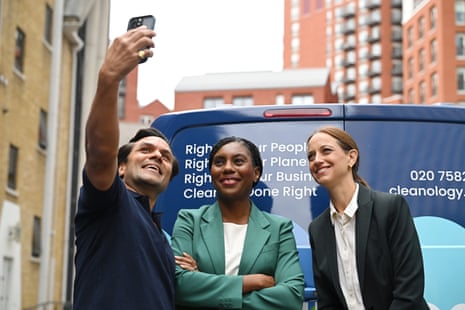
Kemi Badenoch has said that she would not want to form some sort of electoral pact with Reform UK in part because of the scandals surrounding Nigel Farage’s party.
In an interview with GB News, she suggested that Reform UK was riddled with “problematic” ex-Tories, and she said one of the things she was doing as a leader was cleaning up the reputation of her own party.
Badenoch has ruled out a pre-election pact with Reform UK before, despite many figures on the right arguing that the two parties should work together to defeat Labour. But the Tories have generally been less willing to accuse Reform UK of “sleaze and scandal” than Labour, who use this attack line against Farage’s team regularly.
Reform UK is being investigated by the police over allegations that the party has accepted donations that are impermissible under electoral law. Farage is also being investigated by the parliamentary commissioner for standards over claims he broke Commons rules by not declaring a £5m donation from Christopher Harborne. Farage and his party deny wrongdoing.
In an interview with GB News, asked if recent polling (see 8.59am and 10.35am) meant it was time to “unite the right”, Badenoch replied:
What I have said is that it’s about uniting the country, not just uniting the right. Uniting the country behind common sense is what Conservatives want to do. There was actually another poll about two weeks ago that showed that if you have a coalition, some of the people who are supporting you will go elsewhere. So you can’t just add those two groups together and assume that you’re getting a block vote on the centre right.
What I have said is that it’s about uniting the country, not just uniting the right. Uniting the country behind common sense is what Conservatives want to do.
There was actually another poll about two weeks ago that showed that if you have a coalition, some of the people who are supporting you will go elsewhere. So you can’t just add those two groups together and assume that you’re getting a block vote on the centre right.
Badenoch said the Conservatives and Reform UK were divided on policy. But she insisted that ethics and standards were an obstacle to any form of cooperation too.
What are we uniting about? It’s not just policy; it’s also character. And when I look at the things that Reform are doing, we saw that exposé. Of course, they deny it. But Nigel Farage is under investigation. That £5m, the money. Robert Jenrick has donations being investigated. We just don’t want this any more. People saw the Conservative party doing all sorts of things that they didn’t like, and I said, I’m coming in to clean this up. Many of the problematic people have gone to Reform. How can we then join with them?
What are we uniting about? It’s not just policy; it’s also character.
And when I look at the things that Reform are doing, we saw that exposé. Of course, they deny it. But Nigel Farage is under investigation. That £5m, the money. Robert Jenrick has donations being investigated.
We just don’t want this any more. People saw the Conservative party doing all sorts of things that they didn’t like, and I said, I’m coming in to clean this up. Many of the problematic people have gone to Reform. How can we then join with them?
Badenoch also insisted that, with her in charge, the Tory party was changing.
I want people to see that the Conservative party is getting its act together. We know we got a lot of things wrong. I wasn’t there for the whole 14 years. I was there for half of it. I did what I could, but I’m in charge now. And the people who were very frustrated by the direction of the party are now running the party. I want your viewers to see that.
I want people to see that the Conservative party is getting its act together. We know we got a lot of things wrong. I wasn’t there for the whole 14 years. I was there for half of it. I did what I could, but I’m in charge now.
And the people who were very frustrated by the direction of the party are now running the party. I want your viewers to see that.
Backlogs in magistrates’ courts and crown courts have reached a record high, according to Ministry of Justice figures released today.
At crown courts in England and Wales, where the most serious crimes are prosecuted, there were 80,829 cases waiting to be heard at the end of June. That is a record since the MoJ started compiling these figures, and represents a 3% increase on the previous year.
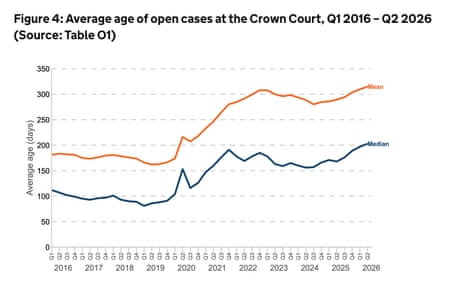
These cases are also taking longer to process. Average waiting times, from the case being referred to crown court to it being finished, are also at a record high, with the median at 203 days, a 21% increase on the previous year. (The mean is much higher because the relatively few very, very long waits distort the average when it is calculated as a mean, not a median.)
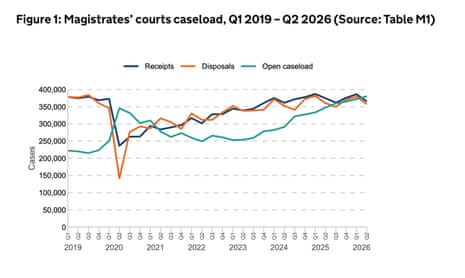
And at magistrates’ courts, there were 380,230 cases waiting to be heard at the end of June, up 9% on the previous year.
Sarah Sackman, the courts minister, said the figures showed “the scale of the challenge facing our courts, with victims waiting far too long for justice – that’s why it’s our priority to reduce the backlog so that cases are heard sooner”.
But Nick Timothy, the shadow justice secretary, claimed Labour policies were making the problem worse.
Labour have spent their time in office attacking our ancient right to a jury trial, rather than taking effective action to tackle the courts crisis. With both the crown court and magistrates’ court now facing record backlogs, Labour’s proposals to simply shift the problem from one part of the court system to another are dead in the water.
Labour have spent their time in office attacking our ancient right to a jury trial, rather than taking effective action to tackle the courts crisis.
With both the crown court and magistrates’ court now facing record backlogs, Labour’s proposals to simply shift the problem from one part of the court system to another are dead in the water.
Mark Evans, president of the Law Society of England and Wales, said the figures also showed that 23,706 crown court cases have been in the backlog more than a year. This is 22% more than a year ago.
The government must seize the chance to deliver a long-term, whole-system plan for criminal justice reform. This should include usable courts, enough judges and staff and the maximum number of sitting days to hear cases promptly.
Tim Shipman has written about what will be coming up at the Labour conference next week in his cover story for the Spectator. He says:
Labour special advisers summoned last week to the pillared state room on the first floor of No. 10 to hear the plan for conference from Burnham’s political secretary, Hayden Munro, left in no doubt that the PM wants to be a transformational figure. The conference ‘narrative’ these advisers were urged to push includes the telling line: ‘This Labour government will bring forward the biggest change to Britain in 40 years, with a new political and economic model.’ On the specifics, Burnham will pledge: ‘We will make the choices that are needed to end rough sleeping, solve the social care crisis and get more young people into work.’ Burnham will pledge to run a ‘cost-of-living government’ with further ‘immediate action’ to ‘provide the breathing space people need’, as well as outline plans to devolve power ‘out of Whitehall’, ‘reindustrialise Britain’ and take back public control of ‘the essentials in life – such as energy, water and housing’ to ‘make them affordable again’.
Labour special advisers summoned last week to the pillared state room on the first floor of No. 10 to hear the plan for conference from Burnham’s political secretary, Hayden Munro, left in no doubt that the PM wants to be a transformational figure. The conference ‘narrative’ these advisers were urged to push includes the telling line: ‘This Labour government will bring forward the biggest change to Britain in 40 years, with a new political and economic model.’ On the specifics, Burnham will pledge: ‘We will make the choices that are needed to end rough sleeping, solve the social care crisis and get more young people into work.’
Burnham will pledge to run a ‘cost-of-living government’ with further ‘immediate action’ to ‘provide the breathing space people need’, as well as outline plans to devolve power ‘out of Whitehall’, ‘reindustrialise Britain’ and take back public control of ‘the essentials in life – such as energy, water and housing’ to ‘make them affordable again’.
The article is headlined “Is the prime minister planning to call an election?” Like everyone else, Shipman does not know for sure, but he leans towards probably not. This is his conclusion.
Ultimately, the election choice is Burnham’s. ‘If you knew what Keir’s aides thought, you knew what he would do,’ says a ministerial aide. ‘But Andy has political opinions of his own.’ Burnham may go for it. But those closest to him doubt it. ‘He likes risk, but he has stuff he wants to get done,’ says one close confidant. While outsiders think his ambitions require an election, Burnham thinks he can transform Britain without one. ‘Andy really cares about the devolution stuff,’ the ministerial aide observes. ‘Most of Westminster roll their eyes but he thinks that will change the country. He thinks doing that will make him a great prime minister.’ And those who think none of that will deal with Britain’s economic problems seize on another clue. A Labour adviser concludes: ‘Ultimately I think Burnham and his team will do what they often do with difficult decisions, and not make one.’
Ultimately, the election choice is Burnham’s. ‘If you knew what Keir’s aides thought, you knew what he would do,’ says a ministerial aide. ‘But Andy has political opinions of his own.’ Burnham may go for it. But those closest to him doubt it. ‘He likes risk, but he has stuff he wants to get done,’ says one close confidant. While outsiders think his ambitions require an election, Burnham thinks he can transform Britain without one. ‘Andy really cares about the devolution stuff,’ the ministerial aide observes. ‘Most of Westminster roll their eyes but he thinks that will change the country. He thinks doing that will make him a great prime minister.’
And those who think none of that will deal with Britain’s economic problems seize on another clue. A Labour adviser concludes: ‘Ultimately I think Burnham and his team will do what they often do with difficult decisions, and not make one.’
Richard Adams is the Guardian’s education editor.
Lucy Powell, the education secretary for England, has defended her plans to add vocational courses to the subjects available for pupils taking GCSEs, saying that schools could choose to offer the new courses based on local interest.
The government has announced that the range of GCSEs in England will be expanded to include more vocational subjects such as business management and building and construction, starting from September 2029.
What I imagine is that some schools will offer some of these subjects where their local labour market demands, and this is where our mayors and our local leaders are really helping to shape that in their area. So I wouldn’t expect a school to offer all of these, as they don’t offer all GCSEs at the moment. They will specialise in particular areas.
What I imagine is that some schools will offer some of these subjects where their local labour market demands, and this is where our mayors and our local leaders are really helping to shape that in their area.
So I wouldn’t expect a school to offer all of these, as they don’t offer all GCSEs at the moment. They will specialise in particular areas.
The Conservatives claimed that adding vocational subjects would dilute GCSEs, with shadow education secretary Laura Trott arguing it was “sabotaging young people’s futures” by creating “easier routes” for some pupils.
But Powell told Times Radio that the vocational courses would be just as rigorous as existing GCSEs. She said:
If you’re trying to do engineering or construction, for example, you know that involves a lot of problem solving, a lot of maths, a lot of thinking, as well as the hands-on skills that’s required. So it’s not dumbing down, it’s the opposite of that, actually, because this is about raising the standards and the rigour and regulating these qualifications.
If you’re trying to do engineering or construction, for example, you know that involves a lot of problem solving, a lot of maths, a lot of thinking, as well as the hands-on skills that’s required.
So it’s not dumbing down, it’s the opposite of that, actually, because this is about raising the standards and the rigour and regulating these qualifications.
The government has launched a drive to recruit thousands more magistrates to cut court delays, the Press Association reports. PA says:
Adverts will appear on national television, as well as on social media channels. The Ministry of Justice (MoJ) is aiming to have a 21,000-strong magistracy by 2029, with the number having fallen to 12,500 in 2022. Magistrates, made up of unpaid members of the public, hear around 95% of all criminal cases. Under Labour reforms, their powers will be increased so they can hand down sentences of up to 18 months’ imprisonment, up from 12 months currently to deal with more cases. Some 57% of magistrates are women, and 14% are from ethnic minority backgrounds. The role requires volunteers to sit for a minimum of 13 days a year, which the MoJ says makes it compatible with work and family commitments.
Adverts will appear on national television, as well as on social media channels.
The Ministry of Justice (MoJ) is aiming to have a 21,000-strong magistracy by 2029, with the number having fallen to 12,500 in 2022.
Magistrates, made up of unpaid members of the public, hear around 95% of all criminal cases.
Under Labour reforms, their powers will be increased so they can hand down sentences of up to 18 months’ imprisonment, up from 12 months currently to deal with more cases.
Some 57% of magistrates are women, and 14% are from ethnic minority backgrounds.
The role requires volunteers to sit for a minimum of 13 days a year, which the MoJ says makes it compatible with work and family commitments.
Announcing the campaign, Alex Norris, the justice secretary, said:
Magistrates embody the very best of public service. They give their time, experience and judgment to make vital decisions that help ensure justice is delivered fairly in communities across the country. I’m calling on the public to play their part – we need more people from all walks of life to step forward and become their local magistrate.
Magistrates embody the very best of public service. They give their time, experience and judgment to make vital decisions that help ensure justice is delivered fairly in communities across the country.
I’m calling on the public to play their part – we need more people from all walks of life to step forward and become their local magistrate.
Nick Clegg, the former deputy PM and former Meta executive, has dismissed fears over AI’s “godlike power to exterminate humanity”, calling it a sign that tech bosses are “breathing their own fumes”. Rachel Hall has the story.
The SNP has welcomed the findings of the YouGov MRP poll released this morning. (See 8.59am.) Keith Brown, the party’s deputy leader, said:
This poll tops off a massive month for Scotland with our constitutional future centre stage. It shows growing support for the SNP and a landslide in Scottish seats for our party … Polling shows independence is the preferred choice of the Scottish people and this poll proves the momentum of this moment – the opportunity to build our future as an independent nation back home in the EU.
This poll tops off a massive month for Scotland with our constitutional future centre stage. It shows growing support for the SNP and a landslide in Scottish seats for our party …
Polling shows independence is the preferred choice of the Scottish people and this poll proves the momentum of this moment – the opportunity to build our future as an independent nation back home in the EU.
Andy Burnham has suggested he would like to lift the ban on drinking alcohol in the stands at football matches. He did not say the government would do this; he was stating what has been his personal view for a long time. In the past, prime ministers have worked on the basis that they can’t have a personal view on anything, because the moment they articulate it, it is taken as government policy. But Burnham has said that he wants MPs to have a bit more freedom to speak out without having to worry about the party line.
This means that cabinet colleagues don’t necessarily have to agree – and in an interview on BBC Radio 5 Live this morning Lucy Powell, the education secretary, suggested she had concerns about allowing drinking at football matches.
Asked about Burnham’s idea, she said:
I go to the football most weekends with my young son and 30 years ago that probably wouldn’t have been all that comfortable an environment for a mum and their child to go to, but things have changed significantly. And that’s why we’ve been able to reintroduce safe standing, for example, which is something that fans want. So I think it’s a conversation we need to have to make sure that we keep the great atmosphere.
I go to the football most weekends with my young son and 30 years ago that probably wouldn’t have been all that comfortable an environment for a mum and their child to go to, but things have changed significantly. And that’s why we’ve been able to reintroduce safe standing, for example, which is something that fans want.
So I think it’s a conversation we need to have to make sure that we keep the great atmosphere.
Powell said other sports, like cricket and rugby, allowed drinking without “bad behaviour” being a problem.
I think we need to do this in consort with fans and with football, so that we make sure we keep the really good atmosphere, the good behaviour, and we don’t put that at risk.
The Survation MRP polling also explores the views of the various different voter types Labour would need for a “progressive majority”. Ashley Kirk and Jessica Elgot have the details here.
There are two MRP polls out today. In addition to the YouGov one, commissioned by Sky News and the Times (see 8.59am), the Guardian is today publishing details of a Survation one. It says progressive voters could push Reform UK into fourth place and put Labour within touching distance of a majority if tactical voting is widespread at the next election.
In their report, Jessica Elgot and Ashley Kirk say:
Andy Burnham is beginning to attract a significant number of left-leaning voters back to Labour, motivated by a desire to stop Nigel Farage, the results suggest. The poll of more than 8,000 voters, shared with the Guardian, suggests a widespread openness to voting tactically. It also shows the prime minister’s most successful electoral strategy would be to unite the centre and left bloc of voters, while the right remains split. It would be a marked contrast to the tactics of Keir Starmer’s Labour before the 2024 general election, when the party tried to attract more conservative older voters. Such a tactic would be likely to unsettle some in Labour, given the same strategy was deployed for Ed Miliband’s failed bid in 2015, albeit before Reform’s arrival as a major electoral force. The poll on the eve of Labour’s annual conference in Liverpool shows a significant shift of left-leaning voters towards Burnham’s Labour and will encourage those in the party who are thinking of gambling on an early election while Reform’s ratings are ebbing and while leftwing parties such as the Greens appear to be losing momentum. Twice as many voters have returned to Labour from the left as from the right since April.
Andy Burnham is beginning to attract a significant number of left-leaning voters back to Labour, motivated by a desire to stop Nigel Farage, the results suggest.
The poll of more than 8,000 voters, shared with the Guardian, suggests a widespread openness to voting tactically. It also shows the prime minister’s most successful electoral strategy would be to unite the centre and left bloc of voters, while the right remains split.
It would be a marked contrast to the tactics of Keir Starmer’s Labour before the 2024 general election, when the party tried to attract more conservative older voters. Such a tactic would be likely to unsettle some in Labour, given the same strategy was deployed for Ed Miliband’s failed bid in 2015, albeit before Reform’s arrival as a major electoral force.
The poll on the eve of Labour’s annual conference in Liverpool shows a significant shift of left-leaning voters towards Burnham’s Labour and will encourage those in the party who are thinking of gambling on an early election while Reform’s ratings are ebbing and while leftwing parties such as the Greens appear to be losing momentum.
Twice as many voters have returned to Labour from the left as from the right since April.
The report illustrates the potential impact of tactical voting and it contains this quote from Damian Lyons Lowe, Survation’s chief executive.
Estimating tactical voting is a complex consideration, but the mechanics here are simple. Four in 10 voters are currently backing a party that can’t finish in the top two where they live and are willing to vote tactically. But when we ask whether they would lend their vote to the stronger local contender in a two-horse race, around half said yes. That gap – worth some 18 points of the national electorate – is an enormous untapped reservoir for parties looking to squeeze voters. Should these voters act as they say, our model shows Reform falling from second place to fourth, losing around 90 seats, despite its own vote share actually going up. Reform-leaning Conservatives will consolidate too. Reform doesn’t collapse; it risks being outnumbered, seat by seat, by voters coordinating around whoever is best placed locally on the left and right.
Estimating tactical voting is a complex consideration, but the mechanics here are simple. Four in 10 voters are currently backing a party that can’t finish in the top two where they live and are willing to vote tactically.
But when we ask whether they would lend their vote to the stronger local contender in a two-horse race, around half said yes. That gap – worth some 18 points of the national electorate – is an enormous untapped reservoir for parties looking to squeeze voters.
Should these voters act as they say, our model shows Reform falling from second place to fourth, losing around 90 seats, despite its own vote share actually going up. Reform-leaning Conservatives will consolidate too. Reform doesn’t collapse; it risks being outnumbered, seat by seat, by voters coordinating around whoever is best placed locally on the left and right.
Yesterday YouGov published separate polling showing that the number of people minded to vote tactically against Reform UK has risen significantly over the past year.
Not every migrant boat can be intercepted, a cabinet minister has suggested, after two uncontrolled landings from the Channel in two days. The Press Association says Lucy Powell, the education secretary, said “(you) can’t stop everything all of the time”, the day after 21 people were detained when a boat evaded Border Force to reach the beach of Samphire Hoe in Dover. PA reports:
It was the second undetected landing in two days, following a dinghy making it to shore at Folkestone on Monday morning. Shabana Mahmood, the home secretary, who has ordered an urgent review by the Border Security Command, said the failure to intercept the two boats was “not acceptable”. Powell echoed that language in interviews this morning, while suggesting not all crossings could be prevented. Asked on BBC Radio 4’s Today programme if the situation was embarrassing for the government, she responded: “[You] can’t stop everything all of the time. Of course, it’s a concern. That’s why the home secretary has demanded and ordered this urgent review, because this is not what we want to see. This is not acceptable. “But the overall picture is an improving picture. It is hard, difficult work that requires constant, constant effort by our border forces, our security services, police, our partnerships with France and other countries. “This is a mammoth and huge task, which is now starting to reap some dividends. But of course, you know where there are still issues arising, we must absolutely tackle them.”
It was the second undetected landing in two days, following a dinghy making it to shore at Folkestone on Monday morning.
Shabana Mahmood, the home secretary, who has ordered an urgent review by the Border Security Command, said the failure to intercept the two boats was “not acceptable”.
Powell echoed that language in interviews this morning, while suggesting not all crossings could be prevented.
Asked on BBC Radio 4’s Today programme if the situation was embarrassing for the government, she responded: “[You] can’t stop everything all of the time. Of course, it’s a concern. That’s why the home secretary has demanded and ordered this urgent review, because this is not what we want to see. This is not acceptable.
“But the overall picture is an improving picture. It is hard, difficult work that requires constant, constant effort by our border forces, our security services, police, our partnerships with France and other countries.
“This is a mammoth and huge task, which is now starting to reap some dividends. But of course, you know where there are still issues arising, we must absolutely tackle them.”
In related news, Daniel Thomas, the far-right agitator and anti-migrant activist, has been arrested on suspicion of “criminal damage with intent to endanger life”, two days after he filmed himself slashing the side of a dinghy in the middle of the Channel, while a rescuer was on board.
Good morning. Andy Burnham and Kemi Badenoch are both preparing for their party conferences (next week, and the following week, respectively), and this morning YouGov has released a new MRP poll with encouraging news for both of them. Polling is very good at revealing electoral trends, but a lot less good at predicting electoral outcomes, and wise politicians don’t treat them as gospel. But they also find polling impossible to ignore, not least because it shapes the landscape within which parties operate. A leader expecting to win the next election acts differently from one expecting to lose it.
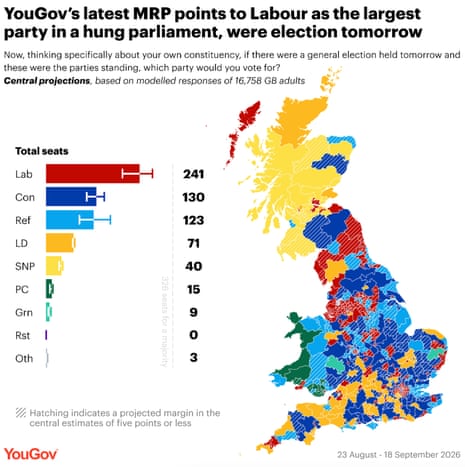
And would Burnham win an election held now? Not exactly, according to the YouGov figures, but Labour would be the largest party. Here is YouGov’s summary of its results.
-Labour would be the largest party in a hung parliament, were an election held tomorrow, winning 241 seats in our model’s central estimates -Such a result would be a net loss of 170 seats for Labour on the 2024 election, but is up from our MRP this time last year, which projected the party would be reduced to just 144 seats and showed Reform UK within touching distance of a majority -Reform UK are now neck-and-neck with the Conservatives, with the parties respectively on 123 and 130 seats in our median projection -Our central projection shows the Lib Dems on 71 seats, the SNP on 40, Plaid Cymru on 15, and the Greens on nine -37% of constituencies are decided by margins of five points or less in our central estimate, with this rising to 67% of seats projected to be won by Reform UK
-Labour would be the largest party in a hung parliament, were an election held tomorrow, winning 241 seats in our model’s central estimates
-Such a result would be a net loss of 170 seats for Labour on the 2024 election, but is up from our MRP this time last year, which projected the party would be reduced to just 144 seats and showed Reform UK within touching distance of a majority
-Reform UK are now neck-and-neck with the Conservatives, with the parties respectively on 123 and 130 seats in our median projection
-Our central projection shows the Lib Dems on 71 seats, the SNP on 40, Plaid Cymru on 15, and the Greens on nine
-37% of constituencies are decided by margins of five points or less in our central estimate, with this rising to 67% of seats projected to be won by Reform UK
This is not a terrific result for Labour, but the party is in a much better position under Burnham than it was under Keir Starmer.
The YouGov figures suggest Badenoch has no chance of forming a government. But she may be even happier with these numbers than Burnham. A year ago polling suggested Nigel Farage was on course to be the next prime minister, and there was serious talk about the Conservative party being totally eclipsed by Reform UK. Not anymore. Today’s figures have the Tories narrowly ahead of Reform on the central estimate (the best guess – YouGov also has highest and lowest estimates for seat numbers). More importantly, the poll confirms that Farage’s hopes of forming a government are – for now at least – fading.
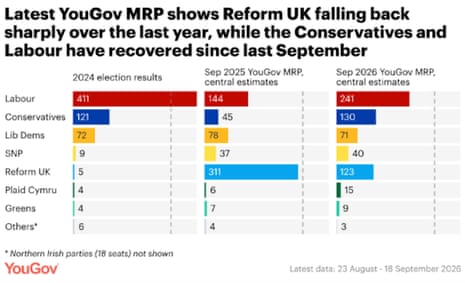
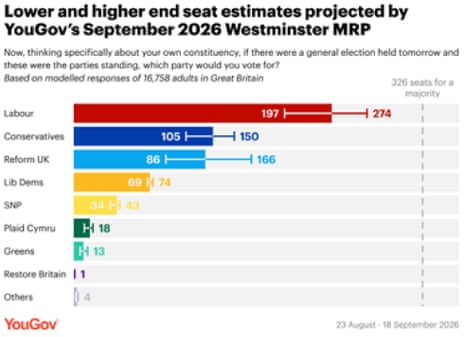
YouGov surveyed almost 17,000 people for the poll, between 23 August to 18 September.
I will post more on the poll as the day goes on. There will be other news too, although there is not a lot in the diary.
I’m afraid we are no longer able to have comments open below the line every day on this blog. If you want to contact me, please email politics.live@theguardian.com. You can use this email to flag up corrections, comments for publication, questions or complaints.
Politics live with Andrew Sparrow