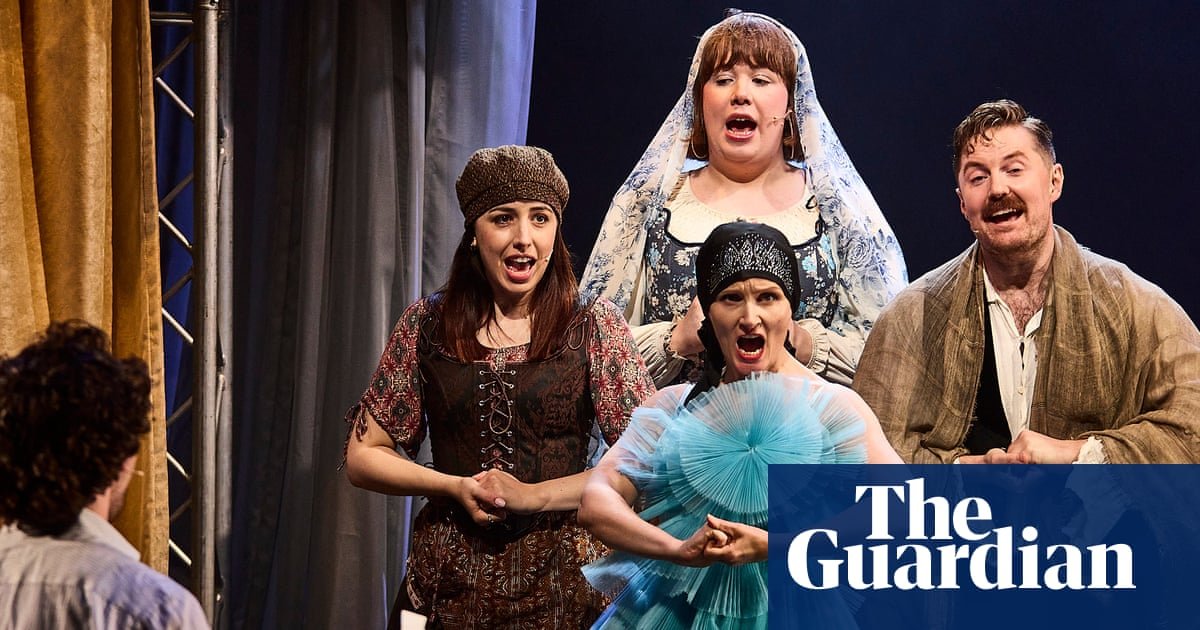
Effervescent … Danielle James, Iestyn Arwel, Molly Lynch, Nichola MacEvilly and Riain Cash in Lourdes!
The Musical.
Photograph: Patricio Cassinoni Lourdes gets a Vegas glow-up at Dublin theatre festival, where canvases are slashed A musical about a drama group’s pilgrimage and reflections on activist art join an intriguing show about lost languages In a Dublin theatre festival programme tackling heavy themes of racism, conflict and prejudice, Lourdes!
The Musical (★★★★☆) promises something effervescent.
Xnthony Ltd, the creators of Oliver Cromwell Is Really Very Sorry, have turned their lightly quizzical gaze to the French pilgrimage town – “a holy Blackpool, a divine Las Vegas” and a site of hope or desperation for five unlikely travelling companions.
Back in his home village in “Countryland”, in 2008, following a diagnosis of HIV that punctures his dreams of Los Angeles, singer-songwriter Matthew (Riain Cash) lends his star power to a parish drama group taking a musical about Saint Bernadette to Lourdes.
Interweaving this show-within-a-show and the pilgrimage strands, Xnthony’s lyrics and Matthew Floyd Jones’s score blend pop, club beats and soulful ballads.
Directed by Sarah Meadows, the supercharged ensemble joining Cash as, variously, a droll priest (Iestyn Arwel), a terminally ill mother and her transgender daughter (Nichola MacEvilly and Danielle James) and an eager tour manager (Molly Lynch) carry the music’s tonal shifts effortlessly.
Instructed by neon signs to “please wait for a miracle”, characters reveal what brings them to this Marian shrine with its bizarre mix of tackiness and piety.
Each has a Catholic faith of sorts – something that might have been more complicated to portray if set in the present day.
Rather than settling on an archly ironic approach, Xnthony’s sensitive, often lyrical writing allows fear of death, regret and above all, grief, to seep through.
Clever and knowing … Alice Roots in Heroes of Tomorrow.
Photograph: Ste Murray An aura of reverence pervades the white cube gallery setting of Heroes of Tomorrow (★★★☆☆), the latest production from the restlessly inventive Brokentalkers.
Co-directors Feidlim Cannon and Gary Keegan are joined here by British theatre artist Andy Smith to burrow into the relationship between art and activism.
Pinging through centuries and continents, they make connections between historical instances of human invention and resultant exploitation, technological breakthroughs and protest, underlining the point that progress is not linear.
If this sounds abstract, it is; much of it is delivered in carefully flat, affectless narration by Alice Roots, Michael Tient and Malua Ní Chléirigh, as if making a presentation in the gallery, taking turns to outline the biography of a (fictional) Norwegian conceptual artist called Jan Hansen.
His latest work, The End of It All, has been commissioned by three global tech companies, a testing moment of groupthink for an artist who has acquired cachet for financially supporting climate activists who fling paint over old masters in museums.
Amid questions about whether it is possible for art to remain pure, uncompromised by its corporate sources of funding, the audience is teased into imagining what Hansen’s new artwork will be.
As the performers playfully poke their heads through slashed canvases and make black imprints of their hands on the pristine gallery wall, this performance is itself a form of conceptual art, played out in a highly coded space.
The result is clever and knowing but, for Brokentalkers, surprisingly tentative.
Zinc (★★★★☆) from Dead Centre focuses on a forgotten mini-state, Neutral Moresnet, on the border of Germany, Belgium and the Netherlands.
A political anomaly, designated a neutral zone to protect its prized zinc mines, it was passed between European powers, its inhabitants’ nationality changing as borders shifted.
Adapted from a book by Belgian political philosopher David Van Reybrouck, the production brings multiple perspectives to bear on the experience of one man, Joseph Rixen, born in Neutral Moresnet in 1903.
One of their most ambitious works to date … Timmy Creed, Fabio Godinho, Cathy Min Jung, Mila Moinzadeh and Julie Mughunda in Zinc.
Photograph: Alexandre Fytrakis Playing with the idea of neutrality, co-directors Ben Kidd and Bush Moukarzel and the superb international ensemble – Julie Mughunda, Timmy Creed, Fabio Godinho, Cathy Min Jung and Mila Moinzadeh – rewind, wittily, to the 1815 Congress of Vienna.
Reflecting on colonisation, annexation and the accidents of history, each actor explores their personal experience of exile, displacement and lost native languages. skip past newsletter promotion after newsletter promotion A co-production with Théâtre de Liège, this is one of Dead Centre’s most ambitious works to date: multilingual, integrating video mapping, projection, layered music and sound design, and, as always with their work, commenting on the art of theatre itself.
Richly allusive, it connects a performer on an empty stage, before the act of imagination begins, to the perceived neutrality of a geographical place – until it can be exploited, no longer a country but “a business”.
Moving away from the cartography of loss, the performance seizes on the lost political project of Esperanto as a possible neutral language of hope – literally utopian, with its root meaning of “nowhere”.
Explore more on these topicsTheatre Ireland Europe Musicals Painting Festivals Religion features Share Reuse this content