There is a certain rhythm to crochet that cannot be hurried. Every loop must find the next. Every knot must hold. Over the past few months, that rhythm has travelled from drawing rooms in Visakhapatnam to homes across India and overseas, where hundreds of hands have been working towards a common goal: knitting tricolour crochet flags for a World Record.
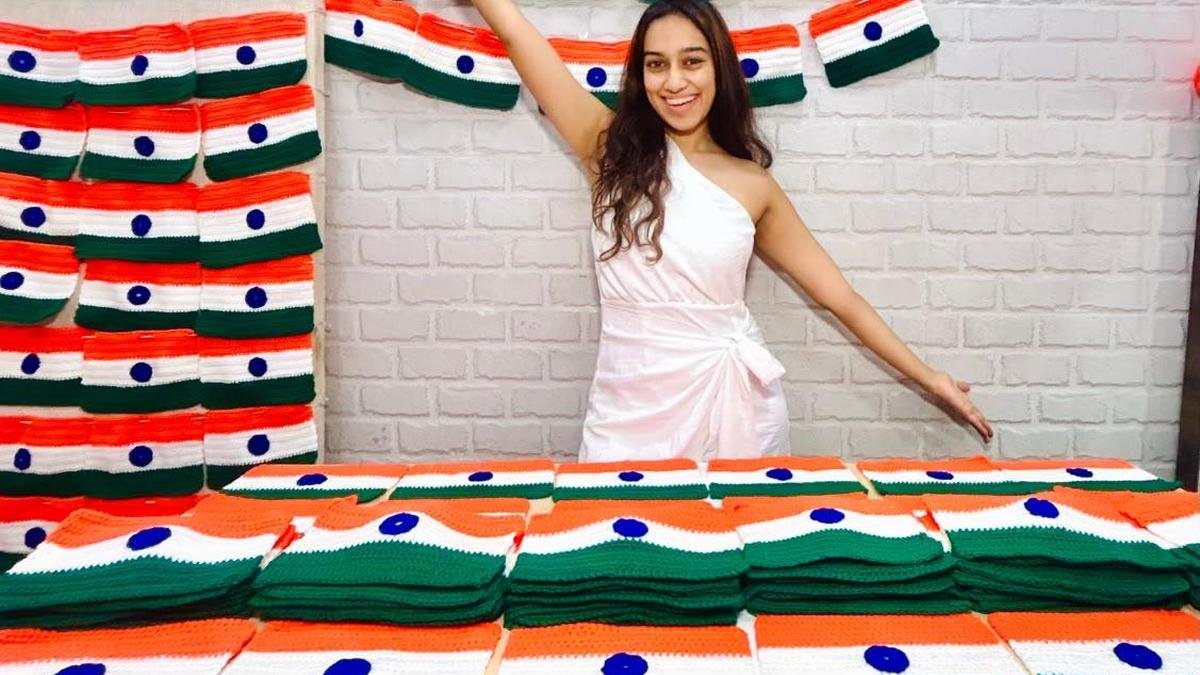
On August 1, more than 40,000 handmade crochet tricolour buntings stretching nearly 13 kilometres will be displayed at Port Stadium, Akkayyapalem, in what Mahila Manovikas hopes will become the world’s longest chain of crochet buntings and earn the organisation its fourth Guinness World Records title. A formal gathering of participants will follow on August 2 at CMR Function Hall, Venkojipalem.
The scale of the undertaking is striking. Around 330 crocheters, divided into six groups, have contributed to the project. They span generations, from school children and teenagers to Gen Z enthusiasts, homemakers, working professionals, senior citizens and experienced Guinness Record holders. Some learnt crochet only recently, while others have been practising the craft since childhood.

Madhavi Suribhatla, founder of Mahila Manovikas, and a Guinness Record Holder in crochet. | Photo Credit: SPECIAL ARRANGEMENT
Founded in Visakhapatnam by Madhavi Suribhatla, Mahila Manovikas has steadily built a community around crochet while placing equal emphasis on women’s self-worth, skill-sharing and social engagement. The organisation’s earlier Guinness achievements include the display of 4,686 crochet caps in 2022, many of which were later donated to orphanages and old-age homes, followed by 2,719 handmade ponchos in 2023. The group had also undertaken large-scale crochet squares project, steadily widening both participation and ambition with every record attempt.
More than a record
For Madhavi, the record is only one part of a larger story.
“We have members from different countries and different walks of life. Many may never have met one another in person, but crochet has connected them through a common purpose,” she says. Crochet, Madhavi believes, offers participants much more than creative satisfaction. “Project Tiranga is about celebrating India’s identity while also showing how a traditional craft can continue to bring people together.”
One of the senior participants within the organisation is Nakka Padma, who has coordinated with participants both locally and from across cities and countries. Her own contribution to Project Tiranga stands at around 1,400 crochet flags.
“I began making the flags in April,” she says. “Every record pushes us to do better than the last. During our poncho record, I completed 70 ponchos. For the crochet squares project, my target was only 100, but I eventually made more than 3,000 squares. This time, I ended up making nearly 1,200.”
For Padma, the numbers represent persistence rather than competition. Each completed piece reflects evenings spent after household responsibilities, weekends devoted to crochet and countless hours shared with fellow members over calls and online groups.
Crafting an identity
Participants are travelling from several cities to attend the official ceremony. Among them is Anshu Malini from Bhubaneswar, who has been associated with Mahila Manovikas through four Guinness record attempts.
“I started learning crochet when I was eight years old,” she recalls. “My grandmother was the first teacher in our family. Craft was always valued at home.”

A participant displaying her crochet tri-colour flags as part of Mahila Manovikas' attempt at a Guinness World Record of the world’s longest chain of crochet bunting, in Visakhapatnam. | Photo Credit: SPECIAL ARRANGEMENT
She is drawn to Mahila Manovikas because of its sense of community. “Every project teaches something new because people from different places contribute different ideas and techniques.” Crochet also reshaped how she sees herself. “When I began this journey, people knew me simply as someone’s daughter, wife or mother,” she says. “Crochet gave me an identity. Today, many people know me as ‘Guinness Malini’.”
Anshu describes herself as an “energy healer”, but says crochet has been equally therapeutic in her own life. “We started by crocheting for ourselves,” she says. “Later, Guinness records gave us recognition and a platform.”
Diversity remains one of Mahila Manovikas’ defining strengths. Unlike competitive craft circles, participation is measured less by expertise than by commitment. Beginners often work alongside seasoned crocheters who guide them through patterns, colour combinations and finishing techniques. The process becomes as valuable as the finished product.

A participant showing her crochet tri-colour flag as part of Mahila Manovikas' attempt at a Guinness World Record of the world’s longest chain of crochet bunting, in Visakhapatnam. | Photo Credit: SPECIAL ARRANGEMENT
The project has drawn first-time learners into a craft traditionally passed down generations. Among the youngest contributors is 10-year-old Anandita G K, who discovered crochet at a summer camp organised by Mahila Manovikas in association with Crafts Council of Andhra Pradesh earlier this year. Project Tiranga became her first large-scale assignment; weekends soon turned into crochet sessions as she patiently knitted tricolour flags alongside older participants.
“I had never crocheted before the summer camp, so making flags for this project was exciting,” she says. “Sometimes it was difficult to keep the stitches even, but I kept practising. I liked making something that will become part of a big display. Now, I want to learn more patterns.”
The organisation is also looking beyond record books to include charitable distribution, while members are exploring ways to introduce handcrafted crochet products into mainstream retail spaces.