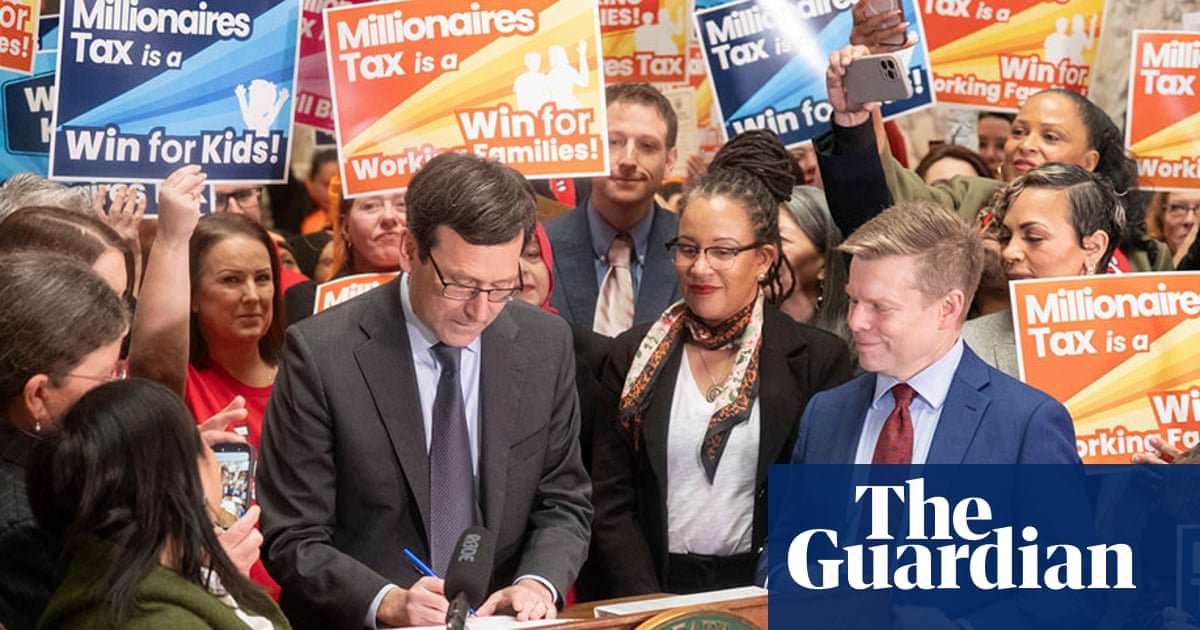
The millionaire tax is signed into law by Governor Bob Ferguson.
Rightwing groups lead effort to repeal Washington state law An initiative on November’s ballot aims to overturn the 9.9% tax on earnings above $1m – who’s winning the fight?
Voters in Washington state will soon decide the fate of the state’s so-called “millionaire tax” – a 9.9% income tax on earnings above $1m that was signed into law in March and is now facing a conservative-backed effort to repeal it.
An initiative on November’s ballot aims to overturn the tax, claiming that the tax represents a slippery slope, and would eventually result in taxes for more than just millionaires.
A coalition of advocacy groups and unions opposing the initiative say taxing the state’s 20,000 highest-earning households could raise approximately $3.5bn in necessary annual revenue to fund core priorities like education and healthcare, and expand tax credits and sales tax exemptions.
Facing dwindling federal funds under the Trump administration yet home to substantial tech-industry wealth, including prominent billionaires such as Bill Gates, Steve Ballmer and, until recently, Jeff Bezos, Washington has joined other states and municipalities by turning to its wealthiest earners as a source of revenue.
Massachusetts, Maine and New York already impose a unique tax rate on millionaires, and Hawaii passed a similar measure in May.
California, whose resident billionaires possess a collective net worth hovering above $2tn, will see voters decide on a proposed one-time, 5% tax on billionaires’ wealth.
The measure is opposed by most billionaires as well as Gavin Newsom, the governor; some progressive groups also question the long-term benefits of the one-off tax.
Washington’s governor, Bob Ferguson, has said he would veto any effort to expand the millionaire tax to encompass lower-earning households.
And, after decades of voter-rejected efforts to reform the state’s tax structure, which has historically lacked an income tax and instead levied sales taxes, property taxes and fees, Washingtonians in recent years have approved new progressive revenue streams, including a capital gains tax.
Advocates claim that the millionaire tax is part of a clear mandate to better align the state’s largely regressive tax code with its progressive values.
The statewide fight over an income tax really began in the 1930s, according to the Washington state senate majority leader, Jamie Pedersen, an architect of the millionaire tax.
Nearly 100 years ago, the state’s supreme court ruled that income taxes constituted a property tax, hamstringing efforts to diversify beyond flat-rate excises.
By 2002, a state commission led by Bill Gates Sr concluded that Washington’s tax code was uniquely regressive, and called for a state-level income tax.
But, in 2010, voters still voted by wide margins against a proposed tax for those earning above $200,000; Steve Ballmer, Microsoft’s then CEO, was the leading contributor to the campaign opposing the tax, and the Amazon founder, Jeff Bezos, ranked fourth.
A reliance on sales, property and other taxes leaves the state with “the second-worst tax code in the nation when it comes to who actually pays as a share of their income”, said Emily Vyhnanek of the Washington State Budget and Policy Center, a non-partisan research group.
Those in the lowest-earning quintile spend up to 13.8% of their annual income on state taxes, while those in the top 1% currently spend about 4%, she said.
In 2021, lawmakers passed a 7% tax on capital gains above $250,000, which survived a constitutional challenge and a conservative-led ballot initiative aiming to overturn it in 2024.
The initiative’s resounding defeat was “some indication that voters were willing to vote for something that the opponents labeled as an income tax”, Pedersen said.
By 2025, facing a nearly $15bn shortfall over the ensuing four years, Democratic lawmakers debated new ways to tackle the state’s structural budget problem, and landed on the high earners’ income tax.
Lawmakers had “99.9% certainty” that conservative groups would challenge the tax through a ballot initiative, Pedersen said.
Brian Heywood, a conservative hedge fund executive and the founder of Let’s Go Washington, a political action committee, has helped spearhead and fund initiative 645, the ballot initiative to overturn the millionaire tax.
Heywood and his business moved from California to Washington state in 2010, in part drawn by the state’s lack of capital gains and income taxes.
Voicing concerns about a slippery slope, Heywood said the new income tax and ensuing capital flight risked compromising Washington’s “golden goose” economy, which features Microsoft, Amazon, Boeing and others.
“I can’t tell you how many people have left the state,” he said.
“My business partner moved to Arizona.
I probably know 50 people that are deca- or centi-millionaires that have left the state.” Academic research suggests about 2% of residents affected by the millionaire tax might leave Washington, according to Rian Watt of the Seattle-based thinktank Economic Opportunity Institute.
Brian Heywood, who has opposed the millionaire tax and wants it repealed.
More than 60% of voters rejected that effort in 2024, and the campaign opposing Heywood was partially funded by Gates and Ballmer.
In September, several business owners in Washington confronted public outcry and boycotts after public disclosure forms revealed they had donated to Let’s Go Washington; in both cases, business owners claimed they solely supported Let’s Go Washington’s efforts to overturn the millionaire tax, and not its other initiatives on the 2026 ballot.
Let’s Go Washington is behind two other proposals, including a campaign to ban trans girls from participating in girls’ sports at school.
Opponents have expressed alarm at the initiative and have dubbed it “the most extreme proposal of its kind”, as it would require girls to undergo “verification of biological sex” during sports physicals, potentially through genital exams. skip past newsletter promotion after newsletter promotion Heywood claimed Democratic lawmakers, and the state’s election-finance watchdog, have strategically tried to isolate him and Let’s Go Washington, and “try to make me toxic, somehow” in the eyes of donors.
A separate campaign backing the millionaire tax repeal was launched in July, and selected former Republican congresswoman Jaime Herrera Beutler as its spokesperson.
That campaign did not return the Guardian’s request for comment.
Pedersen suggested that advocates interested in overturning the millionaire tax may “have figured out Brian Heywood” and may be “trying to distance themselves from his pretty toxic brand”.
The state supreme court is also slated to hear a legal challenge to the tax early next year, which will test the validity of the new income tax against state-constitutional and legal precedent.
Recent polling suggests that the initiative is likely to fail.
In a survey of Washington residents, research firm DHM found 57% of respondents opposed repealing the tax.
Kara Krnacik, who helped lead the survey, said Washington residents may be growing more open to an income tax below the million-dollar threshold: 41% of respondents said they were in favor of an income tax that might eventually extend to those making $100,000 or more, up from 36% in November 2025.
But if the tax is overturned, lawmakers face a “very stark reality”, Pedersen said, and may have to find revenue through “inferior alternatives” such as hiking the sales tax rate, or enacting a statewide payroll tax.
Meanwhile, if the tax survives, Pedersen said lawmakers may begin to scrap or reform other regressive taxes in Washington, including its business taxes.
“I think it’s really significant that you do not see almost any major business that is aligning itself with the initiative 645 folks,” Pedersen said.
Public disclosure records suggest the initiative’s opponents have outspent its supporters by more than 50%; and major labor unions in the state have contributed more than $6m to the campaign defending the tax.
In addition to new legal challenges, Heywood said he had begun to consider ways to circumscribe how unions receive and disburse funds in the state.
Explore more on these topicsWashington state West Coast US economy Economics features Share Reuse this content