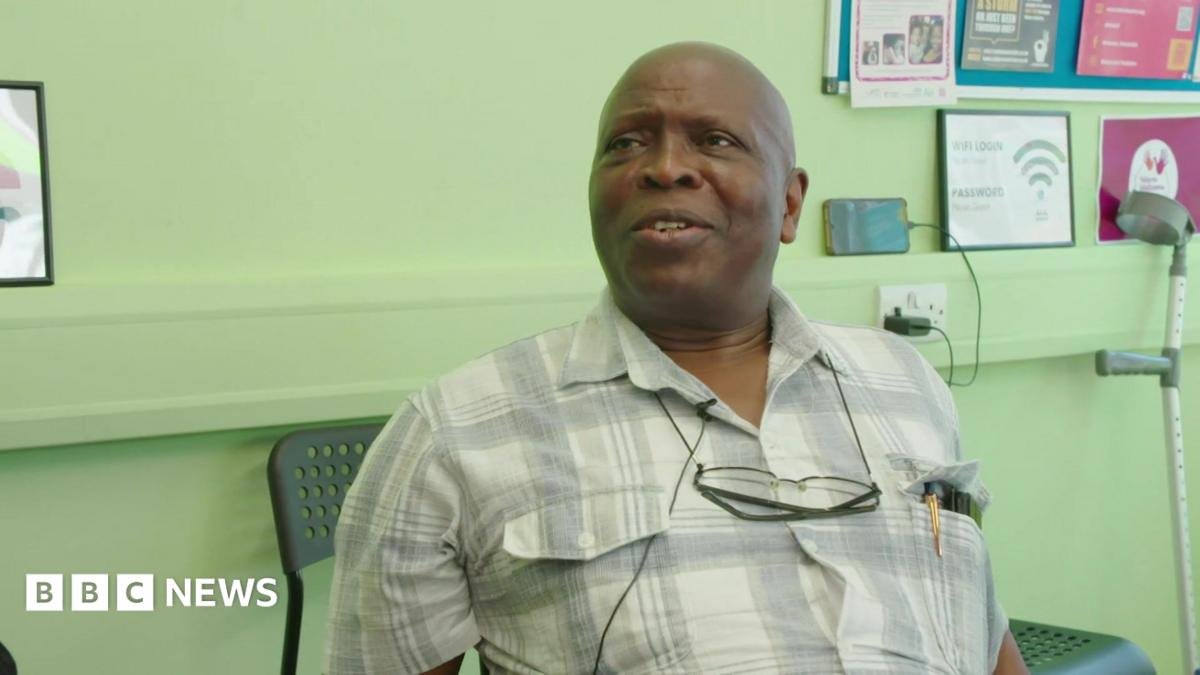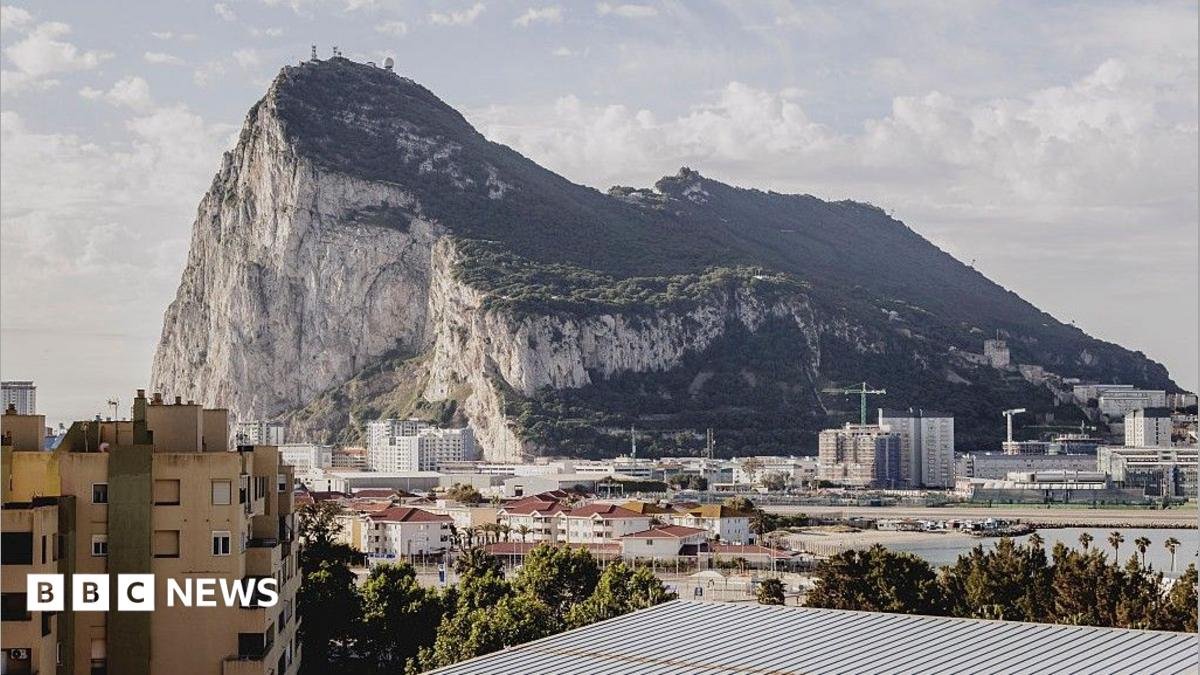
Image caption, Shilpi Chotrani, who commutes from Spain to Gibraltar every day, can't wait for the removal of the border ByGuy HedgecoeBusiness reporter, Reporting fromGibraltar Published 16 minutes ago Every weekday morning, Shilpi Chotrani rides her bicycle from her home in the Spanish town of La Línea de la Concepción to Gibraltar.
It's a short journey but it means crossing an international border.
A British Overseas Territory of around 40,000 inhabitants, Gibraltar has a border control for those entering and leaving.
That means that during the morning and afternoon rush hours, when around 15,000 Spaniards who work in the territory cross the frontier, there can be long, time-consuming queues.
"The fact that there is a border between us is ridiculous," says Chotrani, who has a job in human resources in a Gibraltarian shipping and tourism company.
"I don't think a fence should separate people from one place and another." Behind her, the 1,400-foot-tall Rock of Gibraltar is shrouded in early-morning cloud.
Perched at the southern tip of mainland western Europe, it is just nine miles from Morocco, at a point where the Atlantic Ocean and the Mediterranean Sea meet.
It is a place that has witnessed military battles, sovereignty disputes and a 13-year blockade imposed by Spain.
But from 15 July it is scheduled to see a new development - the removal of the border, allowing freedom of movement between Spain and Gibraltar.
This is part of a carefully negotiated agreement between the European Union and the UK following the latter's exit from the bloc.
Sharing a land border with the EU meant that Gibraltar posed a unique challenge in the post-Brexit era.
"This is going to be a great step forward, both for the Spanish side and the British side," says Chotrani.
"All of those of us who live [in La Línea de la Concepción] think this is a great idea.
This should have been done a long time ago." Gibraltar has one of the highest per capita incomes in the world.
But La Línea de la Concepción and the nearby area is one of the most deprived parts of Spain.
Unemployment, which is high across the southern Andalusia region, is close to 30% here.
The removal of the border is therefore expected to have major economic benefits, facilitating the flow of people back and forth, and possibly going some way to redress the imbalance between the two territories.
"This is something historic, we've had a border fence since 1908," says Juan Franco, the mayor of La Línea de la Concepción, who is keen to underline the local economic dependence on the British territory.
"You have to realise that for an average company in this town a third of its income is from clients in Gibraltar," he says.
After a decade of uncertainty regarding Gibraltar's future relationship with Spain following the UK's vote to leave the EU, Franco says he believes "this solution to Brexit will end up having a positive effect for us".
Spain to check Gibraltar arrivals under post-Brexit deal Published 26 February No threat to British sovereignty over Gibraltar deal, says Lammy Published 12 June 2025 Gibraltarians were staunchly opposed to Brexit, with 96% of them voting to remain in the EU in the 2016 referendum on the issue.
That staunchly pro-EU stance was driven partly by concerns that exiting the bloc would encourage Spanish sovereignty claims on the Rock.
But another major factor was Gibraltar's existing close trade relationship with the EU – particularly in areas such as online gaming, shipping and financial services – and fears about the logistical challenges Brexit would pose.
After years of negotiation involving Spain, the EU and the UK, the solution has been to align Gibraltar with the European customs union and the Schengen European free travel zone.
Travellers arriving from countries outside Schengen, such as the UK, will have to show their passports to Gibraltarian and Spanish officials at the territory's airport and port.
Image caption, Currently there can be long queues of vehicles at the border during rush hour The Chief Minister of Gibraltar, Fabian Picardo, says the new arrangements, which are due to be provisionally implemented with their approval by the UK and European Parliaments still pending, represent "a huge change" for the territory.
"One of the key things which has defined the past eight generations of Gibraltarians is the restrictions at the frontier," he told the BBC in the Gibraltarian government's headquarters.
Picardo describes the agreement as introducing "complete and utter fluidity of people and goods" between Gibraltar, on the one hand, and Spain and the EU on the other.
The most obvious economic benefit for Gibraltar, Picardo says, will be an increase in arrivals.
"Business will now be able, in Gibraltar, to see a footfall increase which is not going to be restrained by a potential queue on the way in or frontier queue on the way out." With Spain contesting the UK's sovereignty of Gibraltar, it is an issue that occasionally flares up in the political arena.
In the most notorious episode of bilateral tensions in recent times, Spain's dictator, Francisco Franco, introduced a blockade of the Rock in 1969, which was only lifted in 1982, well after his death.
The chief minister casts the new arrangement as the opposite of the blockade - a logical, mutually beneficial opening up of a border.
"This will be huge for human relations, it will be huge for business, it will be huge for frontier workers, it will be a new dawn" for Gibraltar's relationship with Spain and the EU, says Picardo.
Spain's foreign minister, José Manuel Albares, has cast it in a similar light, speaking of "a new era" for the Rock.
However, the deal also means that goods sold in Gibraltar must comply with EU regulations, something that had not been the case until now.
Image caption, Gibraltar has been owned by the then Kingdom of Great Britain since the 1713 Treaty of Utrecht In addition, the lack of value added tax (VAT) in Gibraltar has meant that a new transaction tax is being introduced, replacing import duty.
Charged on all goods sold in Gibraltar, it will start at 15% this year, eventually rising to 17%.
There will also be higher rates of excise tax on certain goods.
John Isola, managing director of Anglo Hispano Company, which runs several restaurants and bars on the Rock, says there is a sense of relief among the Gibraltarian business community that the drawn-out Brexit issue has, finally, been resolved – and without a hard border.
He sees the new arrangement as "a good compromise" that will encourage more visitors to Gibraltar and therefore more business.
However, Isola also admits to some nervousness due to the new regulations and tax regime, which he expects will have an impact on competitiveness.
"For anybody importing goods the scenario changes completely in terms of the paperwork that one is going to have to present to get the goods in," he says.
He also believes that new requirements to adhere to EU standards "is a challenge for anybody who is importing goods from the UK or anywhere else outside the EU".
Gibraltarians and residents of La Línea de la Concepción have had plenty of time to get used to the idea of the new arrangement.
In recent weeks, machinery has been tearing down the border fence each night, in preparation for 15 July.
Having witnessed so much drama in the past, this territory is about to discover the significance of the latest twist in its history.