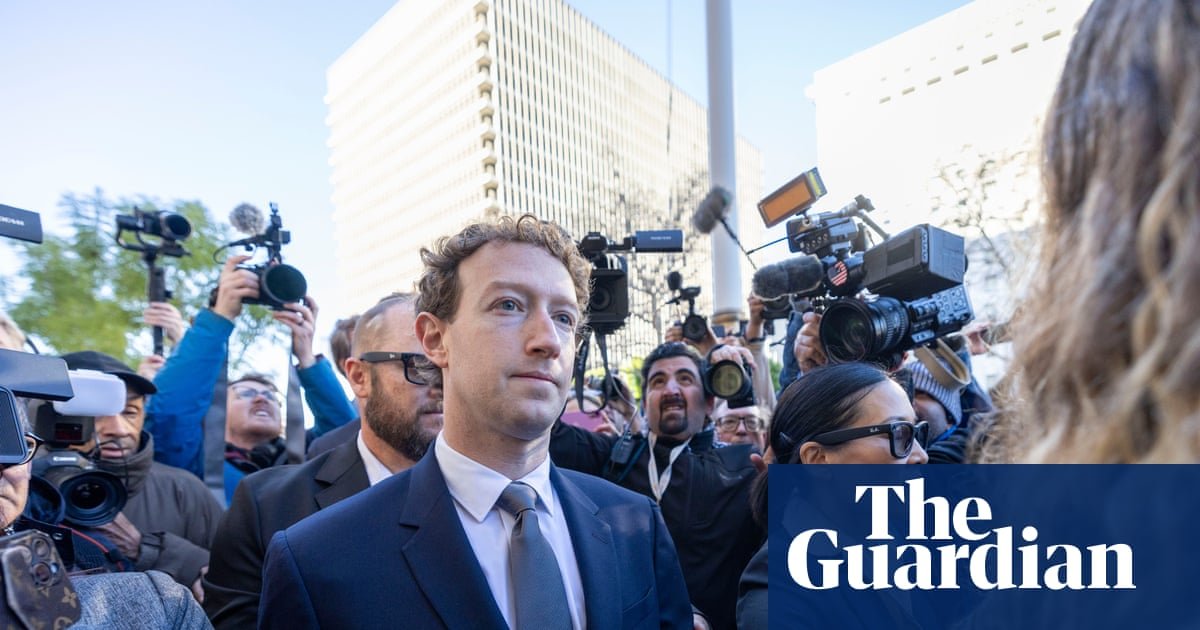
Mark Zuckerberg, the Meta chief executive, outside court in Los Angeles in February.
Ruling comes as part of second phase of landmark trial that found social media company enabled harm against users A New Mexico court has ordered Meta, the parent company of Facebook, to pay $567m into a fund aimed at redressing adverse mental health impacts from the social media giant’s platforms.
The Thursday ruling comes as a part of the second phase of a landmark trial the social media giant lost in March.
At the time, a jury found that the company knowingly harmed children’s mental health and concealed what it knew about child sexual exploitation on its platforms, and imposed the maximum penalty: a $375m fine.
The ruling on Thursday an additional to that fine, bringing the total amount Meta is responsible for to $942m.
Judge Bryan Biedscheid said the bulk of the money – $420m – would be used for treatment services for young people in New Mexico.
The rest will go toward awareness and prevention, screening services and other costs over the next five years.
The March trial was the first to find Meta liable for acts committed on its platform, and followed a 2023 Guardian investigation that revealed how Facebook and Instagram had become marketplaces for child sex trafficking.
Several former Meta moderators told the Guardian there were instances where they flagged harmful content related to child grooming, but the cases were not escalated.
In the second phase of the trial, which began in May, prosecutors had asked the judge to impose fundamental changes at Meta aimed at reining in addictive features, improving age verification, and preventing child sexual exploitation through default privacy settings and closer oversight.
The judge has also ordered other changes, including that Facebook and Instagram build banner and informational screens to clearly explain its protection features, best practices, and tools to address inappropriate comment.
Those changes, and an educational campaign in New Mexico, would be subject to review by the state.
The court said federal children’s privacy laws prevent Meta from applying age-verification tools to children under 13.
The court also noted that ordering verification of children’s ages only for Meta and not other social media companies would be “inequitable and unduly injurious” to the company.
Instead, the court ordered Meta to continue to improve its age-assurance tools in New Mexico, which include using artificial intelligence to determine people’s age based on signals such as who their friends are and what types of content they post and consume.
Meta must also attempt to develop a dedicated “under-13-years-of-age prediction model” in the next two years.
Additionally, Meta should also request proof of age for Instagram and Facebook users in New Mexico it estimates to be under 13.
If it determines a user to be under 13, or under 18 but without being able to estimate a specific age, Meta must treat the user as under 13 or under 18 until the user verifies their age.
The company must also partner with schools or a child safety organization to create a reporting portal where school staff can flag users who may be under 13.
And it must delete personal information it has collected on users under 13.
The court also ordered Meta to report on its progress twice a year on how it is complying with the abatement measures.
New Mexico attorney general Raúl Torrez hailed the judgment.
“This case has always been about protecting children, standing up for families, and making sure that one of the world’s largest technology companies cannot profit from practices that endanger young people without consequence,” Torrez said in a statement.
“Today’s decision is a victory for every parent who has worried about what social media is doing to their child and every child who deserves to grow up safer online.” A Meta spokesperson said in a statement to the Guardian on Thursday that the company “disagrees with the ruling” and plans to appeal.
“We work hard to keep people safe on our platforms and have been transparent about the challenges of identifying and removing bad actors and harmful content.
We remain confident in our record of protecting teens online and will continue to defend ourselves against claims that misrepresent the facts,” the statement continued.
The total amount Meta is responsible for is a small fraction of of its annual profit, which was about $60bn in 2025.
Still, it represents another setback for Meta as it faces a wave of accusations from families of children harmed by social media.
The company is embroiled in a slew of lawsuits in other US states over its alleged harms to young people.
In a trial in Tennessee that began last month, the state has accused the company of disregarding internal warnings about teenagers’ compulsive use of Instagram, which has been linked to eating disorders and depression, among other adverse effects.
Meta is also gearing up for a trial later this month in federal court in Oakland, California.
What comes out of New Mexico is the first of many dominoes that could fall for Meta, said Laura Edelson, an assistant professor at Northeastern University focusing on social media and cybersecurity.
“America is not going to pass a law that bans social media,” Edelson said.
“But if companies like Meta know they’re causing harm to users by product design, the states are finally finding a way to rein this in.” Explore more on these topicsMeta Instagram New Mexico Mark Zuckerberg Facebook Social networking news Share Reuse this content