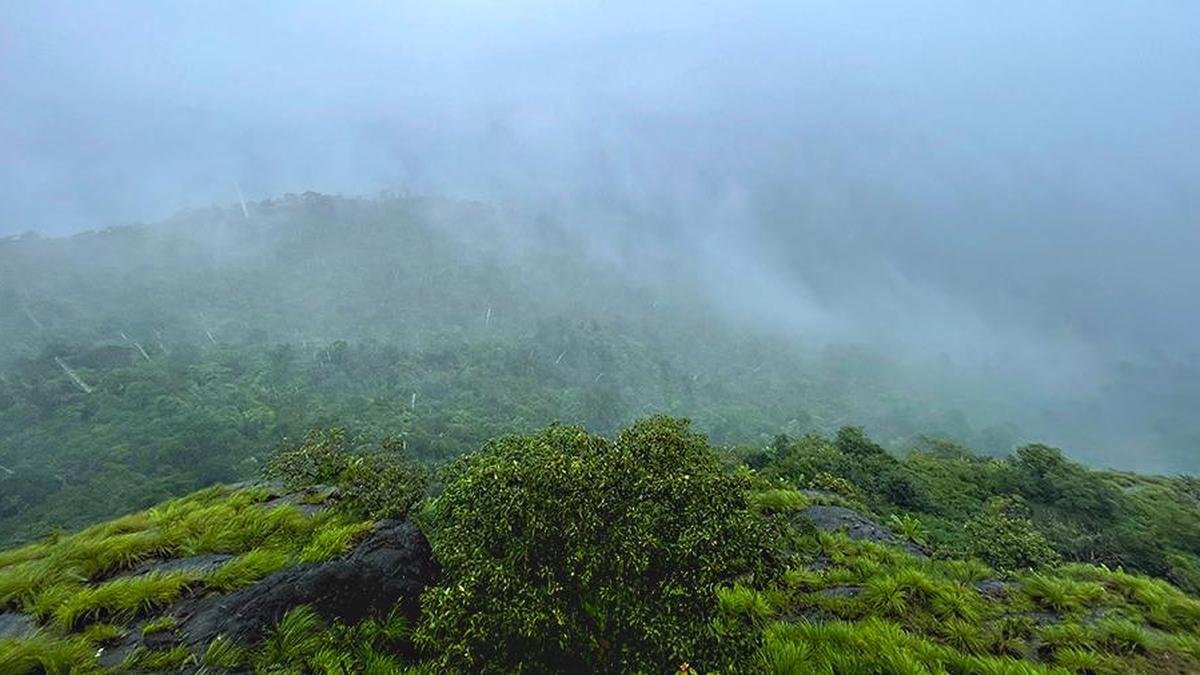
Nearly a quarter of the rain that falls over the north Western Ghats during the Southwest monsoon evaporates mid-air, says a study out of the Indian Institute of Tropical Meteorology (IITM), Pune.
This is the first time this fraction has been measured via an experiment in India.
This will help scientists refine weather and climate models and better understand the monsoon, an accompanying press statement noted.
Monsoon covers entire country, a day later than normal Researchers at the IIITM, Pune, computed that on average, about 25% of the rain mass evaporates; the actual amount varies from day to day and range from 4%-61%, over the four monsoon months of June to September.
“This is the first observational estimate of raindrop evaporation over the Western Ghats, and the technique can be used over whole of India,” the study’s corresponding author, Saikat Sengupta, told The Hindu in a phone conversation.
The work was published in the peer-reviewed journal Atmospheric Chemistry and Physics.
The Pune result is the first step in a wider effort to map the process across India, where Mr.
Sengupta expects it to vary sharply with temperature and humidity, from arid Rajasthan to the rain-soaked coast.
The IITM already runs a rainwater-isotope network of nine sites – from the Himalaya to the north-east and Port Blair – where the sampling is going on for a decade.
Rainfall situation better, kharif sowing improved: Chouhan Crucial yardstick The evaporation rate measurements are not merely an academic exercise.
When a raindrop evaporates on its way down, it absorbs heat from the surrounding air cooling the sub-cloud layer, feeding downdrafts and creating cold pools of air at the surface.
This reshapes the very convection that generates the next burst of rain.
It is a process that climate and monsoon models have long struggled to capture.
Getting it wrong skews their rainfall prediction and associated atmospheric cooling and storm-triggering potential.
India’s rainfall deficit at 35% as monsoon progress stalls The rain mass loss of roughly one-quarter sits at the lower end of global estimates elsewhere.
Satellite data-based measurements put evaporation at the tropics near 20%; over Zurich it was about 40% and near Barbados, roughly 60%.
This is because of Barbados’s smaller drops and drier air; evaporation eliminates the small drops of light rain and barely touches the large drops of an intense downpour.
In the Zurich case, switching evaporation off in the model raised rainfall by about 75%, a measure of how sharply the cooling throttles convection.
To calculate the evaporation rate, Mr.
Sengupta and his colleagues utilised the fact that most substances have different combinations of isotopic atoms.
Most water, for example, is ordinary H₂O, but a small fraction carries a ‘heavier isotope’ (more neutrons), a heavy oxygen or a heavy hydrogen.
These heavier molecules are marginally more sluggish, so when a drop evaporates, the lighter molecules escape preferentially, leaving the surviving drop enriched in heavy isotopes.
Rain that evaporated less keeps a lighter signature; in contrast, rain that evaporated more carries a heavier composition.
During the 2019 monsoon, the team collected rainwater and atmospheric vapour at ground level in Pune, read their isotope ratios on a laser spectrometer, and fed the results into a one-dimensional Below Cloud Interaction Model that tracks a single drop falling from cloud base to the ground.
Collecting the vapour is challenging — each sample took six to seven hours to trap by freezing atmospheric moisture.
The group has begun acquiring portable analysers that read vapour isotopes in real time, to be stationed around the country.
Mr.
Sengupta underlined that the results point to a way to improve how weather and climate models represent rainfall.
Representation, in modelling, means how faithfully the equations inside a model reproduce a real physical process; a model must capture the process correctly before its predictions of that process’s effects can be trusted.
All of the work, he said, was done in-house.
“All observation and modelling work was carried out at the IITM by Ph.D. students, postdoctoral researchers and project associates”.
Sengupta noted that quantitative estimates of evaporation are rare for India.
Even non-isotopic ones are hard to find in the literature, because the quantities needed to gauge mid-air evaporation are not easily measured, which is why they use isotopes as tracers to fingerprint the process, he said.