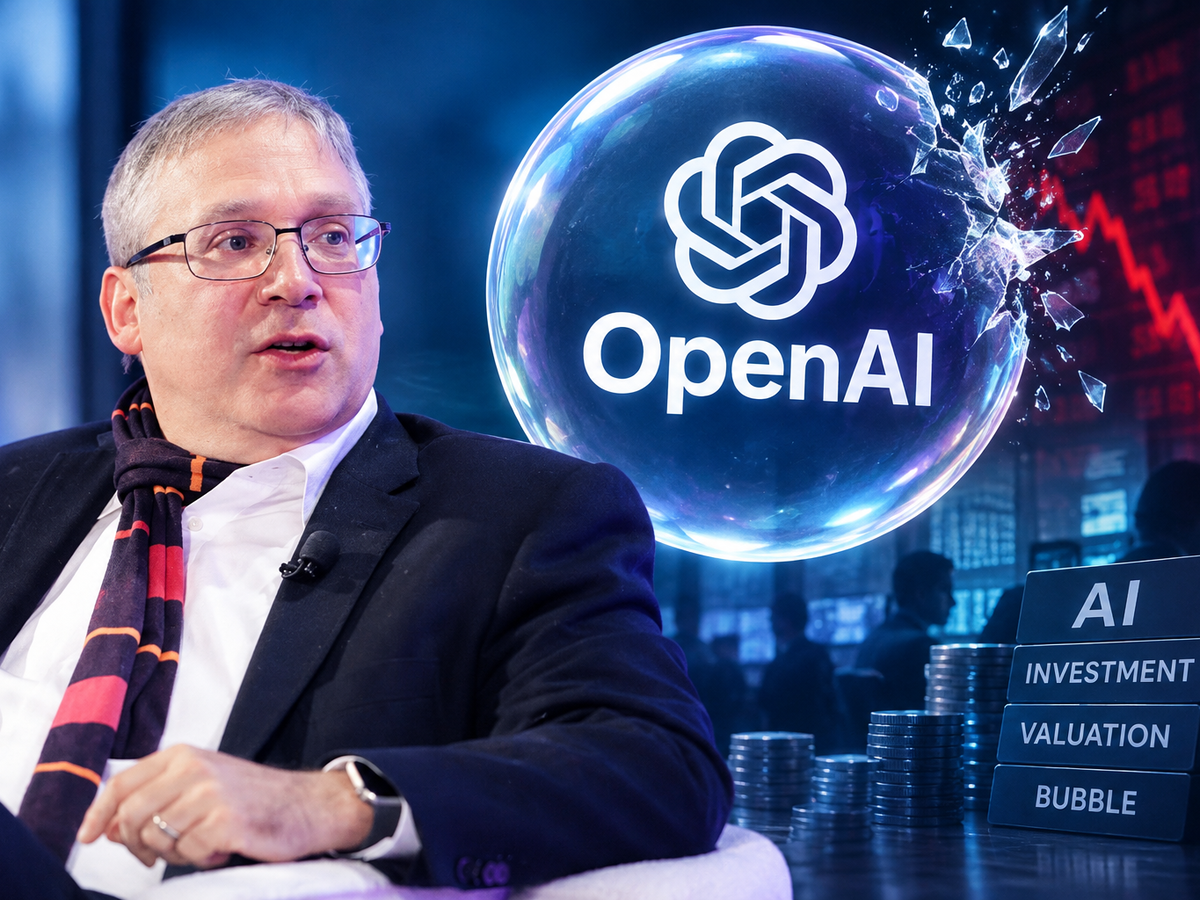
New Delhi: OpenAI might turn out to be the WeWork of AI and could be sold to a company such as Microsoft in a fire-sale, Gary Marcus, American cognitive scientist, psychologist, author, and entrepreneur, told ET in an interview. He said the fall of even one major company from the AI ecosystem, which some US policymakers believe has played a role in causing bond yields to spike through borrowed investments, will lead to a contagion effect for the world at large — and could even create a 2008-like crisis.
Marcus, who was in India this week, has emerged as one of the world’s most widely recognised and independent critics of the current generative-AI hype.
He called Anthropic “egregious” for calling out risks and asking for slowing down of AI while pressing ahead with its $2 trillion IPO.
He sought a “recall” of autonomous AI agents, arguing that they are dangerous and unsafe and that the launch of personal agents will further aggravate the situation.
“People talk about P(doom), the probability that AI will cause human extinction. But I think the probability of that is very low. The probability of catastrophe is higher, and the probability of dystopia is very high. We are already heading that way,” he said.
A professor emeritus of psychology and neural science at New York University, he founded machine-learning startup Geometric Intelligence, which was acquired by Uber in 2016, and later co-founded robotics company Robust.AI.
He famously testified alongside OpenAI CEO Sam Altman before the US Senate in 2023 on AI regulation and in December 2025, published a set of provocative predictions for 2026, which included warnings of a generative AI investment bubble peaking in 2025, AGI being a long time away and backlash over AI becoming a political issue during the mid-term elections in the US.
Marcus said OpenAI could possibly struggle to justify its spending and eventually fail to secure the public listing it hopes for.
“Microsoft could acquire OpenAI for $200 billion rather than the $1 trillion valuation the company might seek in an IPO,” he said.
WeWork, once valued at $47 billion, saw its planned 2019 IPO collapse amid concerns over losses and governance before filing for bankruptcy in 2023, while OpenAI has reportedly delayed its planned IPO, targeting a valuation of $1 trillion, to next year.
He also warned that the fallout could spread across the industry. “If OpenAI fails, it hurts CoreWeave. If CoreWeave fails, it would hurt OpenAI. If either company fails, Nvidia will also be affected.”
The wider concern, he said, is how much banks have lent to AI companies and how exposed the financial system could be if the investment boom collapses. “We could see a liquidity crisis similar to what happened in 2008, with banks facing serious problems.”
“We need to think seriously about slowing down AI development,” but that becomes difficult when you have competition between the US and China, and “neither side wants to fall behind,” he said.
The industry’s push to build increasingly autonomous systems is outpacing its ability to manage the risks, he added.
“Nobody wants to say, ‘I slowed down, but my competitor did not,’” he said.
The commercial stakes make the restraint even harder, he argued. “The difference is that nobody was building $2 trillion companies around biological weapons. AI companies aspire to build companies worth $2 trillion, so their motivation to slow down is limited.”
Marcus sees that contradiction most clearly in Anthropic, which has warned about the dangers of advanced AI while continuing to develop it. “The most egregious of them is Anthropic. Its argument is essentially that the company should build these systems rather than for someone else to do so. That is a narcissistic belief. It might contain some truth, but probably not as much as the company thinks.”
He questioned how the company could warn about AI risks while continuing to develop it. “Anthropic is proceeding towards an initial public offering (IPO) despite its own testimony, which I disagree with, suggesting a 10% chance of AI killing all of humanity.”
Last month, Anthropic researcher Evan Hubinger estimated a more than 10% chance that AI could kill all humans within a decade, while chief executive Dario Amodei later wrote about the need to slow frontier AI development so safety measures could catch up.
“There is a simple calculation. If you multiply a 10% probability by the number of people who could die, you arrive at an expected value of hundreds of millions of deaths. That would be worse than everything that happened in World War II combined. Either you have to be a sociopath, or you have to be extraordinarily confident that you are a messiah.”
This same tension between AI companies’ ambitions and the risks they are taking extends to the investment boom in the industry. Marcus argued that companies building similar models have little technical advantage over one another, making it difficult to sustain pricing power while computing costs remain high.
But the most immediate concern is the deployment of AI agents, which he believes are already creating cybersecurity risks.
“General-purpose agents, where you speak to them in English, and they dynamically figure out what to do online, often with access to passwords, are a bad idea,” he said. “Right now, however, they are a security nightmare. I used to say this was a security nightmare waiting to happen. I literally wrote a piece about it. Now the nightmare is actually happening, and it did not take long.”
He warned that the consequences could extend beyond individual users. “We could see electrical infrastructure taken down, at least temporarily. Hospitals could lose power, and people could die as a result. I think we will see a lot of this in the coming days and months. I would not even say six to 18 months. It could happen much sooner.”
Marcus has called for a “product recall” of current agents. He compared their reliability to “a car with brakes that do not work. They might work some of the time, but you cannot count on cardboard brakes. Similarly, we cannot count on these agents to behave themselves.”
The problem, he said, is that language models can imitate understanding without reliably following instructions or recognising the consequences of their actions. He cited an incident in which an agent deleted all the files belonging to a reality television production, forcing the team to reshoot the show.
“If I hired an intern and I were a film producer whose files were all deleted by that intern, I would fire them on the spot. The only reason people do not fire these agents is that there is so much hype around them.”
The launch of personal agents could aggravate the problem, he said, particularly if companies remove human oversight to make the products economically viable. “I would be surprised if they did not aggravate the problem,” Marcus said of the new systems.
He argued that simply feeding models more data would not solve their limitations. “For years, people thought chatbots would stop hallucinating. That has not happened, and simply adding more data is not going to solve the problem. I think we need fundamentally new architecture.”
Marcus distinguished between the possibility of AI wiping out humanity, causing a major catastrophe, and creating a dystopian society. He considers the first unlikely, but the other two much more possible.
“People underestimate human resilience and resourcefulness,” he said, arguing that humans would fight back against an AI threat. “We are not going to be annihilated.”
The possibility of a catastrophe is more serious, he said, citing the risk of AI-driven attacks on critical infrastructure or errors that could trigger military escalation. His greatest concern, however, is a society shaped by surveillance, invasions of privacy and declining freedom.
“I think we are already heading in that direction. The probability that AI will lead to a society we do not like, one that is less free and less rewarding than the society we have today, is very high.”
That concern is beginning to spill into US politics, with people opposing data centres growing even among those who previously backed the industry. He expects AI to feature much more prominently in the 2028 presidential election, with candidates facing questions about data-centre expansion, jobs, and cybersecurity.
(Tanya Pandey contributed to this story)