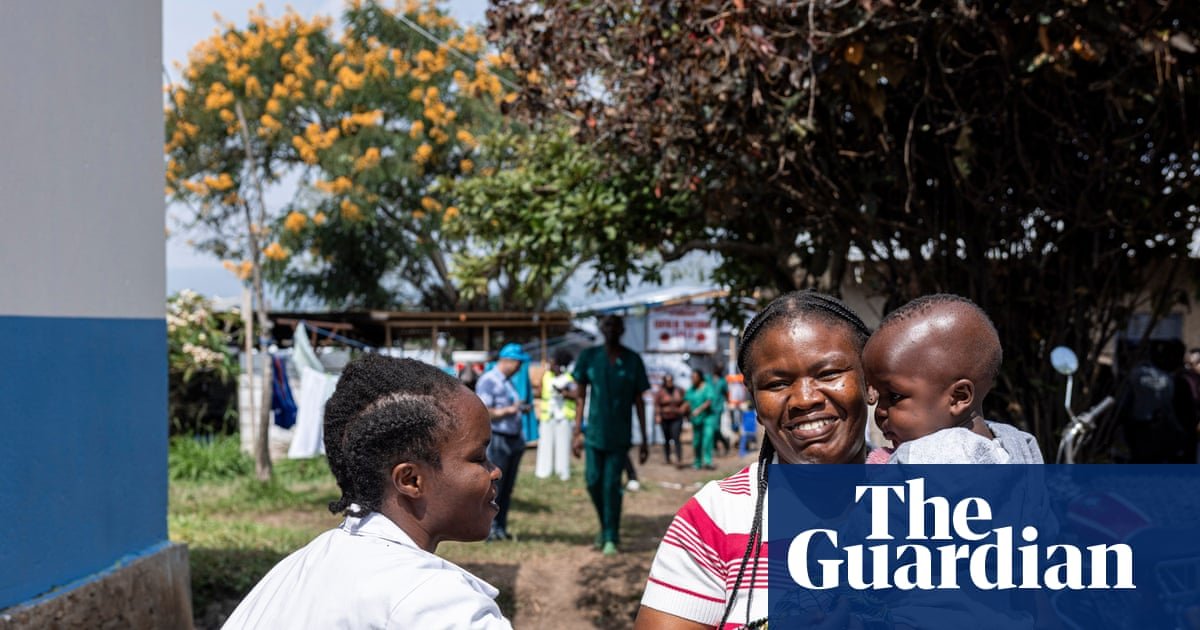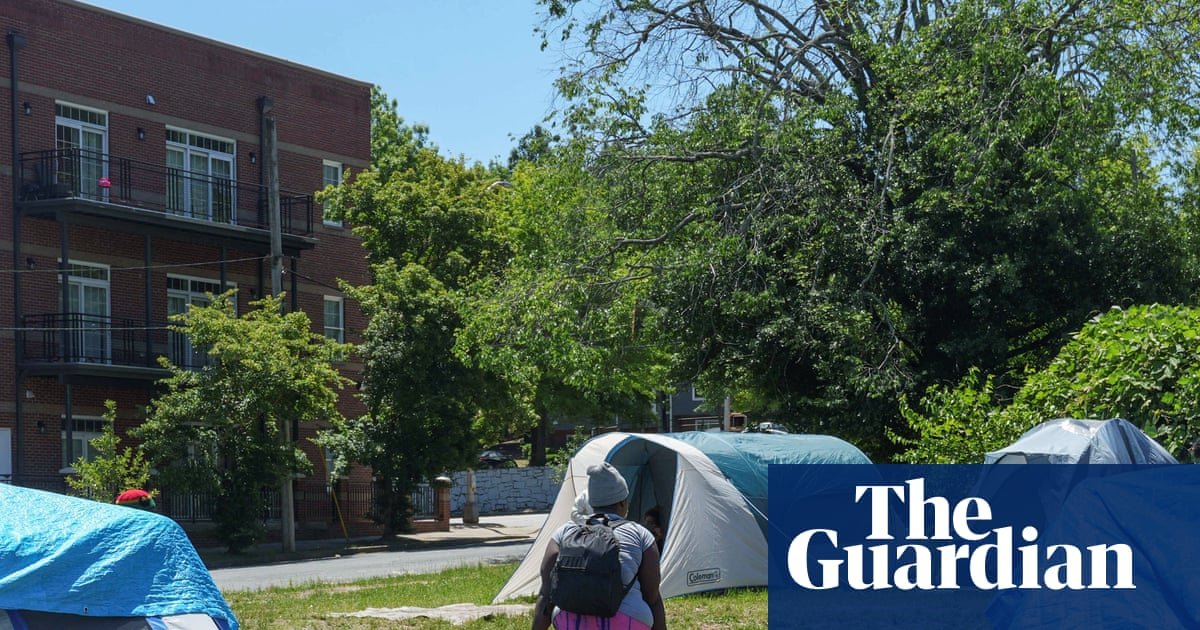
A woman carries groceries at a homeless encampment in the vicinity of Mercedes-Benz Stadium, temporarily renamed Atlanta Stadium, in May.
City official says staffers were performing ‘routine park maintenance’ where 15 people have gathered for months City employees in Atlanta, Georgia, recently threw away tents, medication, identification and other belongings of unhoused people at a public park without warning.
This led activists and a local official to point to an apparent violation of procedures created after a city employee ran over a tent with a front loader last year, killing a man.
The sweep through the park occurred less than a mile from a popular spot for World Cup watch parties, drawing into focus ongoing tension over the issue of what happens to the city’s several thousand unhoused people during the month-long event.
A city official said the park where about 15 people have gathered for months was “not an encampment” and that the incident was not a sweep.
Instead, city staffers were performing “routine park maintenance” last week when they threw out people’s belongings, wrote Chatiqua Ellison, Atlanta senior adviser on homelessness, in an email to the Guardian – and therefore procedures developed last year after months of meetings, including giving unhoused people ample warning before arriving at a camp, did not apply.
But Atlanta city council member Kelsea Bond, whose district includes Freedom Park, disagreed.
“It’s disappointing that the city is more concerned about the strict, and perhaps arbitrary, definition of ‘encampment’ here rather than the impact these kinds of clearings have on the houseless community,” Bond said.
“[Incidents] like this are disorienting and traumatizing no matter whether they adhere to the mayor’s office’s specific definitions.
Our focus should always been on the impact of a policy, not the intention on paper,” the council member said.
The recent incident calls into question the city’s approach to the World Cup and homelessness, as exhibited by the Atlanta mayor, Andre Dickens, months before the event, when he told media: “We want to make sure those unsheltered individuals don’t come anywhere downtown, and throughout the city of Atlanta, not just during the World Cup, but now.” Downtown Atlanta is where Mercedes Benz stadium is located.
Atlanta, New York-New Jersey and Los Angeles all are hosting eight matches, second only to Dallas, host to nine.
Meanwhile, activists said that at least two downtown Atlanta parks where unhoused people gather were also fenced off in recent weeks, leaving dozens of unhoused people to scatter to other parts of the city, disrupting everything from healthcare to the friendships that hold a particular importance for people living on the street.
This has led to more unhoused people sleeping on sidewalks, with nowhere else to go, said Allen Hall, who was homeless for decades and now does street outreach for the American Friends Service Committee.
The practices of sweeping camps and fencing off parks “has been flushing homeless people out of areas … and now the streets are flooded with homeless people”, he said.
Sylvia Broome, director of outreach at a program called Remerge, said she had recently seen about 50 people arrive at her center near Atlanta’s Martin Luther King Jr Historic Park, after being driven from downtown parks.
Several told her their access to healthcare was now more difficult.
“It’s very disturbing,” Broome said, referring to the shuffling of people from one place to another.
City council member Bond, a democratic socialist, is trying to develop legislation that would place a moratorium on clearing homeless camps of people or possessions while a policy is created to cause less harm – like creating a place to store homeless people’s belongings after sweeps occur.
Activists such as the Play Fair ATL coalition lobbied the city government for months leading up to the tournament, seeking guarantees that police wouldn’t simply roust or arrest people in the streets of the city before and during the tournament.
The city, working with a nonprofit organization called Partners for Home, touted a project providing housing to the city’s homeless people before the event.
About 500 people downtown have obtained housing through the effort, in addition to another 900 from other areas of the city, according to the organization.
There are about 3,000 homeless people in the Atlanta area, according to a January estimate.
“The math ain’t mathin’,” said Michael Collins, director of Play Fair ATL, in reference to the many still living on the street and being shuffled around.
“We’re worried about the city being faithful to its promise, that everyone gets housing.” The city also spent months last year developing a policy based in part on warning homeless people before sweeping their camps, after killing Cornelius Taylor while he slept in his tent in January.
That policy appears not to have been followed on 1 July, when some of the 15 or so people who spend much of their time in Freedom Park, less than a mile from the Brewhouse Cafe – a World Cup viewing spot – lost all their possessions.
That includes Mashica King, who lost a tent, clothes, shoes, a laptop and some tools.
Asked whether authorities told her when they would be clearing out the area – as last year’s policy dictates – she said no.
Cassandra, sitting nearby at the park this week, said authorities took a shopping cart with all her clothes, shoes and some detergent.
“I set it there and then it was gone,” she said.
“It was trash to [the city] – but not to them,” said a man named Park, who said he watched from across the street while the sweep happened.
Several people at the park said they lost IDs and social security cards.
Kai, who was at a nearby library when city employees came through, also lost her birth certificate.
Such documents can take months for people living on the street to replace, and are vital to obtaining almost all social services, as well as housing.
Medicines lost at Freedom Park last week include blood pressure pills, an insulin kit and hormones.
“Like a flash of light, it was here, then it was gone,” said Kai, whose possessions were in a bag, suitcase and shopping cart.
She also lost several suitcases that belonged to friends.
“Our whole lives was thrown away.” Council member Bond shared an email from Maj Peter Ries of Atlanta police that said, in part: “This was not an encampment, as there were no tents or homemade beds” – and “Since the site did not meet the definition of an encampment and the property was considered abandoned, park maintenance disposed of … unclaimed items.” But, Kai said, “this an encampment – because we gather here”.
Explore more on these topicsAtlanta World Cup 2026 Poverty news Share Reuse this content