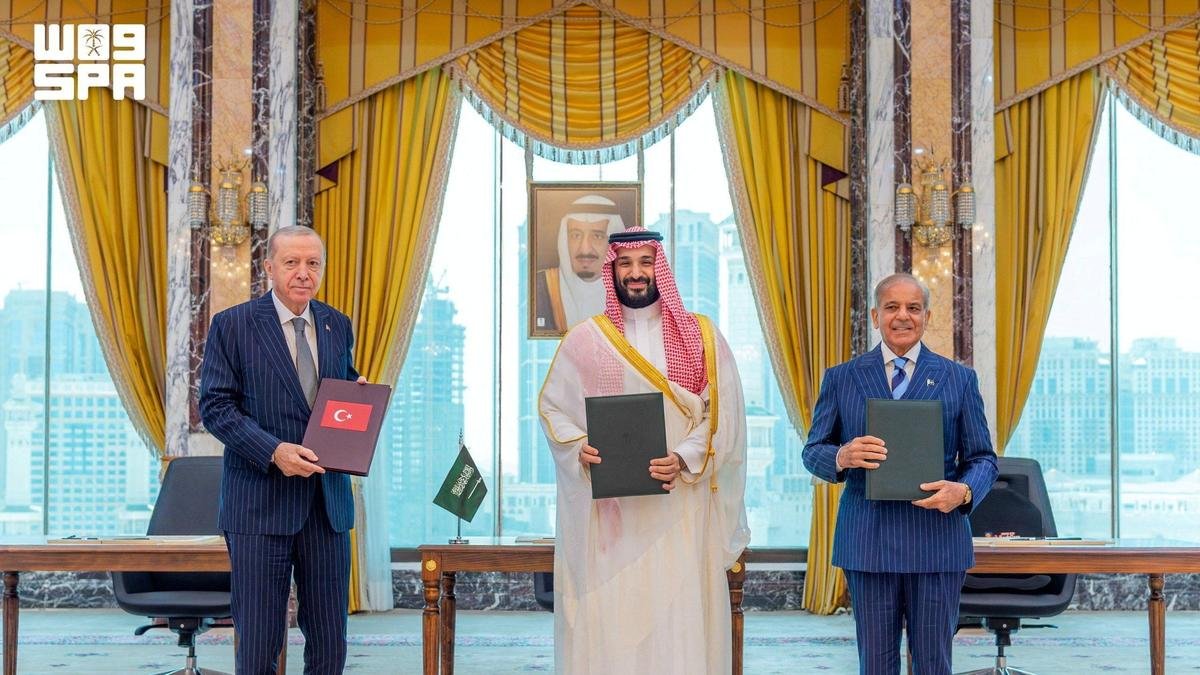
Pakistan, Saudi Arabia and Turkiye on Friday (August 7, 2026) signed a joint defence agreement in Mecca committing to “collective defence” and “collective deterrence”, at a time when Saudi Arabia is under attack from Yemen’s Houthis and West Asia remains engulfed in the ongoing war against Iran.
The three countries, an oil-rich Persian Gulf kingdom, a South Asian nuclear power and a NATO member, said the pact was aimed at strengthening “collective deterrence” and declared that an armed attack against any one of them would be treated as an attack against them all.
The agreement was signed at the Mecca Al-Mukarramah Summit for Joint Defence, attended by Saudi Crown Prince and Prime Minister Mohammed bin Salman, Turkish President Recep Tayyip Erdogan and Pakistani Prime Minister Shehbaz Sharif.
Saudi military says Houthi attacks left 11 civilians, including child, injured near Yemen border According to a joint announcement issued by the Pakistani Foreign Ministry, the leaders, who met at Al-Safa Palace in Mecca after an invitation from Saudi Arabia’s King Salman bin Abdulaziz, reviewed bilateral ties among the three countries as well as a range of regional issues before signing what was described as the Mecca Joint Defence Agreement.
It added that the pact reflected their commitment to strengthening collective security while promoting “peace, security, and stability in the region and beyond, in pursuit of a secure and prosperous future.” Foreign Ministers of Pakistan, Saudi Arabia, Turkiye, and Egypt hold third consultative meeting in Antalya A Turkish government source said the agreement is “a defence-oriented partnership” that doesn’t target any country.
“It seeks to strengthen commitments to preserving regional and global peace, stability and prosperity through burden-sharing and collective security,” the official added.
The agreement was signed as West Asia grapples with a months-long security crisis involving multiple actors.
The war the U.S. and Israel launched against Iran on February 28 remains unresolved.
Over the past five months, all Arab Gulf countries, including Saudi Arabia, came under repeated Iranian attacks.
Last month, after an attack on an airport in Yemen, the country’s Iran-aligned Houthis (Ansar Allah) launched attacks on Saudi oil facilities and imposed a maritime blockade on the kingdom’s Red Sea ports.
The Mecca announcement stated that it was intended to “strengthen collective deterrence against any act of aggression.” It further stipulated that “any armed attack against any one of the three States shall be regarded as an attack against them all.” In September 2025, weeks after Israel attacked Qatar, Saudi Arabia and Pakistan signed a Strategic Mutual Defence Agreement, committing themselves to treat any act of aggression against one as an act against both.
Since then, Pakistan has clashed several times with Taliban-ruled Afghanistan, while Saudi Arabia has come under repeated attacks from Iran and the Houthis.
But neither country has intervened militarily on behalf of the other, raising questions about the practical scope of such mutual defence commitments.
Pakistan deploys jet squadron, thousands of troops to Saudi Arabia amid escalating Iran war tensions According to the joint statement, the trilateral Mecca agreement provides for “the enhancement of all aspects of defence cooperation among the three States,” suggesting closer military coordination and broader security collaboration.
The participation of Turkiye and Pakistan also underscores the growing strategic alignment among the three Muslim-majority countries.
Turkiye has sought a more prominent security role across the wider West Asia, while Pakistan, a nuclear-armed country, has sought to play a bigger role in the region in recent years, both as a security partner and as a mediator (between Iran and the U.S.).
“The Mecca Agreement doesn’t represent a departure from any existing alliance or agreement.
It completes existing alliances, strengthens regional security and provides a framework for cooperation open to other countries in the region,” said the Turkish official.