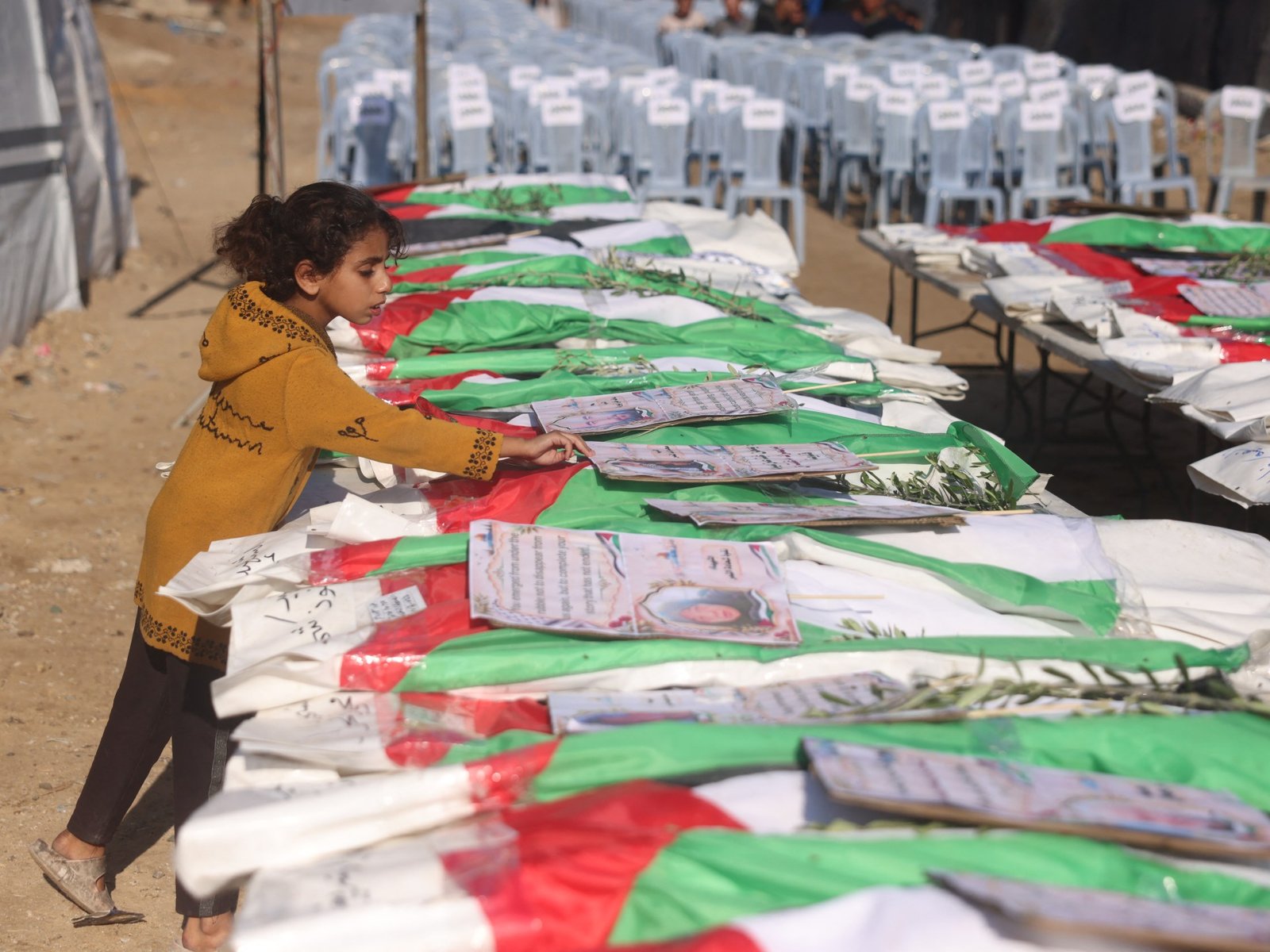
A Palestinian girl checks an ID placed on the flag-draped remains of one of 70 Palestinians recovered from under the rubble of buildings destroyed in Israeli strikes, in Jabalia, northern Gaza, on November 15, 2026 [Bashar Taleb/AFP] By Al Jazeera Staff Published On 17 Nov 202617 Nov 2026 Israel’s parliament speaker is due to be replaced on Tuesday, one of several signs that power is being rearranged as opposition leader Gadi Eisenkot’s bloc angles to lead the government.
But for Palestinians, the machinery of occupation, dispossession and deprivation keeps running.
Israeli attacks killed at least 37 people in Gaza in the past week, while in the occupied West Bank, settlers attacked whole villages with little to stop them.
Gaza: Two narratives of daily killing under the “ceasefire” The past week saw numerous Israeli attacks and killings in Gaza, as military claims of targeting fighters were weighed against accounts of people killed in tents, filling water containers and driving to a wedding photo shoot.
According to Gaza’s Ministry of Health, as of November 16, Israel has killed 1,650 Palestinians since the October 2025 “ceasefire”.
On November 12, an Israeli bomb hit the Nasser Medical Complex in Khan Younis.
The hospital’s surgery building was struck, killing six people, including surgeon Rizq Abu Shaira, and wounding dozens.
The Israeli military said it targeted Hamas’s Khan Younis Brigade commander, Muhammad Abu Ismail, and accused Hamas of running a command centre in the hospital.
In the days that followed, the foreign ministers of 18 Arab and Muslim-majority countries condemned the attack as a violation of international humanitarian law.
Beyond the hospital bombing, the Israeli military told Israeli media it had killed 10 Hamas operatives in the past week.
Among them was Samir Abu Younis, whom the army named as Hamas’s Rafah Brigade commander, killed in a drone strike in al-Mawasi on November 14, which Hamas confirmed.
The strike hit a tent for displaced people, wounding two.
Over the weekend, in Jabalia camp, two men were killed in a strike the army said targeted “terrorists”, and a separate strike on a Gaza government security post in al-Mawasi, Rafah, killed two people, according to Wafa.
Advertisement At the same time, Israeli forces continued to kill Palestinians in circumstances that offered little indication of any military target: A tank shell hit an apartment in the al-Qastal towers in Deir el-Balah on November 13, where mourners had gathered.
Israeli tanks then fired on people fleeing, killing at least three, including 12-year-old Ahmed Abu Daher, and wounding at least 20, according to local activist Hamza al-Masri and Gaza Now.
According to Wafa, a man was killed by a drone on November 11 as he filled water containers on his Gaza City roof.
The next day, a driver taking a groom to a wedding photo shoot in Deir el-Balah was killed by Israeli fire.
On November 16, a man was shot dead at displacement tents in Jabalia, while three people, including a child, were separately wounded by gunfire inside a school south of Khan Younis, Wafa reported.
This week, Gaza’s Health Ministry recorded the winter’s first death from hypothermia – a nine-month-old baby – following the devastation of last week’s rains.
Israel’s Prime Minister’s Office claimed more than 91,000 tents and 8,200 trucks of winter supplies have been delivered, the Times of Israel reported, and blamed Hamas for the suffering.
The United Nations, however, reported this week that aid-truck offloads have fallen about 42 percent after Israel suspended the Egyptian corridor.
The United Kingdom, Australia, Canada and Italy called conditions in Gaza “catastrophic” and urged that 150,000 tents be allowed into the territory.
West Bank: Settler attacks, closures and two pogroms The most violent olive harvest on record continues in the occupied West Bank, as OCHA counted 410 harvest-related attacks this year as of November 9.
The week saw several kinds of attacks by settlers and soldiers unfold repeatedly across the West Bank: Harvest and land: Residents reported settlers attacking pickers at Deir Istiya, Abu Nujeim, Wadi Saif near Beit Fajjar, Beit Dajan and Deir Jarir.
On November 10, dozens of masked settlers attacked Rabbis for Human Rights volunteers and farmers at Qusra, injuring six, the Times of Israel reported.
Settlers also bulldozed farmland at Marj Arzal and Sinjil and uprooted olive trees at as-Sawiya, according to Israeli field monitor Jonathan Pollack and local residents.
Arson and vandalism: Settlers burned a Bedouin tent at Deir Qaddis, set a car ablaze in Taybeh while spray-painting “Death to Arabs”, and destroyed beehives at Atara, according to Wafa and Pollack.
Closures and raids: In al-Mughayyir, settlers pitched a tent in a zone closed to Palestinians, and that night, troops sealed the village, raiding a wedding hall and arresting the groom and three guests.
Forces also imposed a curfew on Beit Ummar and closed ad-Dhahiriya’s main entrance, Wafa reported.
Advertisement But in the past week, two settler attacks escalated into full-blown pogroms against Palestinian communities.
Late on November 10, more than 50 masked settlers set fire to a scrapyard, a workshop and cars beside homes in al-Lubban Asharqiya, south of Nablus, burning more than 100 vehicles and dozens of olive trees and cutting power.
Wafa put the damage from the attack at more than one million shekels ($310,000).
On November 12, after soldiers evicted an outpost near Atara, north of Ramallah, settlers smashed four homes and a factory and wrecked at least three cars, injuring more than 10 residents.
The Israeli army evacuated outposts near Burqa, Wadi al-Rakhim and Jalud, and on November 11, police arrested four Israelis over a September attack by settlers on troops escorting a displaced Palestinian family, the Times of Israel reported.
Yet settlers re-established an outpost at Burqa within days, and in Wadi al-Rakhim, south of Yatta, the six-week siege of Yousef Shanaran’s home by settlers continues unimpeded.
While soldiers pulled down the settlers’ tent outside Shanaran’s home on November 13, the tent was rebuilt after sunset, according to the family.
On November 16, Shanaran told Al Jazeera that settlers had thrown stones at their home throughout the previous night.
Soldiers were present, but did nothing.
“We are alone,” he declared.
Eisenkot condemns racism, but courts the Haredim As the occupation continues largely unchecked, early coalition negotiations suggest that a change of government might mean little more than a rearrangement of the political chairs for Palestinians.
On November 10, Prime Minister Benjamin Netanyahu told the new parliament in a speech Eisenkot called “hate-filled” that Arab-led parties “seek to destroy the Jewish state”, while demanding a Zionist unity government instead of the opposition partnering with the parties representing Palestinian citizens of Israel.
Meanwhile, Israel’s Channel 12 reported on November 15 that Netanyahu’s chief of staff had given police the tip behind three election-day arrests of activists from Ra’am, one of the Arab-led parties.
Israel’s attorney general is probing whether Netanyahu’s office engineered the case to bolster claims that Arab parties stole the vote.
Shin Bet chief David Zini also asked to wiretap five Palestinian members of the Israeli parliament, Channel 12 reported.
Netanyahu’s office has called the report defamatory.
Eisenkot called the campaign against Palestinian citizens of Israel “racist and violent” and said Netanyahu was a threat to Israeli democracy who could not stay “for even one more minute”.
Yet he has ruled out a government with the Arab parties, whose 19 seats would give his bloc 67, above the 61-seat majority threshold.
Instead, the week’s moves point towards Eisenkot working with the ultra-Orthodox: right-wing anti-Netanyahu leader Avigdor Liberman, just approved as chair of the parliament’s Foreign Affairs and Defence Committee, suggested working with military leaders, the High Court and religious leaders to compromise on any ultra-Orthodox conscription bill, the Times of Israel reported.