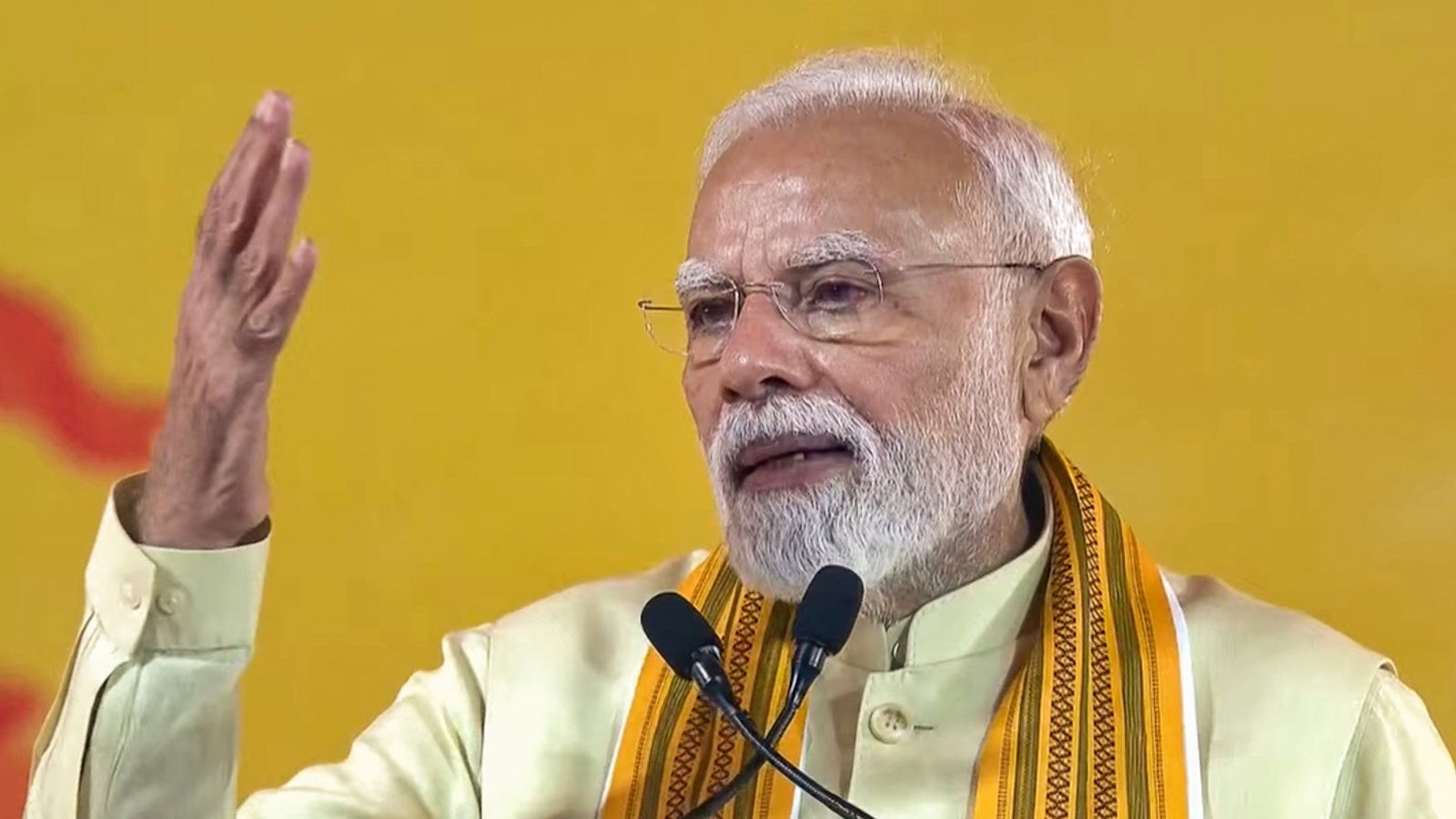
Updated on: Oct 20, 2026, 20:21:36 IST By HT News Desk Prefer HTon Google Share via Copy link Prime Minister Narendra Modi on Tuesday invoked the ideals of Lord Ram to call for good governance, social equality and national unity, urging citizens to work collectively towards a developed India and stand firm against forces that seek to divide society or undermine the country’s cultural identity.
Prime Minister Narendra Modi speaks during the Vijaya Dashami celebrations organized by the Shri Ramlila Committee Indraprastha at IP Extension, in New Delhi. (@NarendraModi) Addressing Vijayadashami celebrations organised by the Shri Ramlila Committee Indraprastha at the DDA Utsav Ground in IP Extension, Patparganj, east Delhi, Modi said the festival represented more than the victory of Lord Ram over Ravana.
It embodied the triumph of truth over falsehood and reaffirmed the enduring relevance of the principles that guided Lord Ram’s life.
The Prime Minister’s address connected religious tradition with his government’s development agenda, presenting the concept of Ram Rajya as a model of administration centred on justice, public welfare and equal treatment.
He also emphasised the importance of preserving India’s civilisational heritage and called for collective resolve in protecting the country’s interests.
Modi said Lord Ram’s significance lay not merely in his defeat of Ravana but also in the ideals he established through his conduct, particularly his commitment to truth and righteousness despite facing formidable challenges.
“Lord Ram faced many difficulties in his life, but he never abandoned the path of truth and morality,” he said.
Recalling Lord Ram’s interactions with Nishadraj and Shabari, Modi highlighted the values of compassion, affection, dignity and social harmony.
He said these episodes illustrated a model of society in which differences did not determine a person’s worth and everyone received respect.
The Prime Minister invoked the ideal of Ram Rajya to underline his vision of governance, saying administration should be free from discrimination and focused on public welfare rather than narrow interests.
He cited the familiar formulation associated with Goswami Tulsidas that Ram Rajya was a society free from suffering caused by physical, divine and worldly forces.
The emphasis on justice and welfare placed the ideals of the Ramayana within the framework of contemporary governance.
Modi called on citizens to serve the poor and disadvantaged, invoking the principle of nagrik devo bhava — treating citizens with the reverence accorded to the divine.
Collective resolve for Viksit Bharat Modi also drew a parallel between Lord Ram’s journey to Lanka and India’s ambition to become a developed nation.
He said the challenges confronting the country should not weaken its determination, arguing that success depended on sustained effort, the judicious use of resources and an unwavering commitment to objectives.
“The difficulties on the path cannot defeat us,” was the central message of his remarks on perseverance and resolve.
He said Lord Ram’s determination to reach Lanka, despite the formidable obstacles involved, demonstrated the importance of clarity of purpose and collective strength.
The Prime Minister presented these qualities as essential to achieving the goal of Viksit Bharat, or developed India, while ensuring that development translated into public welfare.
The reference to collective effort was a key thread running through the speech.
Modi said a nation progressed when its people developed a sense of mutual respect and pride in their heritage, suggesting that national advancement required both material development and a shared cultural consciousness.
Heritage and cultural identity The Prime Minister highlighted efforts to recover India’s cultural treasures taken abroad, saying the country was bringing back its heritage after centuries in which valuable artefacts had been removed.
He also referred to the recognition of Indian sites on UNESCO’s World Heritage list and the inclusion of Indian traditions in the organisation’s list of intangible cultural heritage.
These developments, he said, reflected the country’s growing commitment to preserving and presenting its cultural inheritance.
The remarks placed cultural preservation alongside economic and social development as components of India’s national progress.
Modi’s argument was that a country’s confidence in its future was strengthened by recognition of its past and the protection of its historical legacy.
Call to stand together In a politically sharper portion of the address, Modi called for unity across institutions and political parties in the national interest.
He referred to the principle of collective thinking and shared purpose, urging people to set aside differences when the country’s interests were at stake.
He also asked citizens to identify and oppose forces that, in his words, sought to harm the country’s honour, divide society or foster hatred towards Indian culture.
The appeal gave the traditional festival a contemporary national message: the victory of good over evil, he suggested, required not only symbolic celebration but also a common commitment to protecting social cohesion and national interests.
Modi concluded by reiterating the need for collective resolve and expressing confidence that the country would fulfil its ambitions.
He linked the message of the Ram temple in Ayodhya with the broader idea of nation-building – with good governance, cultural revival, social harmony and the pursuit of a developed India, invoking the vision of moving from Ram se Rashtra, Dev se Desh — from Lord Ram to the nation, and from the divine to the country.
Operating round the clock, the desk brings together experienced editors, reporters and correspondents to deliver fast, accurate and contextual reporting across subjects that influence public policy, governance, business, society and international affairs.
The HT News Desk covers politics, elections, government policies, the economy, business and markets, science and technology, the environment, law and order, infrastructure, education, climate issues and geopolitics, while closely tracking developments across states, institutions and global capitals.
The team also leads coverage of major breaking news events, policy announcements, court proceedings, natural disasters, public emergencies and significant international developments.
Reports published by the newsdesk are based on information gathered from reporters on the ground, official statements, government agencies, court records, regulatory filings, recognised institutions and other authoritative sources.
Stories undergo editorial scrutiny and verification processes to ensure accuracy, fairness and relevance, and are updated as events evolve and additional information becomes available.