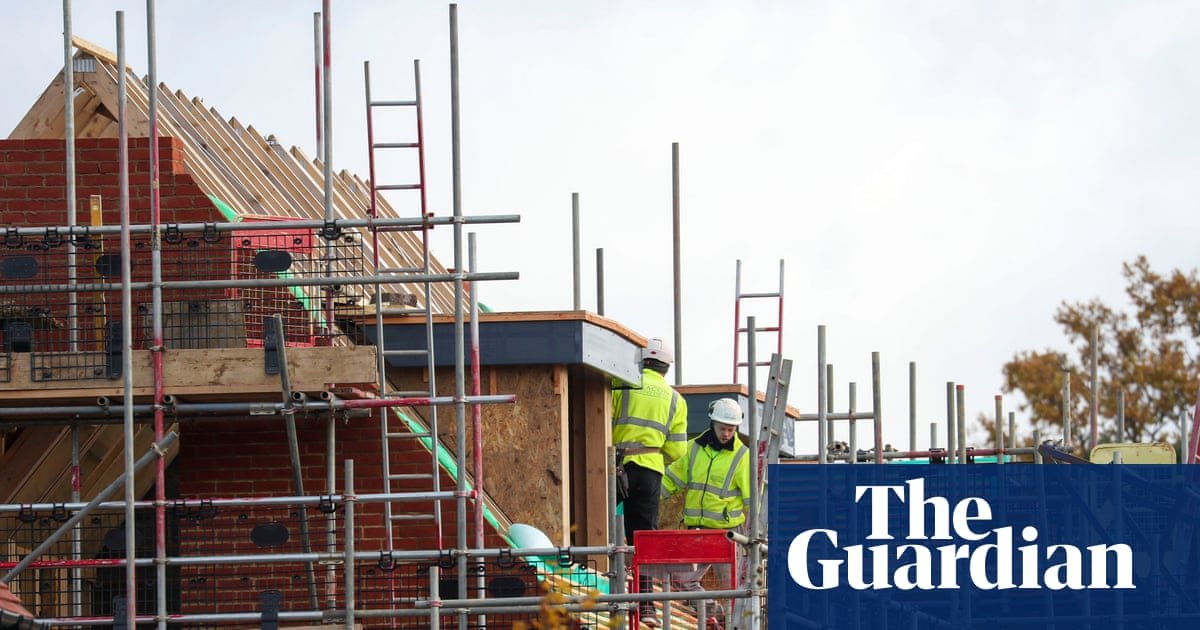
Persimmon said profits were already up 15% for the first six months of its year, with a 13% rise in new homes built.
Firm lifts outlook, saying it is well placed to benefit from PM’s focus on new homes despite cost pressures from Iran war The UK housebuilder Persimmon has lifted its outlook for the full year, saying it is “well-placed” to benefit from the prime minister Andy Burnham’s policy agenda, despite growing costs linked to the Iran war.
As confidence rises across the housebuilding sector, Persimmon plans to complete 12,500 new homes by year-end, which would be at the upper reach of its previous guidance.
The housebuilder is now hoping to benefit from Burnham’s policy programme, including plans to increase housing and slash costs for cash-strapped consumers.
“Persimmon remains well-placed to drive further growth through our unique set of capabilities,” the company said.
“The UK housing market continues to experience both a long-term undersupply of housing and affordability challenges for new homeowners, which is a key focus for the new government.
“As the most cost-efficient national housebuilder, with a clear focus on customer value and affordability, a growing land pipeline and expanding outlet network, we are well-placed to respond.” The FTSE 100 company told investors on Thursday that pre-tax profits were up 15% for the first six months of the year to £168m, after a 13% rise in the number of homes built over the same period.
That was despite “challenging” market conditions, given the rise in building costs, and with many consumers still struggling to afford homes.
Persimmon added that cost pressures were likely to grow in coming months.
“We expect additional inflationary pressure in 2027 including as a result of the conflict in the Middle East,” the company said in a market update.
However, the housebuilder said that even its own focus on low costs and its efforts to make the business more efficient might not be enough to fully offset inflation.
“We have taken additional management actions to secure further cost savings, including identifying procurement savings, specification optimisation, house-type design, overhead savings and operational efficiencies,” the company added.
Optimism across the UK construction sector rose last month, according to data from S&P Global on Thursday.
The data and analytics company found that “hopes of a rebound in domestic economic conditions and signs of an improved near-term outlook for customer demand” had lifted builders’ confidence.
Output across the sector fell again in July, but at the slowest rate in four months, with housebuilding, commercial construction and civil engineering all recording a smaller drop in business activity than in June.
“July data suggests that the performance of UK construction sector has started to stabilise after a sharp downturn throughout the second quarter of 2026,” said Tim Moore, the economics director at S&P Global Market Intelligence. skip past newsletter promotion after newsletter promotion “Business activity levels continued to decline in all three main categories, but in each case the rate of contraction was much slower than in June.
This was supported by the weakest reduction in new business intakes since September 2025,” Moore added.
Burnham has put Britain’s housing crisis at the centre of his domestic agenda, promising to oversee the “biggest council housebuilding programme since the postwar period”.
Economists have said geopolitical uncertainty, economic conditions and high borrowing costs are all dampening the housebuilding sector.
Carly Thorpe, the construction and engineering partner at the law firm Walker Morris, said the sector also continued to face structural barriers.
“Delays in Building Safety Regulator gateway approvals is slowing project delivery, while persistent skills shortages are placing pressure on capacity, costs and timescales across the industry,” she said.
“There are, however, reasons for cautious optimism.
Slower rates of contraction and the government’s focus on planning reform, infrastructure investment and greater regional powers should help boost sector optimism and unlock growth.
But if the industry is to turn housing demand into housing delivery, it will also need faster approvals, more skilled workers and improved affordability.” Explore more on these topicsPersimmon Construction industry Real estate Housing market Housing Inflation news Share Reuse this content