While referees tend to reach for red early in the season before easing off, players are under increasing pressure to keep pace in a frenetic environment
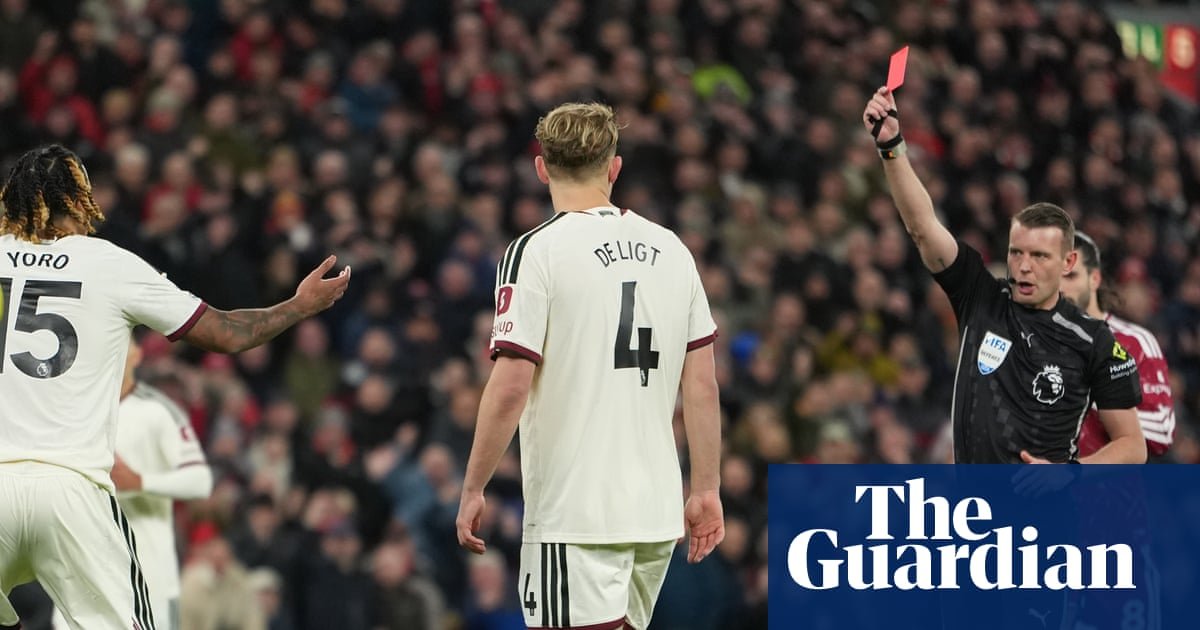
Off! Off! Off! The past three Premier League games have featured a red card, each for a different reason. Brighton’s Costinha was sent off for two bookings at Hull, Leny Yoro collected a red card against Liverpool for denying a goalscoring opportunity (though his suspension was overturned on appeal) and James Tarkowski saw red for serious foul play at Brentford.
This season is shaping up to be an outlier in the VAR era of officiating in English football. The latest red cards took the Premier League total to 22 in 2026-27. The rate of 0.2 per game equates to 76 across the whole season, which would equal the Premier League record set in 2005-06. Refereeing has evolved in the past decade, though. The average across the seven completed campaigns since VAR was introduced is 0.12 per game, with a high of 0.15 in 2023-24.
History suggests the frequency will decrease. It can feel as if referees are keener to exert their authority and clamp down on wrongdoing at the start of a season before calming down.
There have been nine previous Premier League seasons that averaged at least 0.2 red cards per game over the opening 11 matchweeks. The rate dropped between that point and the end of the campaign in every example.
However, only one of those seasons occurred with video assistant referees highlighting indiscretions unseen or underrated by the on-field officials. Six of the 13 straight red cards this season have been thanks to intervention from Stockley Park, with Jean-Philippe Mateta, Igor Thiago and Tarkowski having a booking upgraded after review.
The first two of those three are part of another trend, along with Kevin Danso, Phil Foden and Yoro. They were sent off within the opening quarter of games this season, meaning 2026-27 is one shy of the season-long record of six dismissals before this time bar. Rodrigo Bentancur and Ryan Sessegnon have been shown straight red cards 12 minutes after coming on as substitutes too.
Logic dictates the hot spell of early dismissals will end. The overall rise in red cards stands a greater chance of holding because Premier League football is played at such a frantic pace. Mistakes are common in this environment, with one slightly mistimed challenge potentially all that is required to draw the red from the referee’s pocket. Several other metrics hint at why the chances of a side going down to 10 have increased.
Costly mistakes are occurring more readily. Opta tracks defensive errors that lead to an opposition shot. The average across the past decade was 1.1 per game, yet Premier League clubs are committing 2.1 errors per match in 2026-27, an unprecedented rate. Even though the conversion percentage for this type of chance is below the long-term average this season, the sheer volume of shot-generating blunders means the number of goals from errors (0.56 per game) is higher than ever before.
Players are having to act and react more quickly under the pressure that the preference for man-to-man over zonal marking in open play has brought. Opta’s metric for when a player miscontrols the ball is on the rise as a result. This is reflected in an increase in ball recoveries from last season, as possession is changing sides more frequently. Premier League shots from counterattacking moves have never been as frequent or represented a greater proportion of the total in the data era.
Higher pressure, higher speed football has increased the probability of cards. Which player will be first to be sent off this weekend? It looks inevitable that someone will walk.