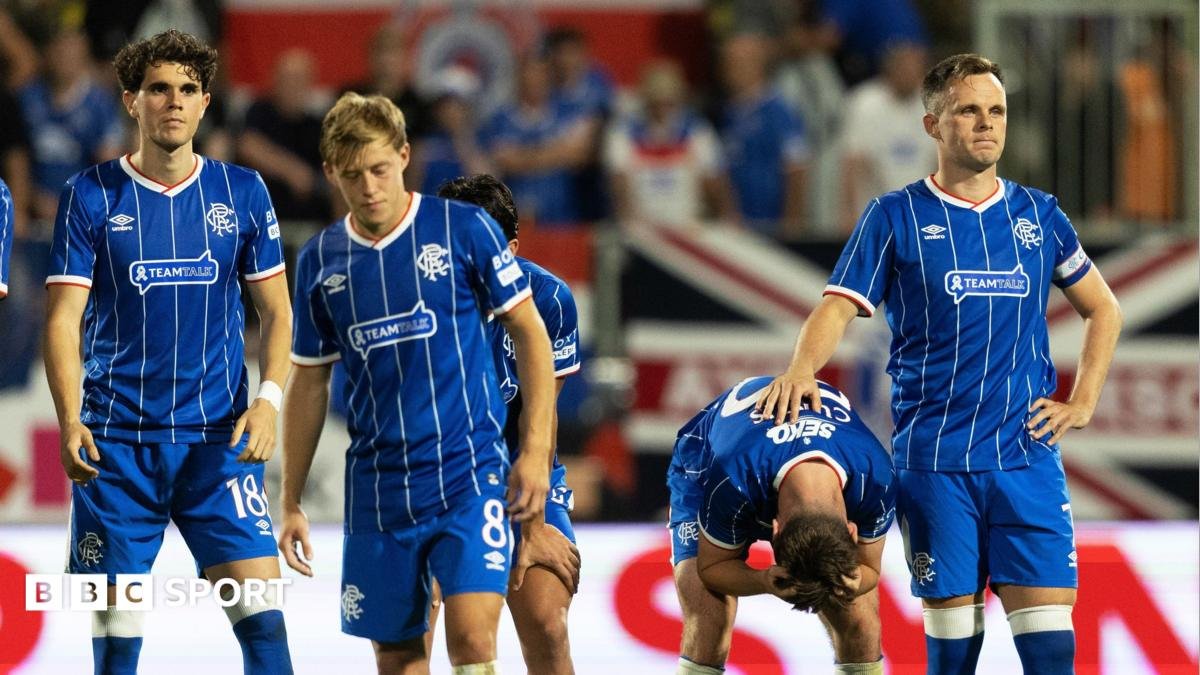
Image source, SNS Image caption, Rangers' European interest has finished before September ByDale Johnson Football issues correspondent Published 33 minutes ago ByGeorge O'NeillBBC Sport Scotland After Jablonec's Jan Chramosta converted from the penalty spot to confirm Rangers' European exit on Thursday, the immediate reaction from the away end was one of understandable anger.
Manager Derek McInnes said he was "embarrassed" and "disappointed" by both the performance and the result as his difficult start at Ibrox continued.
Just one shot on target in 120 minutes against a team they were firm favourites to beat, multiples changes of shape and a multitude of signings failing to have an impact.
But what exactly are the consequences of Rangers missing out on European football this season, both on and off the pitch?
What is financial cost of no European football?
Figure caption, 'That wasn't football' - Halliday reacts to Rangers' exit One of the main benefits of playing European competitions is the financial boost it provides.
Rangers finishing third in the Scottish Premiership last season meant they did not have the opportunity to qualify for the Champions League and they were knocked out of Europa League qualifying by Polish side Jagiellonia Bialystok in a further blow.
However, they still had the chance to reach the Conference League - admittedly, the least prestigious and least lucrative of Uefa's three club competitions.
Teams that qualify for the league phase of the Conference League receive about £2.72m, with about £343,000 more for every win at that stage.
There is a further £114,000 for a league-phase draw.
There are then exponential rewards for reaching the knockout stages and each win from there on.
Last season's Conference League winners Crystal Palace received at least £15m from the competition, plus the bonus of qualifying for this season's Europa League.
There is also the knock-on effect of fewer matchdays and therefore fewer tickets sold, as well as hospitality and corporate packages.
Holes in the squad and lack of style - will spending continue?
Figure caption, 'Rangers have spent £50m and made team worse' It remains to be seen if Rangers' summer spending spree will be curtailed by defeat in the Czech Republic.
The Ibrox outfit continue to be linked with a big-money move for Portland Timbers striker Kevin Kelsy, as they try to replace the injured Youssef Chermiti up front.
Another winger also appears to be a priority, with talks reportedly ongoing with Brighton for Amario Cozier-Duberry.
Daisuke Yokota and Kim Min-su have already arrived to join wide players Ross McCausland, Findlay Curtis and Djeidi Gassama.
Might influential midfielder Nicolas Raskin - who did not travel to Jablonec - be sold to fund more new players?
What is clear, Rangers in their current guise do not look capable of challenging for silverware this term.
"When you look at the performance, it is nowhere near good enough, but not a result I didn't expect," former Hibernian and Celtic midfielder Scott Allan said on the BBC's Scottish Football Podcast.
"He literally said himself the team doesn't know what it is.
And ultimately that falls on Derek McInnes and what they're doing on the training pitch.
"He talked about elite preparation - the performance was anything but that.
If we're totally honest, they're devoid of quality.
"Rangers weren't playing against a top side.
That's a game, with what Rangers have spent, they should be coming through quite comfortably." Podcast: From European agony to weekend Premiership pressure 28/08/26 Listen on Sounds One saving grace might be fewer games helping sharpen Rangers' focus in domestic competitions.
Title favourites Celtic will have to navigate at least eight matches in the Europa League, while Hearts - who also finished above Rangers last season - succeeded where Rangers failed and reached the Conference League proper, where they have at least six games.
'Bleak picture' for Scotland's coefficient It's a bleak picture for Scotland and its Uefa coefficient.
After being ranked as high as ninth between 2021 and 2023, at the end of last season Scotland had plummeted to 18th.
This is important because it determines how many places a league gets in Europe each season - and in which competitions.
For instance, last season's placings in the Scottish Premiership earned five places in Europe.
For this season going into next, it's down to four.
Scotland is now down to one place in the Champions League, starting in the early rounds.
To get places back, Scotland needs to get back into the top 15.
But this week's disastrous results mean there's no chance of that.
Celtic being knocked out of the Champions League and going into the Europa League did not really matter, as it's easier to get results in the secondary competition.
But three of the other teams being knocked out of Europe means there's only a small chance of climbing up the coefficient table.
Historically, Scotland has relied upon the Old Firm for its European results.
So Rangers being eliminated is a huge blow.
Now, Hearts will have to step up and make it deep into the Conference League, results in which are worth far fewer coefficient points.
Scotland has already dropped to 19th in the live standings but would need to drop to 34th for the current allocation to be impacted.
That cannot happen.
But the gap to 15th is considerable and Scotland would need their best ever season to bridge it.
The good news is, at the end of this season, the 2022-23 season drops off the five-year calculation.
And that was one of Scotland's worst seasons.
But if teams continue to fail in the qualifying rounds, Scotland will struggle to reclaim places in Europe.