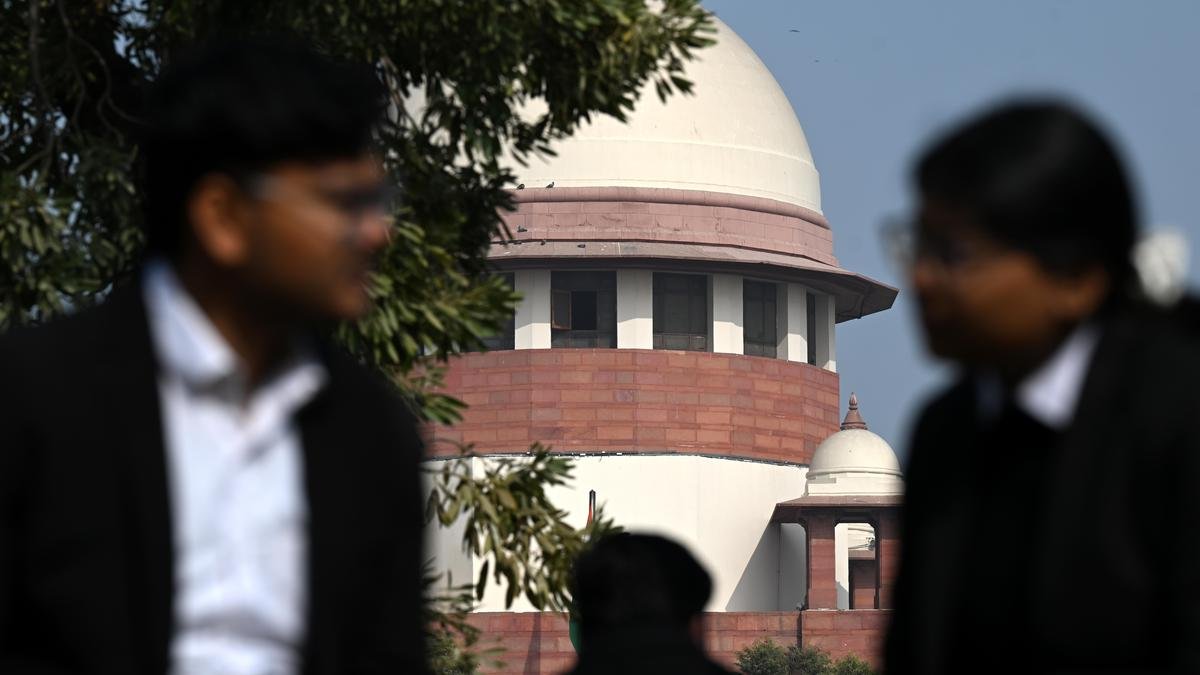
The Supreme Court on Wednesday (July 22, 2026) said interference with bail orders is warranted only where the continuation of liberty is “so egregious that it undermines the administration of justice”. Deprecating the routine practice of challenging bail orders before it under Article 136 of the Constitution, the court said its extraordinary discretionary jurisdiction ought to be invoked only in exceptional cases.
The oral observations were made by a Bench comprising Chief Justice of India Surya Kant and Justices Joymalya Bagchi and V. Mohan while hearing petitions filed by the Enforcement Directorate (ED) and the Chhattisgarh government challenging the bail granted by the Chhattisgarh High Court in January to Chaitanya Baghel, son of former Chhattisgarh Chief Minister Bhupesh Baghel, in cases arising out of an alleged liquor scam.
Addressing senior advocate Mahesh Jethmalani, appearing for the State government, Justice Bagchi questioned whether the apex court, while exercising its jurisdiction under Article 136, should examine every alleged legal infirmity in a bail order and curtail an individual’s liberty on that basis alone. “When the court interferes under Article 136, it does so on the anvil of whether the continuance of liberty is so egregious that it affects the administration of justice. Is it the correct approach, particularly for a court of last resort, to treat the legal artistry of a bail order as the sole and only test for depriving a person of liberty?” Justice Bagchi said.
Expressing concern over the apex court’s burgeoning docket of petitions challenging bail orders, the judge underlined that Article 136 jurisdiction was never intended to function as an ordinary power of judicial review but as a “repository of justice” for interpreting the Constitution.
“We should dig deeper. Notwithstanding any illegality in a bail order, the question is whether the scales of justice warrant depriving a person of liberty on that basis alone... High Courts should ordinarily be the final arbiters of bail appeals,” he added.
Remarks expunged
Acknowledging the Bench’s concerns, Mr. Jethmalani nevertheless contended that the High Court’s order was “perverse” and that Mr. Baghel had been granted bail on “flimsy grounds”. He also objected to the adverse remarks made by the High Court against the State’s Economic Offences Wing, which is investigating the alleged liquor scam.
“He is influential, he is the son of a former Chief Minister... Your Lordships should at least expunge those remarks; otherwise, there will be great injustice to the investigating agency,” he submitted.
Agreeing that the remarks against the investigating agency were “uncalled for”, the Bench ordered them to be expunged from the High Court’s order but declined to interfere with the grant of bail to Mr. Baghel.
The Bench, however, clarified that all questions of law would remain open to be agitated before the concerned trial court at the appropriate stage.
Najeeb precedent
During the hearing on Wednesday, Justice Bagchi also praised the precedent laid down in Union of India versus K.A. Najeeb, authored by CJI Surya Kant in 2021, while heading a three-judge Bench as a Supreme Court judge at the time. Justice Bagchi remarked that the ruling had come as a relief for courts trying to reconcile the stringent statutory restrictions on bail under anti-terror laws with the constitutional guarantee of personal liberty under Article 21.
The apex court had held that prolonged incarceration and undue delay in trial could “melt down” the statutory restrictions on bail under Section 43D(5) of the Unlawful Activities (Prevention) Act (UAPA), 1967, which bars the grant of bail where there are reasonable grounds to believe that the accusations are prima facie true.
Senior advocate Mukul Rohatgi, appearing for Mr. Baghel, however, was quick to point out that despite the “pathbreaking” ruling having authoritatively settled the law, courts had continued to distinguish it instead of faithfully applying its mandate. “The irony is that despite the path-breaking judgment, some courts still want to distinguish it... They have not followed the mandate of the judgment. We still have to keep struggling, whether in the High Courts or, I am sorry, My Lords, sometimes even in this court,” he said.
Mr. Rohatgi was referring to a May 2026 order of a Division Bench led by Justice Aravind Kumar, which had referred to a larger Bench the question of whether prolonged incarceration and delay in trial can override the stringent bail restrictions under anti-terror statutes such as the UAPA. It observed that the Justice Aravind Kumar-led Bench had failed to correctly apply the binding principles laid down by the larger Bench in the Najeeb judgment.
The reference came days after another coordinate Bench headed by Justice B.V. Nagarathna expressed “serious reservations” about the January 5, 2026 judgment refusing bail to Jawaharlal Nehru University scholars Umar Khalid and Sharjeel Imam in the alleged larger conspiracy case arising out of the 2020 Delhi riots. The Bench had observed that the January 5 ruling by the Justice Kumar-led Bench had failed to correctly apply the binding principles laid down by a larger Bench in the Najeeb case.
‘Foolproof conviction’
Acknowledging the concern, the CJI remarked that even High Courts had begun adopting increasingly rigid approaches to bail. The Bench also pointed out that prosecutors should focus on securing convictions rather than routinely challenging orders granting bail.
“If a prosecutor and an investigator invest so much in interlocutory liberties, their ultimate duty to secure a conviction is lessened. You can justify, on grounds of social accountability, that continued undertrial detention is needed, but at the same time, you absolve yourself of the higher responsibility of ensuring a foolproof conviction,” the Bench said, adding that conviction rates in terror and money laundering cases had declined significantly.
Mr. Baghel was arrested by the ED on July 18, 2025 in connection with the alleged ₹2,833-crore liquor scam. On December 22, the Chhattisgarh Economic Offences Wing filed a chargesheet alleging that he had received ₹200-250 crore between 2019 and 2022, when his father, Mr. Bhupesh Baghel, was the Chief Minister of the State. The ED, meanwhile, has alleged that Mr. Baghel personally handled nearly ₹1,000 crore in proceeds of crime generated through the scam.
Besides Mr. Baghel, the chargesheet names former Excise Minister Kawasi Lakhma, accused of approving the excise policy and receiving proceeds of crime; former Deputy Secretary in the Chief Minister’s Office Saumya Chaurasia, alleged to have coordinated the illicit cash network and managed the posting of compliant officials; and Anwar Dhebar, brother of Raipur Mayor and Congress leader Aijaz Dhebar, who has been described as the alleged mastermind of the scam.
Granting bail to Mr. Baghel in January, the High Court had observed that the prosecution’s case rested largely on broad assertions of his influence and proximity to the alleged conspiracy rather than any specific acts attributable to him. “Viewed cumulatively — absence of the applicant’s name in the FIR (First Information Report), consistent non-arraignment in first chargesheet and thereafter five supplementary chargesheets, lack of recovery, completion of investigation, grant of bail to similarly placed co-accused, procedural lapses on the part of the investigating agency, and the inevitability of a protracted trial — this Court finds no compelling reason to curtail the applicant’s liberty any further,” Justice Arvind Kumar Verma had observed.