The Patriots owner’s decision to ban the rapper from performing at the team’s stadium brings back memories of the blackballing of Colin Kaepernick
Six years ago, in the middle of a “racial reckoning” that never was, a White House that had begun out of control reached its chaotic apex. Federal officials were sweeping citizens off American streets in unmarked vehicles, surrounding the Lincoln Memorial with armed guards and rolling military vehicles through residential neighborhoods in a fascist reaction to protests against the murder of George Floyd. It was at this point that NFL commissioner Roger Goodell, realizing it had all gone too far, appeared on a Zoom and admitted his league was “wrong” for not listening to its players when they had protested against police brutality.
The implication was clear: more than any other sports league, the NFL was harshest in its reaction to the protests that began with Trayvon Martin in 2012 and continued with Ferguson, Baltimore, and Colin Kaepernick. By blackballing Kaepernick, sitting by while broadcast partners refused to air the national anthem to undermine the protests, and, most embarrassingly, Goodell’s draconian announcement that teams would be subject to fines if players showed dissent, the NFL had proven itself to act in the most un-American of ways.
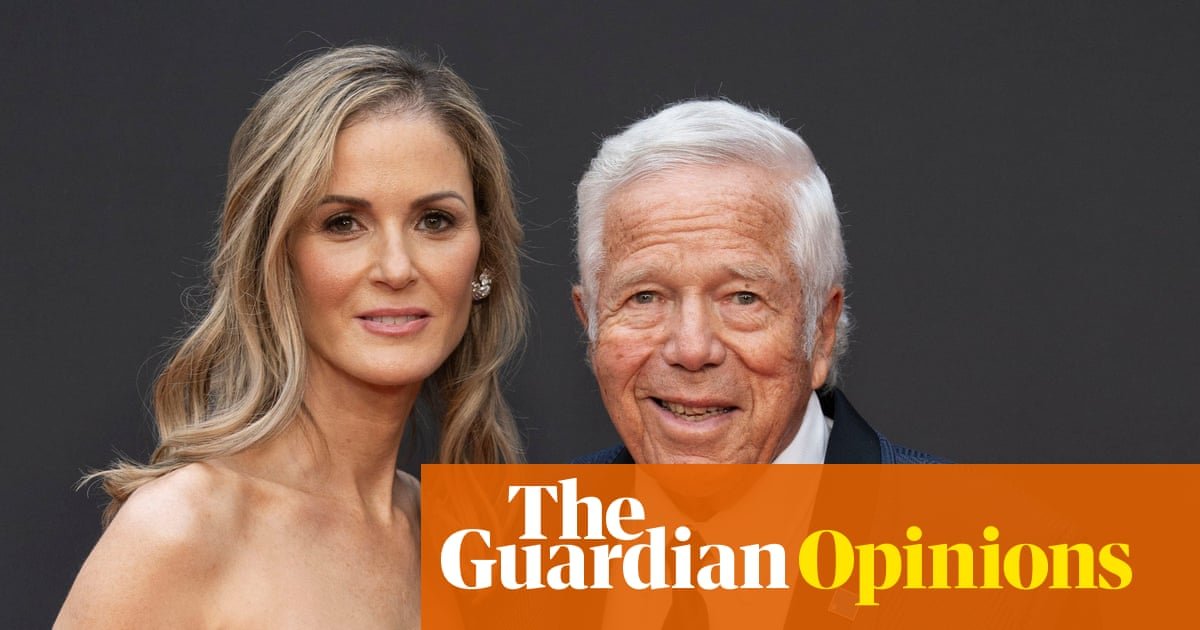
This week, New England Patriots owner Robert Kraft showed he has learned nothing from those years. He banned Macklemore from supporting Ed Sheeran at the Patriots’ Gillette Stadium over the rapper’s vocal support for Palestine – something that has become a career-threatening political position as dangerous as kneeling during the national anthem. Kraft imposed his own version of authoritarianism: Macklemore claims that Kraft not only banned him from his stadium, but appeared to influence other NFL owners to stop the rapper from appearing at most of Sheeran’s other stadium dates. For his part, Kraft says his decision to stop Macklemore from performing at Gillette was due to both Macklemore’s “recent actions” and “a broader history of antisemitic rhetoric and imagery that we believe has been deeply offensive and hurtful to the Jewish community”. In 2013, Macklemore apologized after he wore a wig, beard and hooked nose at a Seattle concert, which critics said was an anti-semitic caricature.
No NFL owner has worked harder to be seen as reasonable and socially conscious as Kraft. He has appeared on the surface as a shrewd businessman, power-neutral, making political donations to Republicans and Democrats alike. New Englanders recall him fondly as the man who rescued the Patriots from the misogyny and vile incompetence of the Victor Kiam years; from the threat of the team relocating to St Louis when he bought the Patriots from James Orthwein in 1994; and, of course, the man who saved them from all the losing.
Kraft was eventually given the benefit of the doubt as the hero in his stadium battle against disgraced former Massachusetts legislature speaker Thomas Finneran that nearly led to Kraft moving the Patriots out of the Commonwealth. He did so by building the only 100% privately financed stadium in the NFL – even though in 1998 Kraft himself had agreed to take a lucrative offer of public money from the Connecticut legislature and move the Patriots to Hartford. It was under Kraft’s ownership – led by his late wife Myra – that the Patriots took a stand for women, renouncing the rights to Christian Peter a week after drafting him, when multiple domestic violence accusations and convictions against the player surfaced.
As the NFL collectively destroyed Kaepernick’s career (the former quarterback says the same tactics of collusion are now being used against Macklemore), it was Kraft who tried to appear sympathetic to those who suffered under systemic racial injustices. He supported Patriots Devin and Jason McCourty in their advocacy of criminal justice reform, helped on the release from prison of rapper Meek Mill, and following the deadly 2018 school shooting in Parkland, Florida, it was Kraft who loaned the Patriots’ plane to students traveling to Washington to protest gun violence. Despite a president who called the pandemic a hoax and encouraged citizens to inject bleach to immunize themselves against Covid 19, Kraft sent his private plane to China to help transport shipments of N-95 masks to the United States. Bob Kraft has always believed he’s one of the good guys.
In the Macklemore situation, he is not. While he has been lauded by his supporters, all Kraft has done is follow a familiar script of a rich man applying power. He has undermined his everyman persona as a guy who sat on the cold metal seats at Schaefer Stadium alongside his fellow Patriots fan but was fortunate enough to eventually buy the team. Now he is just another billionaire using his power to stifle words – to do exactly what his fellow owners did to Kaepernick a decade ago. Nor should it be forgotten that no matter how many rappers treat Kraft like the cool old white dude, Bob Kraft, hater of hate speech, lover of peace, Is a prominent part of a league that conspired to ban a player from playing football for telling the truth: Cops are getting paid leave for killing people. That’s not right. Hardly hate speech.
The end result is an old man threatened, unable to maintain the facade that he is any different, any better, than the moral rot around him. While truth often belongs to those who get to tell the tale, who control the airwaves, who get to do the blackballing and destroy the careers, it also belongs to the silenced. Both the overstepping Kraft and the tattered Sheeran – whose opening acts have resigned from the tour in solidarity with Macklemore – know that now. One looks like a dictator, the other a wimp.
Kraft is also displaying a perverse, pervasive strain of American exceptionalism normalized by Donald Trump where might makes right. His supporters have attempted to argue that Kraft hasn’t violated the first amendment over Macklemore because he owns Gillette Stadium, the land under it, and paid for it with his money rather than with public funds that would be better spent on potholes, bridges and better schools. Along those narrow grounds, Kraft can certainly decide who gets to say what on his property – although even that argument is a specious one if he cares about community and not oligarchy. By then extending his influence from his private bubble of Foxborough to allegedly use his influence to blackball Macklemore from the rest of Sheeran’s tour by calling ahead to Philadelphia, Dallas, Miami, Charlotte, Indianapolis and Atlanta, Kraft engaged in yet another collusion, for each of those venues are largely publicly financed. They do not belong privately to Kraft, or the rest of the football oligarchy, but to the taxpaying public. Public space is protected by the first amendment. Kraft has either forgotten what the pregame flags and flyovers are supposed to be about, or like so many other foundations in this country, has simply decided to stop caring.
Where does Kraft stand today? The lover of peace and hater of hate speech is now backpedaling, remembering his position as one of the good guys, offering to throw money at the bad publicity – a $2m donation to unspecified charities in the Middle East without reinstating Macklemore – but he really stands with Trump, that most seasoned practitioner of hate speech, who once called Kaepernick and the NFL players who smash their bodies into a million pieces every Sunday “sons of bitches.”
Kraft gave Trump $1m for his first inauguration then said in 2024 that he hadn’t spoken to the president since the January 6 attack on the Capitol. But there he sat this January in the Kennedy Center presidential box next to Trump for a screening of the Amazon Studios bomb Melania. As Trump petulantly destroys the arts, Kraft’s wife Dana Blumberg sits on the Kennedy Center board, part of the unanimous vote to close the center unless Trump’s name is added to the building. Kraft has his name on another blackballing, but he’s headlining the marquee this time. For people who decry anti-democratic behavior, the Krafts seem comfortable in its company and quick studies at mastering it themselves. They’ve had a lot of practice.
Howard Bryant is the author of 11 books, including Full Dissidence: Notes from an Uneven Playing Field, and Kings and Pawns: Jackie Robinson and Paul Robeson in America. He also writes on Substack