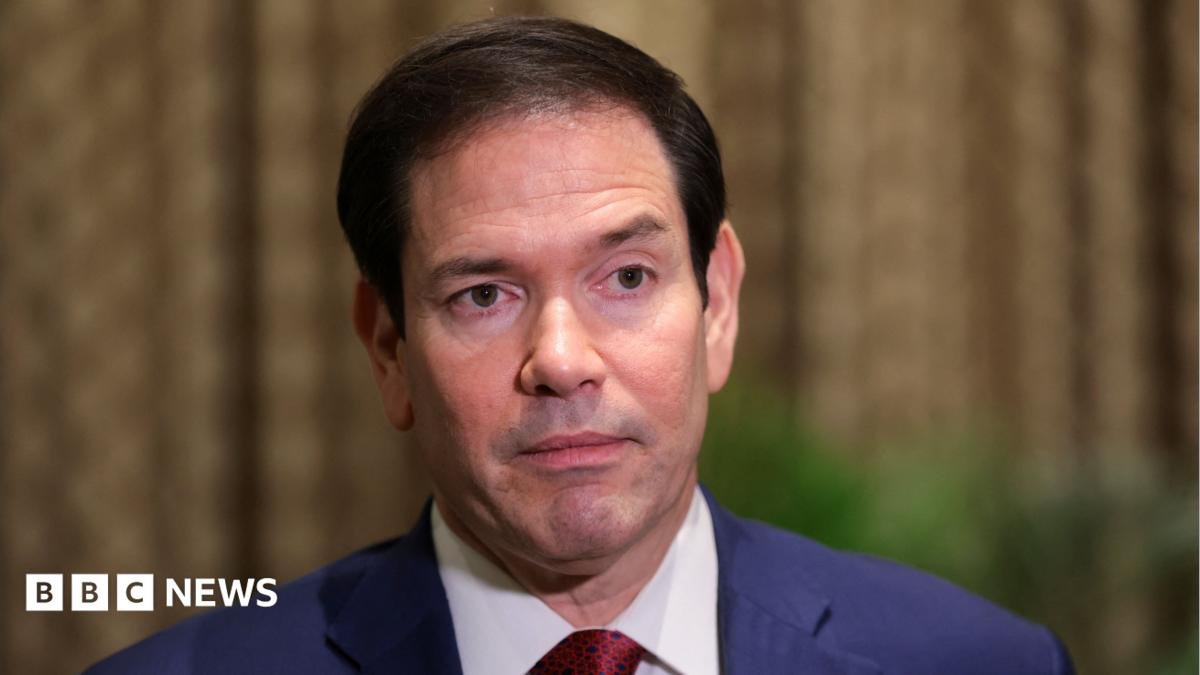
Image caption, US Secretary of State Marco Rubio was in India this week ByNikita Yadav & Rachita PrasadBBC News Published 1 hour ago The western Indian port town of Jamnagar is not a usual stop for foreign leaders, yet it featured prominently in US Secretary of State Marco Rubio's recent visit.
So, why did Rubio visit the town?
And, more importantly, why did he skip the Indian capital, Delhi?
The answer to both questions may have less to do with India and more to do with Donald Trump administration's domestic compulsions – or, more precisely, its domestic oil needs.
Rubio arrived in the financial capital Mumbai on Tuesday, where he met Indian Foreign Minister S Jaishankar and some of the country's top business leaders.
He officially ended his trip in Jamnagar - in the western state of Gujarat - home to the giant oil refinery owned by one of Asia's richest men, Mukesh Ambani.
It was his second trip to the country this year and experts say what is significant this time is the timing of the visit as well as his choice of destinations.
The Trump administration is under pressure to keep fuel prices in check ahead of November's US midterm elections, while rising tensions in the Middle East threaten global energy supplies.
With little new refining capacity expected in the immediate future in the US, India's ability to process large volumes of crude oil offers Washington a potential way to ease pressure on the fuel markets.
And that puts Reliance's Jamnagar refinery at the centre of the equation.
The visit, however, comes at a tricky moment in India-US relations.
Trump has imposed tariffs on Indian goods, there are sanctions against Delhi for buying Russian energy (though currently paused) and there is a trade deal between the two countries that has remained elusive for around 20 months now.
Image caption, Rubio (left) held talks with foreign minister S Jaishankar (right) in Mumbai Announcing the visit, the US State Department had earlier said that it would focus on energy cooperation, commercial investment and economic ties.
The official itinerary also did not include Delhi, which raised some questions, especially from Indian opposition politicians.
But analysts say the choice was strategic.
"Delhi is where the trust gap is largest.
Officials there are unhappy with a number of decisions and policies from Trump's administration," Michael Kugelman, a senior fellow at the Atlantic Council, told the BBC.
But former Indian ambassador to the US, Meera Shankar, cautions against reading too much into him skipping the capital.
"This was primarily an energy-focused visit," she says.
"And after all, Rubio did meet the foreign minister in Mumbai." The meeting between the two foreign ministers at the Taj Hotel covered trade, investment, energy security and defence cooperation, according to official statements.
India's foreign ministry also said both sides welcomed progress in trade negotiations and reaffirmed their commitment to concluding a deal, which has long been in the works.
But once the diplomatic meetings were over, Rubio headed to Jamnagar, where the crown jewel of the Ambani business empire is located.
This came to define the trip.
Shankar says the refinery visit "showed how much importance the US is attaching to getting more refined fuel into the market before the November midterms".
Reliance's Jamnagar complex can process about 1.4 million barrels of crude oil a day, roughly 1.5% of global refining capacity, according to the company website.
It is also a major exporter of diesel and other petroleum products, giving it a crucial role in global fuel markets.
During a tightly controlled visit on Wednesday, with limited media access, Rubio toured the facility and met members of the Ambani family, including Mukesh Ambani.
The company later released a statement, saying, "the visit included wide-ranging discussions on the global energy landscape and opportunities for commercial partnerships across conventional and new energy".
It, however, did not specifically address any commitments to buy crude oil or supply refined products.
Just a day earlier, while speaking to the press, Rubio had called India a "refining superpower" and said the US wanted Reliance to process more Venezuelan oil.
"They have the capability to refine heavy crude.
They've done so in the past, and I think as more and more Venezuelan oil comes online, that's something they could do," he told reporters.
Rubio added that oil from Venezuela "can certainly provide relief" in the short term and can possibly help ease supply pressures amid tensions in the Middle East.
Reliance was once among the largest buyers of Venezuelan crude before US sanctions disrupted trade.
After Venezuelan President Nicolás Maduro was captured in a US intervention earlier this year and Washington eased sanctions on the country's energy sector, Reliance re-emerged as a major importer.
Image source, Sergio Gor/X Image caption, Rubio's visit to the Jamnagar refinery was closed to the media, with images released afterwards by the Reliance Group Experts also say the visit might ease some tensions in the Delhi-Washington relationship over India's purchase of Russian oil.
India became one of the biggest buyers of Russian oil since Moscow invaded Ukraine in 2022.
Between December 2022 and July 2026, it accounted for 37% of Russia's crude oil exports, according to the Centre for Research on Energy and Clean Air (CREA).
And Reliance was among the Indian companies that processed Russian crude.
In August 2025, US President Donald Trump imposed an additional 25% tariff on Indian goods over its Russian oil purchases, taking total tariffs on many Indian goods to 50%.
The US, however, withdrew the additional penalty in February 2026 but India's import of Russian oil has continued to be an irritant in Washington-Delhi ties.
India has always said that securing affordable and reliable energy for its 1.4 billion people was its priority.
Then earlier this month, the US itself temporarily lifted sanctions on Russian diesel.
In that context, experts say Rubio's Jamnagar visit is aligned to three goals that the US appears to be pursuing: reducing India's dependence on Russian crude, encouraging greater imports of Venezuelan and American oil, and advancing a trade deal in which energy cooperation could become a key area of agreement.
There is also another possible business angle behind this push.
Kugelman says Rubio had two reasons to meet the Ambani family.
First, to secure greater refining of Venezuelan oil and second to seek assurances that Reliance remained interested in backing a proposed Texas refinery.
In March, Trump announced a proposed refinery at the Port of Brownsville in Texas on his Truth Social platform.
He said that it would be the first major new refinery in the US in 50 years.
Reliance has not publicly commented on it and there are no details on the project or when the work is expected to begin.
"The Texas facility may not be as immediately important to US interests as the arrangement tied to Venezuelan oil, but I still think it's part of the story," he says.
Image caption, Trump hopes to bring down gas prices as the US heads to midterms next month However, analysts point out that closer cooperation with Reliance and progress on energy security do not necessarily mean a trade deal is imminent.
"I don't think anyone really expected a trade deal to be announced at this point, but this trip seems to have helped get the relationship back on track, to the extent that it can, given the significant points of tension that remain," Kugelman said.
Rajani Sinha, the chief economist at credit rating agency CareEdge, told the BBC that greater cooperation could allay energy security concerns in both countries, help push the stalled trade negotiations forward and "boost trade and sentiment" in India.
Meera Shankar says that India is possibly "waiting for the US to formalise its tariff positions so that we know whether Delhi has a preferential trade deal".
She adds that, although ties between the two countries have been strained in recent times, their bilateral trade continues to grow.
India's merchandise exports to the US was $50.81bn between April and September, up 11.1% from the previous year, according to India's ministry of commerce.
Its imports rose to $32.33bn from $25.66bn in the same period.
India's merchandise trade surplus with the US narrowed to $18.48bn from $20.07bn a year earlier.
"The economic relationship remains strong, but a long period of uncertainty could eventually affect it," Shankar said.
So, for now, the visit may have possibly helped get the relationship back on track, but whether that translates into a trade agreement or a lasting shift in energy ties remains to be seen.