Some online shoppers may have left it too late to order – but you can view partial eclipse indirectly without specs
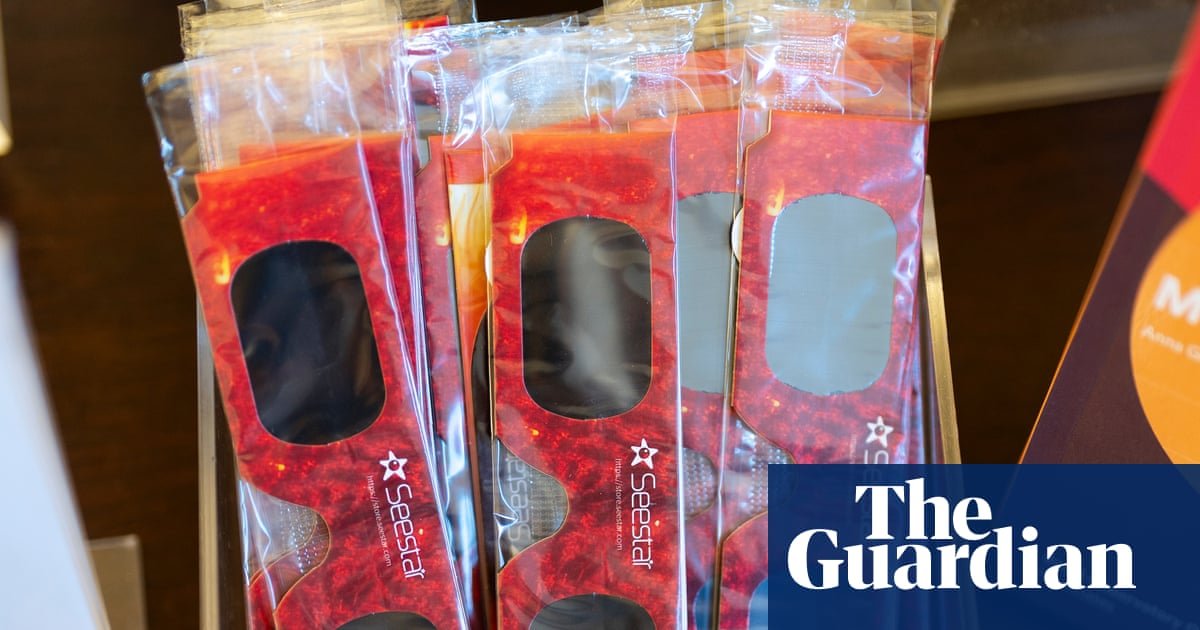
A frantic rush is on across the UK to find the right kind of protective eyewear ahead of Wednesday’s partial solar eclipse.
High street stores are running out of eclipse glasses and online shoppers who track down a pair are being told they may not reach them until the end of the week. In other words, in plenty of time for the next comparable UK eclipse – in 2081 – but no good at all for Wednesday’s show.
The Royal Observatory Greenwich said it was aware of a shortage of glasses. A spokesperson said: “We have sold out of solar eclipse glasses, both online and in our shops, due to an unprecedented volume of orders.”
Ordinary sunglasses are not safe to use and over the last few weeks consumer experts have been recommending specialised glasses. But try to get, for example, a pack of Lunt solar eclipse glasses (£14.99) on Amazon and the dispiriting message “free delivery Thursday 13 August” pops up.
The Robert Dyas store was offering Bresser eclipse glasses for £2.99, but there was an “out of stock” message on its website.
Emma, from Tonbridge in Kent, described her mission to find pairs for herself and three relatives. “They were sold out everywhere,” she said. When she called her local opticians, she received short shrift. “They sounded really angry. I said: ‘I’m calling to see if you have any glasses for the …’ The assistant interrupted and said no and hung up.”
Emma managed to get one from a friend whose forward-thinking mum had bought a multipack. “If we can’t get any more, we’ll have to share,” she said.
Neill Sanders, the founder of Go Stargazing and the UK coordinator of Astronomers Without Borders, said there wasn’t a shortage – it was just that people had not planned ahead.
He said: “I’m getting loads of calls, text messages, emails with people asking ‘do you have some glasses?’. Everyone’s suddenly realising we need glasses for Wednesday.”
Sanders said he had imported 300,000 pairs from the US. He had sent out 100,000 pairs in the last few weeks at discount prices to astronomy clubs and community groups but it was too late to get most of the others out.
Another distributor said: “We have good stocks, our issue is everybody has left it until the last minute to order and we only have so many people we can put into packing at a time.”
Jake Foster, an astronomer at the Royal Observatory Greenwich, said: “If you don’t have a pair of eclipse glasses, you can still view the eclipse indirectly. Any household item with small round holes in it, such as a colander or even a piece of paper with a small hole poked in it can project an image of the eclipse on to a flat surface.
“Don’t look at the sun itself but instead at the shadow that’s being produced – you should be able to see the shape of the eclipse within it.”
After the 1999 total solar eclipse, the Royal College of Ophthalmologists reported about 70 cases of people experiencing vision problems from watching it.
The UK Health Security Agency and the royal college have issued detailed advice on their websites on the sort of glasses that are safe and other ways of watching the eclipse.