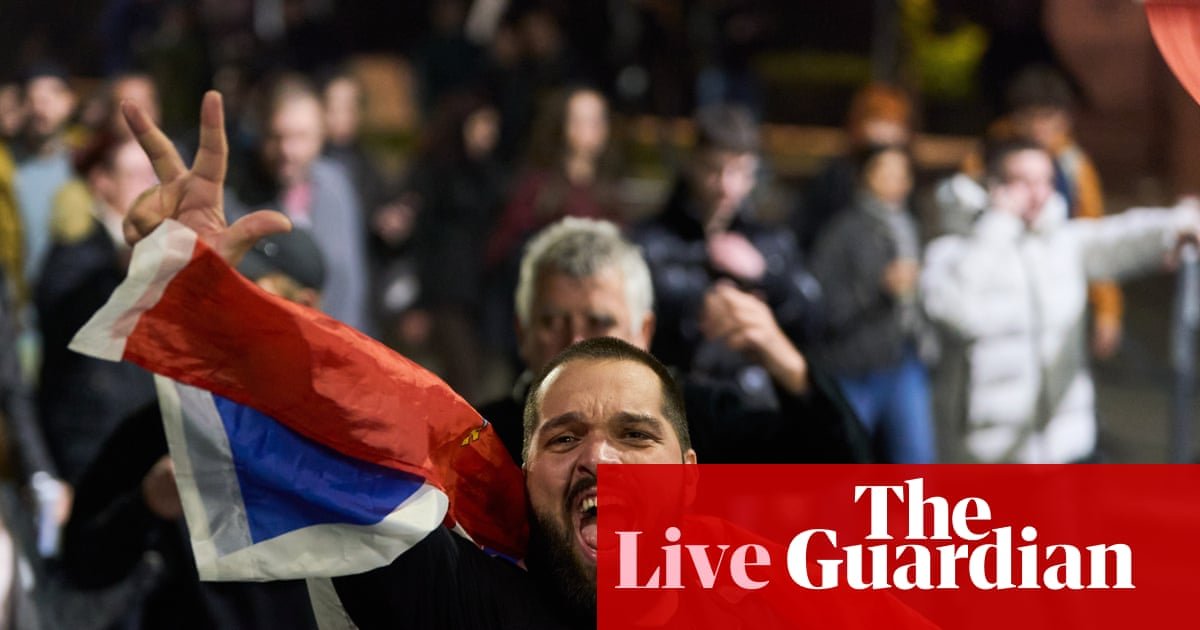
Serbia wakes up to a new reality this morning after a grassroots opposition movement led by students ousted the country’s former authoritarian president Aleksandar Vučić, raising hopes for a new opening in relations with the EU and other partners.
Opposition supporters celebrate at the parliament building after Aleksandar Vučić, represented by the silhouette, conceded defeat in the parliamentary election in Belgrade, Serbia.
With 96.9% polling stations processed, the Student List has 52.6% of votes, well ahead of Vučić’s bloc at 39.22%.
The latest CeSID projection suggested the students will have 140 seats in the new parliament, well clear of the 126 required for majority, with 103 for Vucic’s bloc.
No other party crossed the 3% threshold, with national minority parties taking the remaining seven seats.
We are likely to get more reactions to the vote today, with international observers set to present their preliminary report on the vote in the early afternoon.
I will also pick up the latest on the first round of the presidential vote in Bulgaria, which saw a record-low turnout of just 22%.
The second round will be held this Sunday.
Elsewhere, I will be looking for updates from France and Italy after another rocky weekend of protests.
French PM Sébastien Lecornu is going to meet with the student unions in the afternoon for what could be pivotal talks on the future of the demonstrations.
And E5 defence ministers – that’s France, Germany, Italy, Poland, and the UK – are meeting in Paris for discussions on Ukraine.
Oh, and Slovakia’s foreign minister Juraj Blanár is in Moscow for energy talks with Russia.
It’s Monday, 26 October 2026, it’s Jakub Krupa here, and this is Europe Live.
Good morning.