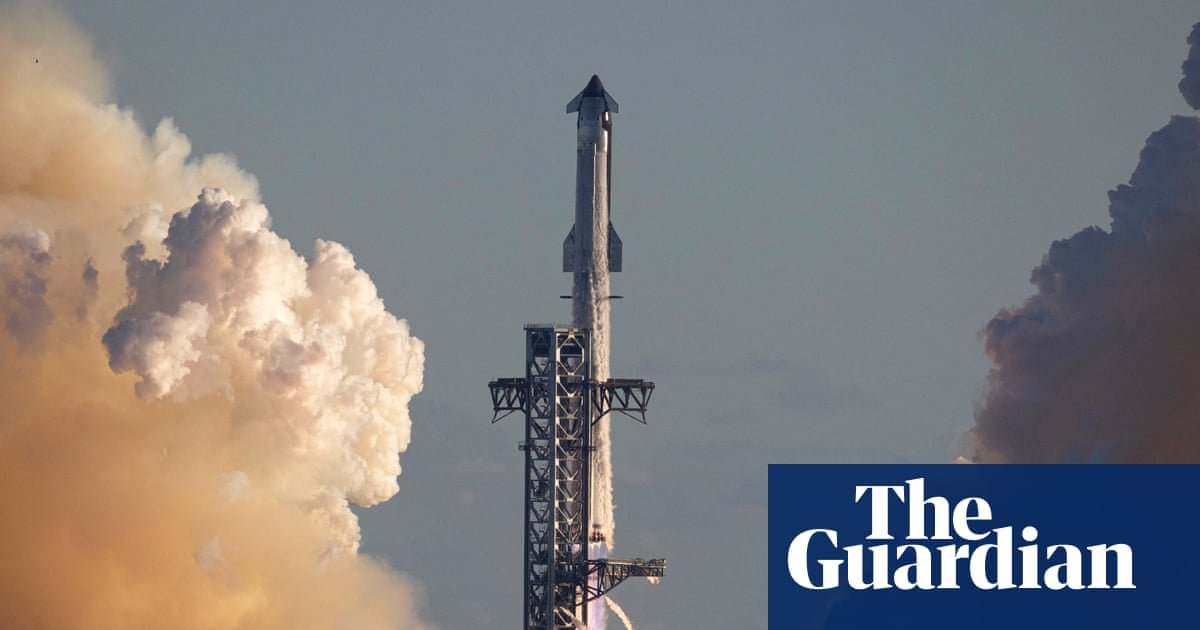
SpaceX's Starship Flight 15 launches from Starbase in Boca Chica, Texas, on Friday.
Flight 15 expected to orbit Earth about 14 times over 22 hours, before company catches it at Starbase, Texas SpaceX’s Starship megarocket blasted off from Texas on Friday afternoon as the aerospace company sought to make history with a double catch of its reusable rocket.
Starship, the world’s largest rocket, standing at 407ft, is expected to orbit Earth about 14 times over the course of 22 hours, before the company catches the rocket at its launchpad at Starbase in south Texas.
The rocket, which is on its 15th flight, is composed of two elements: the lower booster, with 33 raptor engines that fired off during takeoff, and the Starship at the top.
SpaceX had planned for both components to return to its tower, but the booster, named Super Heavy, was aborted, and splashed down in the sea.
The cause of that diversion remains unknown.
The Starship, meanwhile, continued on sailing through space.
Friday’s test fell short of the double-catch mantle, but the flight is poised to mark another milestone for the company.
If all goes to plan, it would be the first time SpaceX has caught the rocket’s 171ft upper stage.
Previous tests focused on the retrieval of the booster.
SpaceX chief executive Elon Musk has sought to advance Starship’s “rapid reusability”, which he hopes will take humans to the moon and, controversially, to Mars.
Nasa has contracted Space X, along with Jeff Bezos’s Blue Origin, to provide the lunar landers that will return astronauts to the moon in 2028.
SpaceX has launched a flurry of test flights, in recent years, some of which have resulted in explosions that signaled major design flaws.
In September, the most recent flight test, SpaceX notched a victory, sending the spacecraft into Earth’s orbit for the first time, although its engine failed during the ascent.
Explore more on these topicsSpaceX Texas Space Elon Musk news Share Reuse this content