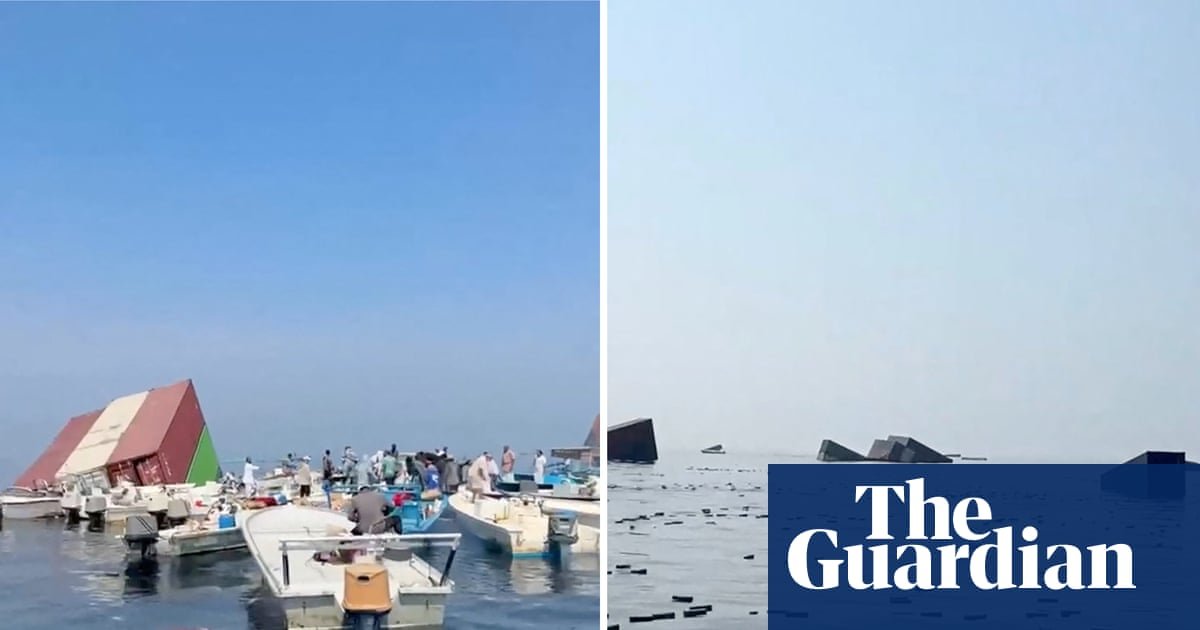
Screengrabs from a social media video show containers and debris floating in the sea after the GFS Pride sank off the coast of Oman last week.
Composite: Reuters Screengrabs from a social media video show containers and debris floating in the sea after the GFS Pride sank off the coast of Oman last week.
Composite: Reuters People scour strait of Hormuz for spilt cargo after Iran attacks container ships At least 15 vessels struck in waterway in past 10 days, with rumours that they were carrying valuable goods People have been scouring the strait of Hormuz for spilt cargo after Iran attacked at least 15 container ships passing through the crucial waterway in the past 10 days.
Some ships have been hit by drones, others by mines.
On Sunday, a ship was struck by a rocket-propelled grenade launched from a small boat 75 miles (120km) north-east of the Saudi port of Jubail.
The rise in Iranian attacks appears to have helped resolidify Tehran’s disputed control over the strait, as well as pushing the price of a barrel of Brent crude oil close to $108 a barrel on Monday morning.
A container from the Singapore-flagged GFS Pride floats alongside small motorboats after the ship sank off the coast of Oman on 14 October.
All 21 crew members were evacuated and no injuries were reported.
Dozens of its 2,500 containers were seen floating in the water.
Rumours that iPhones and other expensive goods were among its cargo – fuelled by fake AI-generated photos published on social media – prompted fishers and others to investigate.
One fisher told an Iranian reporter: “The Arab boatmen, who were closer to the ship, arrived earlier than the Iranians.
They used stonecutters to cut the container and took whatever was there.” Col Javad Mokhtar Rezaei, the deputy head of cultural and social affairs for Iran’s cyber police (Fata), told the Tasnim news agency: “In some cases, the phones offered may actually exist, but exposing electronic components to salt water and extreme humidity can cause corrosion of internal components, damage to the boards, battery and display, and cause hidden malfunctions in the device’s performance.” Meysam Doost-Mohammadi, a spokesperson for the Iranian mobile phone Aassociation, said it would be unusual for valuable devices to be transported by ship.
The bulk of the recent attacks have occurred close to the coast with Oman, a route that Iran regards as unauthorised.
In the seven days to Friday 16 October, 12 vessels were attacked, according to the UK Maritime Trade Operations Centre (UKMTO).
The Islamic Revolutionary Guard Corps (IRGC) says it has the right to attack any ship that seeks to traverse the strait without its permission or with its transponders off.
Officials have also ordered local fishers not to pillage the sea for luxury items, saying the goods are the property of the state.
Two oil tankers were hit on Saturday, including a supertanker carrying 2m barrels of oil, according to the IRGC.
The Fars news agency published a video that appears to show the tanker burning, but which cannot be independently verified.
A third tanker was hit late on Sunday.
It is disputed how many ships have been hit by mines or IRGC shelling.
UKMTO’s weekly overview recorded 254 transits of the strait (125 outbound, 129 inbound) in the week to 14 October, approximately 70% below pre-conflict levels.
A satellite image shows containers and items floating in the water after the Singapore-flagged GFS Pride sank off the coast of Oman on 14 October.
Iranian strikes on the Emirates, he said, were likely to have contaminated seagrass beds with hydrocarbons and caused auditory damage to cetaceans – marine mammals such as dolphins and porpoises – which are sensitive to loud noise that travels through the sea.
Oil released by attacks on tankers at Fujairah could have caused ecological harm, he added.
“Oil spills, chemical leaks and acoustic disturbances have impaired biodiversity, fisheries, aquaculture, desalination, and eco-tourism,” he wrote in the International Journal of Research and Innovation in Social Sciences.
Vessels in the strait of Hormuz, as seen from Musandam, Oman.
Iran has offered to open the strait in six days in return for sanctions relief.
“What has occurred in our region as a result of wars of aggression is ecocide, or environmental genocide, and it must be condemned,” Masoud Pezeshkian said.
He argued that countries subjected to economic sanctions or military aggression should not be forced to shoulder the financial burden of environmental damage resulting from conflicts they did not initiate.
Successive studies, mainly by US universities using satellite imagery, have warned of the dangers facing the strait.
Meanwhile, the Russian foreign minister, Sergei Lavrov, visited Tehran offering to act as an intermediary between Iran and Donald Trump, especially over the issue of Iran’s nuclear stockpile, which the US president insists must be addressed before he lifts his threat to attack Iran again.
Russia has offered to take Iran’s stockpile of highly enriched uranium, but Iran is reluctant to make a commitment on its nuclear programme and has not given the International Atomic Energy Agency access to its bombed nuclear sites since June 2025.
Lavrov also proposed a trilateral summit between China, Russia and Iran to agree new security architecture for the strait.
He said the region was on the verge of a full-scale crisis.
Tehran is braced for another attack soon, especially after the Israeli prime minister, Benjamin Netanyahu, launched a new national security doctrine on Sunday that included an emphasis on prevention and offence, including pre-emptive strikes on potential threats.
Explore more on these topicsStrait of Hormuz Iran Oman United Arab Emirates US-Israel war on Iran Middle East and north Africa Shipping industry news Share Reuse this content