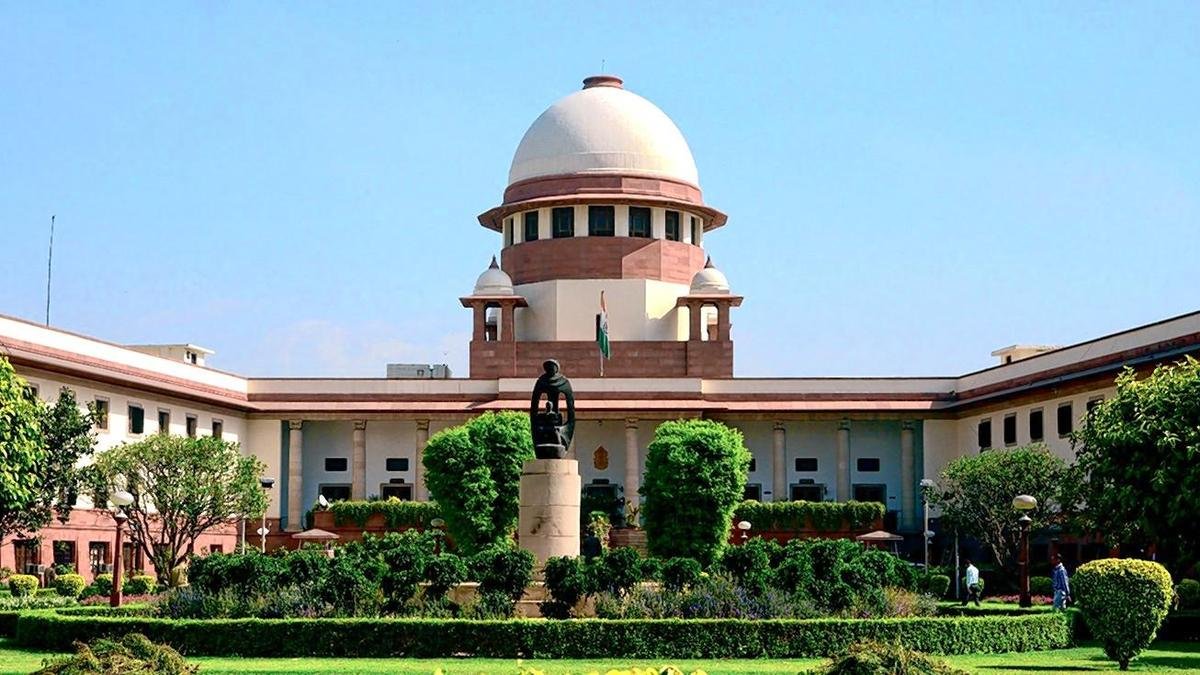
The Supreme Court of India on Thursday (August 13, 2026) asked the union government to consider a petition filed by an apex court lawyer flagging the lack of a comprehensive statutory regime on the government’s use of “high-risk” Artificial Intelligence technology in areas affecting public access to food, health benefits, wages, pension, scholarship and grant of welfare subsidies.
A three-judge Bench headed by Chief Justice of India Surya Kant asked the government to consider the detailed petition of advocate N.K.
Goswami as a representation for taking comprehensive action.
How far should governments go in using AI?
In his petition, Mr.
Goswami questioned whether the government could employ AI, machine learning (ML), automated decision-making systems, risk-scoring mechanisms, biometric surveillance tools, predictive policing technologies and AI-assisted content moderation systems in crucial areas of governance affecting welfare, liberty, privacy, dignity, livelihood and speech, without a “specific statutory framework” or meaningful human oversight.
The lawyer clarified that the constitutional vice pleaded in the petition was not that technology must be prohibited.
AI and the national security calculus “The vice is that technology affecting fundamental rights cannot be permitted to operate outside the discipline of the Constitution.
When a citizen’s access to food, health benefits, wages, pension, scholarship, subsidy, liberty, privacy or speech is affected by an opaque automated or semi-automated system, the State must satisfy the minimum constitutional requirements,” Mr.
Goswami submitted.
The petition said he was only trying to constitutionalise innovation.
“AI is no longer merely an administrative aid or technological convenience.
It has begun to enter the bloodstream of governance.
Public-domain official materials, policy and supporting documents show that AI/ML, automated decision-making, fraud-detection, beneficiary-verification, Aadhaar-linked authentication, data-driven de-duplication and similar algorithmic systems are being used in welfare-linked governance, from health-benefit delivery to ration-distribution optimisation to fraud-prevention,” it said.
The next DPI — how India can commoditise AI The Chief Justice said the petition raised technical issues in the policy domain, and the court lacked the necessary technical know-how to address them.
Mr Goswami argued that the court could indeed intervene to fill the legislative gap, given the lack of any statutory mechanism governing the use of AI/ML in public welfare.
The petition had sought that the court direct the Centre to file a “complete affidavit” disclosing all existing and proposed high-risk AI systems used by Union Ministries/agencies in welfare, policing, surveillance and content regulation, together with their legal basis, vendor/agency, purpose, data categories, safeguards, grievance mechanism and audit status.