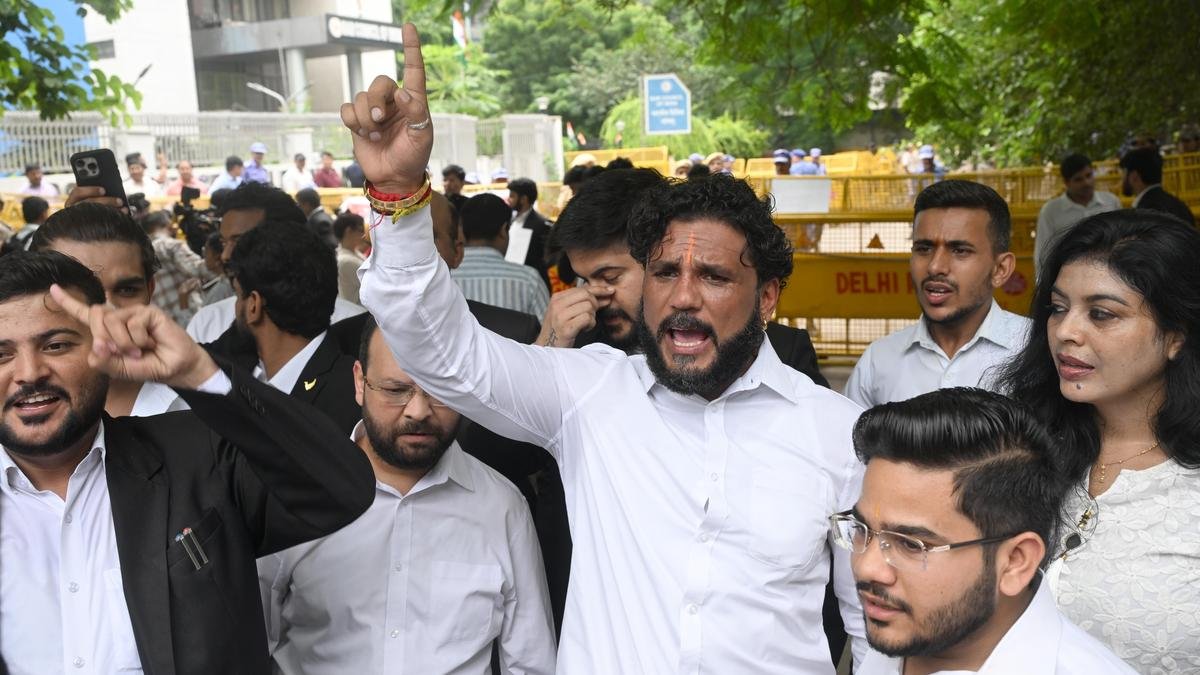
The Supreme Court on Thursday (September 3, 2026) allowed young lawyers to move the Delhi High Court with their petition for an independent investigation into allegations of targeted violence committed against them by an unidentified mob while they were peacefully protesting at the Bar Council of India (BCI) premises on August 21.
Supreme Court rules that BCI has no power to punish law students A Bench headed by Chief Justice of India Surya Kant asked advocate Prashant Bhushan, representing petitioners Kunal Yadav and others, to approach the High Court with their plea that they were physically assaulted, dragged, abused and forcibly thrown out of the BCI premises during a peaceful sit-in for the resignation of chairperson Manan Kumar Mishra and comprehensive reforms in the regulatory body.
Large police presence “The assault took place inside the BCI premises that are under round-the-clock CCTV surveillance in the presence of a large deployment of Delhi Police personnel, including an officer of the rank of Assistant Commissioner of Police, who did not intervene,” the petition submitted.
Mr.
Bhushan, in an oral mentioning, alleged that BCI chairperson, senior advocate Manan Kumar Mishra, had later on referred to the protesting lawyers as “legal cockroaches” who were dealt with.
Bhushan sought a CBI probe into the affair.
Supreme Court orders oversight by AG, SG in BCI policy decisions ahead of polls Justice Joymalya Bagchi, on the Bench, said though lawyers have a right to protest, the legal fraternity was still a disciplined community, which had multiple fora to present their grievances.
Bhushan said nobody had a right to beat up anyone.
The protesting lawyers were mostly in their twenties, he said.
The senior lawyer said he would comply with whatever the top court thought best.
He explained that the petition was filed directly in the Supreme Court as several pleas connected to the BCI were currently being heard by the court.
Chief Justice Kant observed that it would be more opportune if the petition came up before the High Court first.