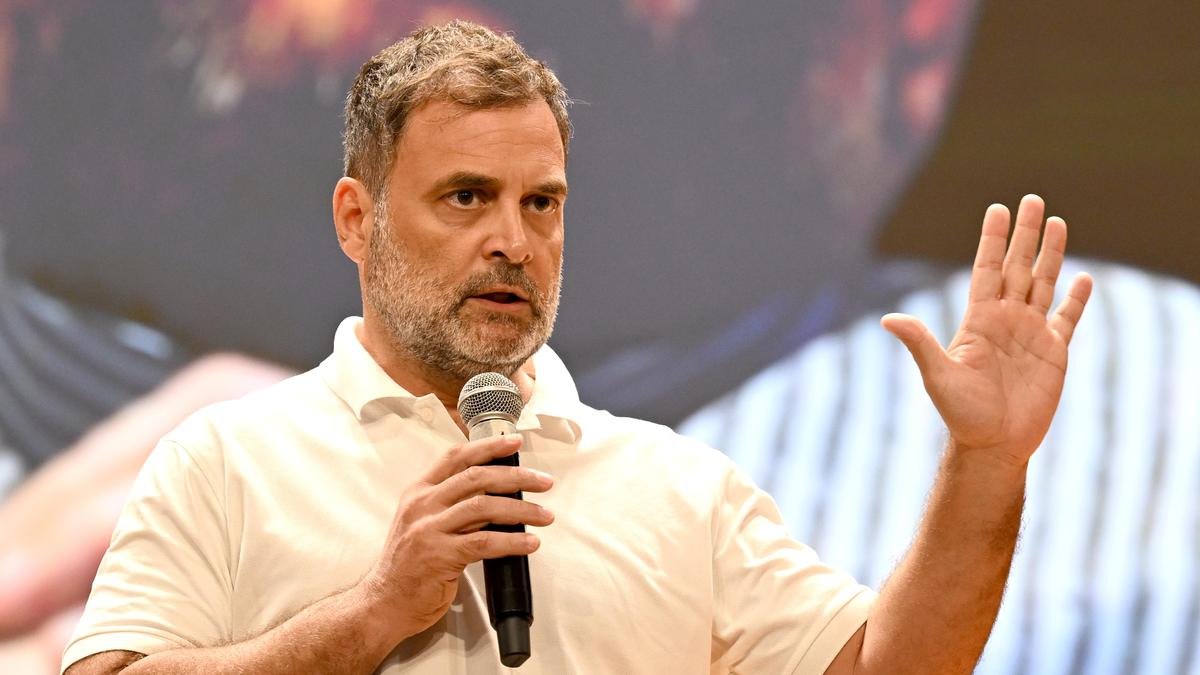
The Supreme Court on Monday (August 17, 2026) ordered an immediate halt on disproportionate assets proceedings initiated by the Allahabad High Court against Leader of Opposition in the Lok Sabha Rahul Gandhi while observing that at least courts should follow “principles of natural justice”.
A three-judge Bench headed by Chief Justice of India Surya Kant was reacting to submissions made by senior advocate Kapil Sibal and advocate Prasanna S., appearing for Mr.
Gandhi, that High Court proceedings and subsequent directions to the Central Bureau of Investigation (CBI) and Directorate of Enforcement (ED) to inquire into the allegations of disproportionate assets made by the private complainant, S.
Vignesh Shishir, against the Congress leader, amounted to a “witch-hunt”.
Supreme Court quashes hate speech case against Rahul Gandhi over Savarkar remarks after U.P. govt. refuses sanction The High Court was scheduled to hear the case on August 20.
Mr.
Sibal said the High Court proceedings were conducted in-chamber and not in open court.
The records were kept in sealed covers.
Gandhi was not given an opportunity to be heard on the allegations.
“According to our understanding of the law, the police or an investigating authority can register a case on a complaint.
They do not require permission of the accused to do that.
But the courts are different.
If the courts want to issue directions [for inquiry/investigation], the courts are expected to fulfill the principles of natural justice,” Chief Justice Kant addressed the CBI counsel, Additional Solicitor General S.V.
Raju.
Rahul Gandhi moves SC against ‘fishing inquiry’ into allegations of disproportionate assets Mr.
Raju said he was strictly on the law.
He said the facts presented in Mr.
Shishir’s complaint may be right or wrong.
“But if the facts are right, it is a gross case of disproportionate assets,” the law officer, who is also appearing for the ED, submitted.
He maintained that the allegations in the complaint were “very serious”, and could not have been dismissed as “frivolous”.
“If they [allegations against Mr.
Gandhi] were so serious, why did your agency keep quiet all this while?
Did you require an impetus from the court?
You could have used your own statutory powers to start an inquiry…”, Justice Joymalya Bagchi addressed Mr.
Justice Bagchi said since the CBI had admittedly not taken suo motu cognisance and conducted an inquiry, the apex court was bound to examine the correctness of the High Court order which directed the agencies to start the inquiry.
‘Compromised PM forced to sell India’s interest’: Rahul as U.S. court dismisses Adani case “If someone is approaching the court, and the court compelled you, then we certainly feel this should be looked into… When the court says something, its subjective satisfaction would be recorded.
We will look into that,” Chief Justice Kant said.
The court further asked Mr.
Gandhi’s side to share the case paperbook with Mr.
Shishir, who appeared on caveat.
Gandhi had termed the series of directions passed by the Lucknow Bench of the High Court in May and July directing the CBI and the ED to probe the allegations against him as one of the rarest instances of a Constitutional court acting contrary to several first principles or basic, fundamental legal rules all at once.
The Opposition Leader said terming these orders outside the settled rules of law or erroneous would be a gross understatement.
Congress leader Rahul Gandhi declares assets worth ₹20 crore Mr.
Gandhi submitted that the proceedings were characterised by the unjustified secrecy of in-chamber hearings with documents and pleadings kept under wraps in sealed cover.
He had maintained that the High Court did not refer to the foundational material or provide reasons in the orders for directing a “roving inquiry”.
Gandhi challenged the locus standi of Mr.
Shishir, saying he was a member of the Rashtriya Swayamsevak Sangh who had instituted multiple complaints and public interest litigation against him in the past.
The Leader of Opposition said the High court orders had directly affected his civil rights and political reputation.
He noted how the High Court had ordered an investigation by ED under the money laundering even without a predicate offence being registered.