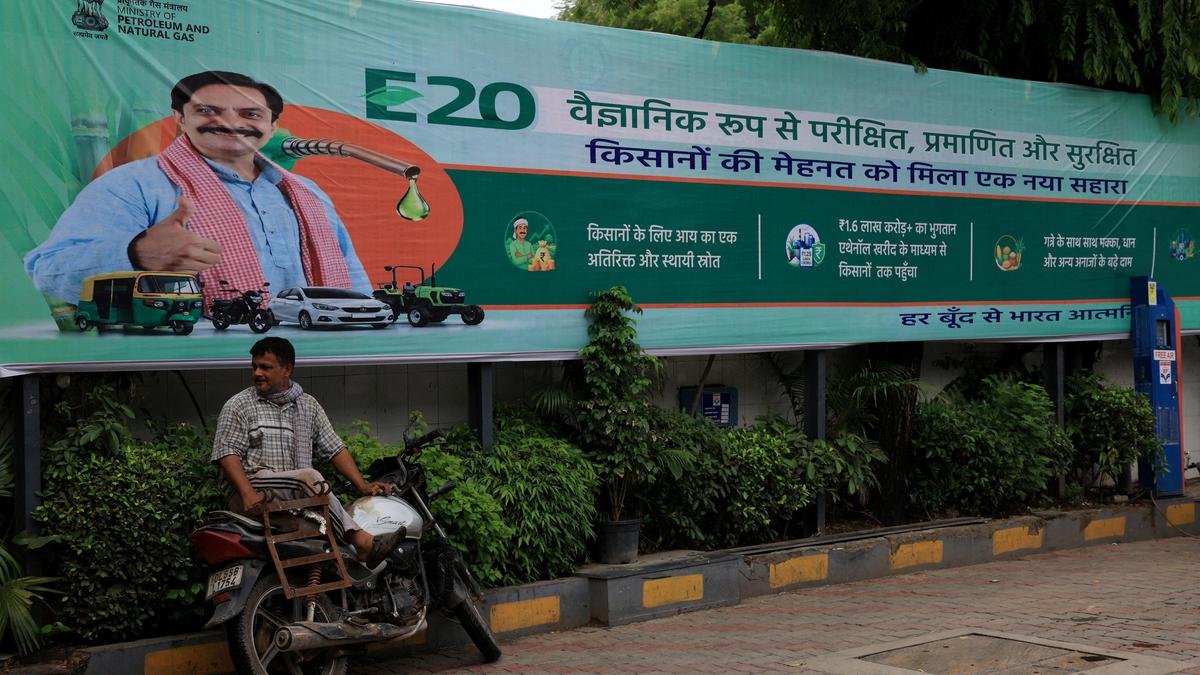
The Supreme Court on Monday (August 31, 2026) refused to entertain a petition alleging an element of “silent compulsion” in the rollout of E20 petrol and seeking mandatory disclosure of the ethanol content in petrol sold at fuel stations across the country.
A Bench of Justices M.M.
Sundresh and Prasanna B.
Varale was hearing a petition by advocate and petitioner-in-person Narendra Kumar Goswami, contending that consumers were entitled to know the composition, quality, standards and compatibility implications of the fuel they purchase.
Such disclosure, the plea said, was not a “decorative consumer slogan but a constitutional requirement when the State itself creates a nationwide compulsory market”.
The road to E20 is not without bumps The Bench declined to entertain the plea, observing that the petitioner could approach the competent authority with his grievance instead of directly moving the top court.
“Dismissed… It will remain open for the petitioner to approach the competent authority,” the Bench said in its brief order.
During the hearing, the Bench questioned Mr.
Goswami’s locus standi and asked why he had approached the Supreme Court directly instead of the jurisdictional High Court.
“Who are you?
You are practising where?
Go to the High Court and file it,” the Bench said.
Mr.
Goswami, however, maintained that consumers had a right to know the ethanol content of the petrol they were purchasing.
“We have the right to know what we are purchasing… Even when we buy a packet of biscuits, we know the ingredients,” he submitted.
How sustainable is India’s E20 push? | Explained Attorney General R.
Venkataramani, appearing for the Centre, opposed the petition, describing it as “proxy litigation” and pointing out that the Supreme Court had previously rejected challenges to the government’s ethanol-blending policy.
“Your Lordships have already dismissed pleas challenging the policy,” the Attorney General submitted, referring to the court’s earlier orders rejecting challenges to compulsory ethanol blending.
Goswami, however, clarified that he was not challenging the government’s E20 policy itself, but was seeking disclosure of the ethanol content in petrol so that consumers could make an informed choice.
“I am not challenging the policy.
I just want to know.
I have the right to know… Last time, the Attorney General said it was an experiment.
After that, they gave a clarification,” he submitted.
Akhilesh Yadav attacks Centre over E20 petrol, cites CEA’s reported backing for E10 In September last year, the Supreme Court had dismissed a PIL challenging mandatory ethanol blending and seeking the continued availability of ethanol-free petrol for vehicles incompatible with blended fuel.
The plea, filed by advocate Akshay Malhotra, had directly challenged the government’s move towards E20 petrol.
The Court had then taken into consideration the Centre’s submission that the ethanol-blending programme formed part of its broader energy security and environmental objectives, including reducing dependence on crude oil imports and curbing vehicular emissions.
The Centre had strongly opposed the earlier challenge as well.
The Attorney General had described the petitioner as a “name-lender” and alleged that a larger lobby was behind the litigation.
He had maintained that the policy was formulated after considering all relevant factors and also benefited sugarcane farmers.
The Union Government amended the National Policy on Biofuels in 2022 to accelerate the phased blending of ethanol with petrol.
Under the revised policy, the target was to achieve ethanol blending of 12.06% in 2022–23, 14.6% in 2023–24 and 17.98% in 2024–25 (up to February 2025), before reaching the milestone of 20% blending.
The government has since achieved the 20% blending target.
The programme has, however, attracted criticism over its potential impact on older vehicles and fuel efficiency.
The Centre has dismissed these concerns, maintaining that there is no evidence to suggest that ethanol-blended petrol causes mechanical damage to vehicles.