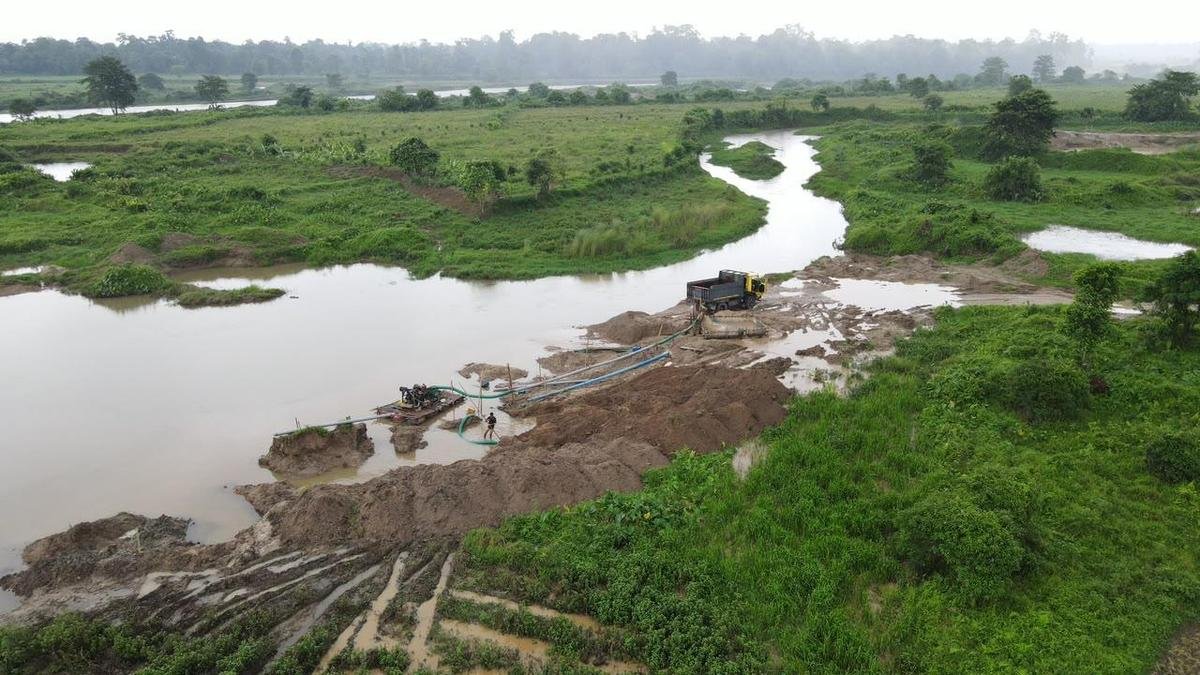
Ahead of a controversy over a plan to reduce the Eco-Sensitive Zone of Kaziranga National Park, a Supreme Court-constituted panel has pulled up the Assam government over its handling of mining on the southern boundary of the one-horned rhino habitat.
The Central Empowered Committee (CEC) said that the government did not address the mining issue in and around the Parkup Pahar Range, a declared wildlife sanctuary and vital ecological corridor, with the seriousness it deserves.
The latest development follows a June 15 RTI (Right to Information) application filed by Rohit Choudhury, a Golaghat district-based environmental activist, seeking details of compliance with the CEC’s directions to the Assam Chief Secretary on May 30, 2025.
Mr. Choudhury sought the comprehensive Watershed Drainage Analysis Report that was to identify all areas draining into Kaziranga, along with quarterly status reports on action taken against reported violations.
The CEC’s response to the RTI on July 17 states that it did not receive the comprehensive Watershed Drainage Analysis Report. It also said the quarterly status reports have been attached, but the response does not indicate that the watershed exercise the CEC ordered was completed.
The CEC had fixed October 2025 as the deadline for submitting the watershed report.
The issue predates the RTI. In its May 30, 2025, report on “Application NO.1592 of 2024”, the CEC recorded allegations of renewed mining in Parkup Pahar despite the Supreme Court’s April 12, 2019, order restraining all mining and related activities along the southern boundary of Kaziranga and throughout the catchments of rivers and streams originating in the Karbi Anglong hills and flowing into the park.
The same order prohibited new construction on private lands forming part of nine identified animal corridors.
On March 3, three months before Mr. Choudhury’s RTI plea, the CEC wrote to the Assam Chief Secretary, noting that mining and related activities have been going on “in some way on one pretext or the other”, and that the Karbi Anglong Autonomous Council (KAAC) was not presenting a holistic picture to the courts.
The KAAC administers Karbi Anglong, the district that forms Kaziranga’s southern boundary. The hills of this district serve as a shelter whenever Kaziranga is flooded beyond the level its animals can withstand.
“It has been observed time and again that the issue has not been addressed with the seriousness it deserves. It may be observed that the unmistakable intent of the order of the Supreme Court is to secure the protection of wildlife and to preserve the integrity of the natural drainage system across the entire landscape, thereby safeguarding the ecological balance of the area,” the letter read.
Terming the issues as sensitive, the CEC asked the Chief Secretary to take immediate action, as any violation of the apex court’s order would be brought to the court’s notice by the committee.
Unresponsive government
The letter further noted the failure to identify the catchment areas of the streams and rivers originating in the Karbi Anglong hills even after more than six years. “The situation is no different with regard to the nine identified animal corridors. The committee, vide its letter dated May 6, 2021, specifically requested that the action taken by the State government to notify the animal corridors connecting KNP be communicated to the committee at the earliest. However, no response has been received from the State government at the earliest,” it stated.
The panel also pointed to areas of the Karbi Anglong Elephant Reserve, which covers Karbi Anglong and Kaziranga National Park, ravaged by large-scale mining and the death of several elephants due to conflicts with humans. It questioned how mining leases around Borjuri had been sanctioned at all, given that the area forms part of the elephant reserve.
“The KAAC seems oblivious of all these notifications and is not conscious of the measures that need to be taken to protect the ecology and wildlife of the area. It is evident that no wildlife management plan which includes measures for mitigation of damage to wildlife is in place to date,” the CEC said.
The committee had submitted a detailed report to the State government on May 30, 2025, with some recommendations. Later, it “regretted that the recommendations have not yet been fully implemented”.
In its latest communiqué, the panel asked the government to ensure fast implementation of all its recommendations and immediately notify the nine identified animal corridors.
It further asked the State Law Department to inform all the courts in Assam about the Supreme Court’s order on Kaziranga’s conservation.