SC takes note of HT report on sale of firecrackers in Delhi, asks govt to act The Supreme Court bench referred to the Nov 3 HT report, which documents firecrackers being openly displayed and sold in several markets.
Updated on: Nov 3, 2026, 12:12:59 IST By Utkarsh Anand Prefer HTon Google Share via Copy link The Supreme Court on Tuesday took note of a Hindustan Times report exposing the open sale of conventional and unauthorised firecrackers in Delhi markets despite restrictions imposed by the court a day earlier, asking the Centre, Delhi government and police to take all necessary measures to prevent violations.
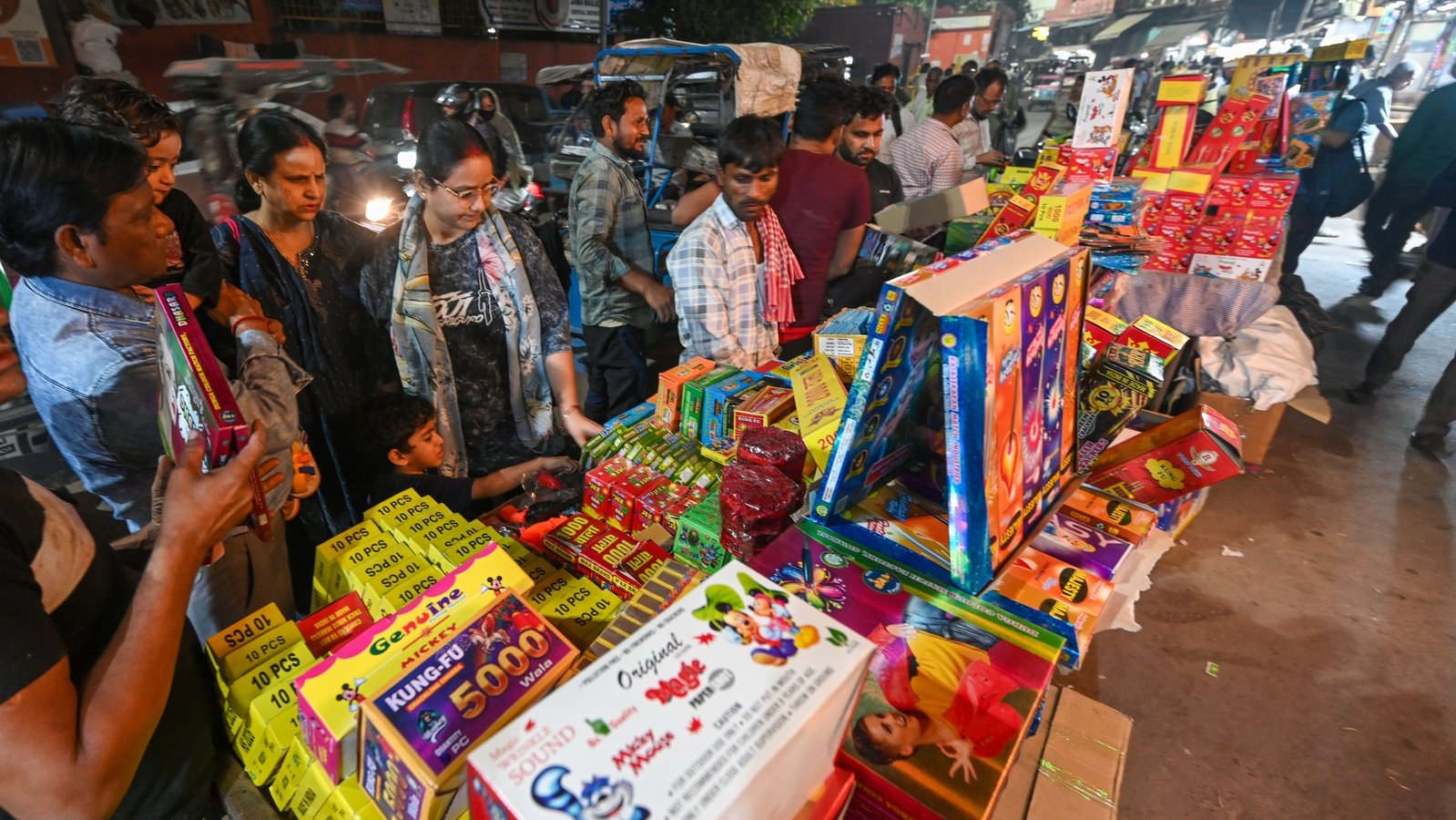
Hawkers sell green firecrackers near Jama Masjid Police Station ahead of Diwali, on November 2 (HT photo/Raj K Raj) A bench of justices MM Sundresh and Prasanna B Varale referred to the November 3 HT report, which documented firecrackers being openly displayed and sold in several markets, with conventional crackers allegedly being supplied on demand and products carrying questionable QR codes being passed off as green firecrackers.
“In today's report on Hindustan Times there is a photograph.
They say that notwithstanding yesterday’s order, now everything is available in the (firecracker) shops.
Please look into it,” the bench told additional solicitor general Aishwarya Bhati, appearing for the Centre, Delhi government and the Commission for Air Quality Management (CAQM).
Referring to the news report’s account of the availability of different varieties of firecrackers, the bench added: “They say that in the market every other cracker, licensed, unlicensed, QR code, or no QR code, everything is available.
Please take a note of it.” The bench asked the law officer to look into the matter and ensure that the necessary measures were taken, bringing the focus back on the enforcement machinery even as the court had relaxed its blanket prohibition on firecrackers for a limited period around Diwali.
The HT report The HT report, based on visits to major markets on October 22 and November 2, found firecrackers being sold openly in Chandni Chowk, Sadar Bazaar, Shastri Nagar, Sarojini Nagar and New Friends Colony, among other places.
Vendors were displaying products labelled “green crackers”, “pollution-free” and “zero pollution”, while conventional firecrackers were reportedly available on request, often from concealed stocks or nearby warehouses.
The report also found that several boxes did not carry QR codes mandated by the court, while some codes redirected customers to online catalogues rather than enabling verification of the product's certification.
In some instances, vendors allegedly kept conventional crackers out of sight and brought them out when customers asked for them.
In Chandni Chowk, a seller even advised a customer looking for bigger fireworks to visit Sadar Bazaar, saying everything was available there.
The report highlighted the contrast between the court's detailed safeguards and the situation on the ground, with street vendors and shopkeepers openly displaying firecrackers even before the permitted sales window began.
It also documented sellers accepting advance orders for home delivery, despite the court's prohibition on online sales.
The court’s intervention comes a day after it permitted the sale of certified green firecrackers in Delhi-NCR between November 4 and 6 and their bursting only between 6am and 7am and 8pm and 10pm on November 7 and 8.
A complete ban is to be restored from November 9.
In its November 2 order, the bench of justices Sundresh and Varale had allowed only those firecrackers certified by the Council of Scientific and Industrial Research-National Environmental Engineering Research Institute (CSIR-NEERI) and the Petroleum and Explosives Safety Organisation (PESO).
Sales were restricted to designated locations, with online sales prohibited.
Every box was required to carry a product-specific QR code disclosing the manufacturer, NEERI registration, PESO or district magistrate licence, formulation and test certificate.
The court also prohibited the manufacture and sale of firecrackers joined in series, commonly known as laris, and those containing barium or not approved by CSIR-NEERI.
It directed authorities to confiscate illegal and conventional crackers and initiate prosecution against offending manufacturers and traders.
The order had specifically sought to address the problem of conventional firecrackers being sold under the guise of green crackers, observing that the complete ban imposed earlier had failed to prevent illegal sales and had also prevented consumers from accessing legitimate, tested green products.
“Despite the complete ban having resumed, as aforestated, conventional firecrackers were sold and continue to be sold under the guise of green crackers,” the bench noted in its order, adding that this indicated that the blanket prohibition was facilitating the illegal sale of firecrackers.
The court had also acknowledged that its previous directions had repeatedly failed to achieve the desired results, identifying implementation as the principal problem.
It directed district administrations and police to identify designated sale points, constitute patrolling teams, verify QR codes, check vehicles entering Delhi-NCR and confiscate unauthorised products.
In an additional enforcement measure, the November 2 order required manufacturers and traders to furnish substantial monetary security deposits, which would be forfeited in case of violations.
The bench also directed pollution-control authorities to monitor air quality before, during and after Diwali and collect data on hospital admissions and reported deaths to assess the health impact of firecracker use.
The proceedings arise from a 2015 petition filed on behalf of three minors, including Arjun Gopal, seeking a ban on firecrackers in Delhi-NCR because of their harmful effects on children and other vulnerable groups.
Deep Dive Powered ByAsk HT Referring to the news report’s account of the availability of different varieties of firecrackers, the bench added: “They say that in the market every other cracker, licensed, unlicensed, QR code, or no QR code, everything is available.
Please take a note of it.” ABOUT THE AUTHOR Utkarsh Anand Utkarsh Anand is the National Legal Editor at Hindustan Times, where he leads the newspaper's coverage of the Supreme Court, constitutional law, the judiciary and the Union law ministry.
He joined Hindustan Times in 2020 after stints at Press Trust of India (PTI), The Indian Express and CNN-News18, and has over two decades of experience reporting on law, governance and public policy.
His work has focussed on some of India's most consequential constitutional and legal developments, including the Supreme Court's judgments on Article 370, marriage equality, decriminalisation of homosexuality, the Babri Masjid dispute, electoral reforms and judicial appointments.
He specialises in making complex legal proceedings and judgments accessible to readers while examining their wider social and political impact.
Beyond daily reportage, Utkarsh has led investigative projects and enterprise reporting that have shaped public debate and prompted institutional responses.
His work has received several journalism awards, including the Ramnath Goenka Excellence in Journalism Award.
As National Legal Editor, he has also played a key role in expanding Hindustan Times' legal journalism footprint, mentoring reporters and strengthening coverage across platforms.