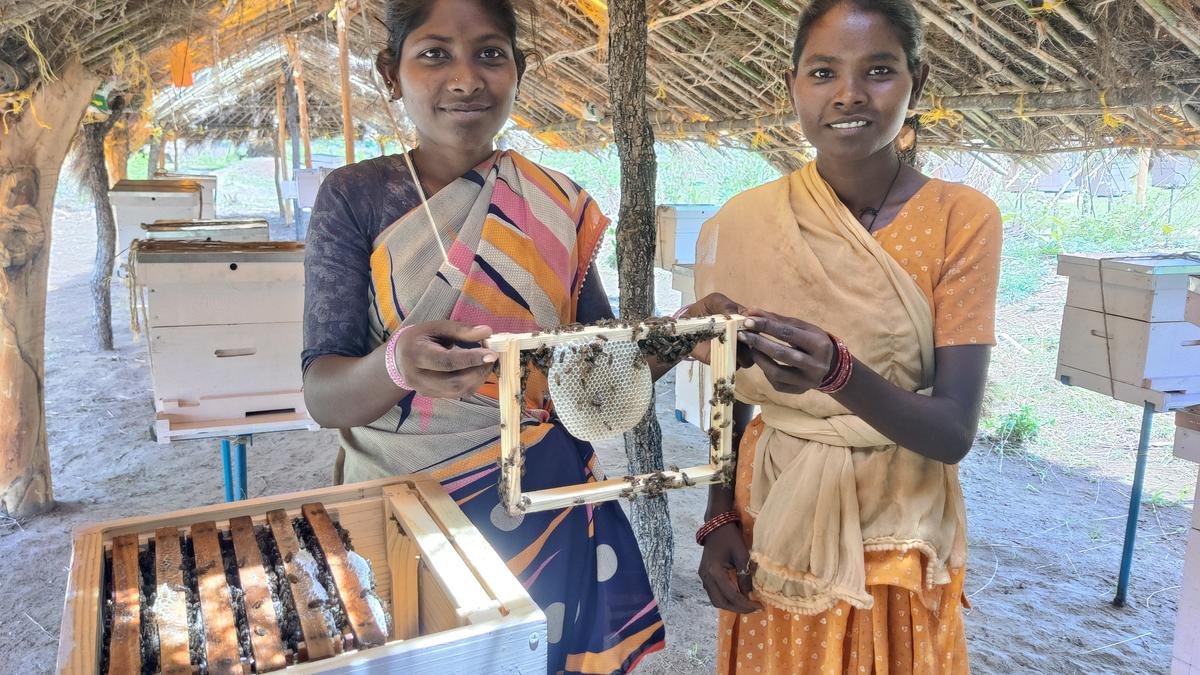
As wild honey becomes harder to find and traditional honey collection grows increasingly risky, scientific beekeeping is offering tribal women a safer and more sustainable livelihood, with support from the Society for Elimination of Rural Poverty (SERP).
For Mankidi Prashanthi (35), an SHG member from Ankampalle in S.S. Tadvai mandal of Mulugu district, beekeeping represents a shift away from her family’s traditional livelihood. “My husband has been an expert at harvesting wild honey from the forest. For many years, honey was an important source of income for our family, bringing us around ₹30,000 to ₹50,000 a year. But the forests have changed. The honeycombs that were once abundant have become increasingly difficult to find,” she said.
Prashanthi added that training and technical support from SERP and Buzzworthy Ventures Private Limited, also known as Humble Bee, had helped her gain confidence.
For other women from forest-dependent communities, scientific beekeeping is also being seen as a way to reduce the dangers associated with traditional honey collection.
Recalling the hazardous journeys involved in harvesting wild honey, Chigurla Malleshwari, 24, from Mallapur Penta in Nagarkurnool district, said, “Men from our community would walk deep into the forest to harvest wild honey, sometimes facing accidents, disabilities and even losing their lives.”
SERP entered into a three-year agreement with Humble Bee, and the programme was launched in April 2026.
“In the first phase, we are planning to empower 1,500 tribal and rural women,” said Rajitha Nared, Chief Operating Officer, Farm and Food Processing Sector, SERP.
The pilot is being implemented in Mulugu, Nagarkurnool and Kumuram Bheem Asifabad districts.
The programme proposes to establish about 15,000 beehives. Each woman is expected to manage 10 colonies, with the asset investment per woman estimated at around ₹64,000, covering beehives, bee colonies and a toolkit. “The asset investment per woman is approximately ₹64,000,” Ms. Rajitha said.
The programme currently has 139 women trained, all of whom have already established their apiaries. Nearly 1,400 hives are operational while all 1,500 women are expected to be trained and begin their beekeeping enterprises over the next three to four months. The first honey harvest is expected by December this year.
“The annual income is expected to be approximately ₹50,000, while the asset has a life of 10 to 15 years,” Ms. Rajitha said.
The total programme budget, including credit being extended to rural and tribal women, is ₹12 crore. The programme also envisages a buy-back arrangement under which Humble Bee will procure honey produced by participating beekeepers.
Surender Thaduru, State lead, Humble Bee, said they are also training some women as ‘Bee Sakhis’ to provide technical support to around 25 beekeepers in their respective villages. “Plans are also under way to establish a viable women-led value chain around scientific beekeeping,” he added.