Partnership between American Federation of Teachers, one of the largest labor unions in the US, and AI firms has stirred controversy
Darius Saczuk, a high school teacher, views artificial intelligence as his enemy. Earlier this year, he and several dozen New York City teachers spent the day inside a windowless conference room in downtown Manhattan to learn how to use AI and prevent students from outsourcing their thinking to it.
As Saczuk sees it, he needs to understand his enemy in order to beat it.
“It’s killing our jobs, it’s changing our society, it’s replacing humans,” said Saczuk, who teaches English as a new language at Long Island City high school in Queens. “In order to retain my job, I need to know how to use AI because it’s not going away.”
So he turned to training offered by the American Federation of Teachers, one of the largest labor unions in the US with roughly 1.8 million members, at its new National Academy for AI Instruction. Last year, the academy began offering in-person and virtual AI training across the country. The goal is to train 400,000 educators over the span of five years, helping them understand AI’s benefits and potential harms and also shape how it’s used in the classroom.
Without guidance from their schools or districts, many teachers are left to figure out whether and how to use AI tools. Though the AFT’s $23m training initiative is one of the few structured programs for teachers, its funding, provided entirely by Microsoft, OpenAI and Anthropic, is stirring controversy. Supporters say the training is necessary for the future, but critics argue the academy pushes AI into classrooms, steering teachers toward tools that undermine students’ learning.
“It’s handing more political power over” to big tech, said Audrey Watters, author of Teaching Machines: The History of Personalized Learning. It’s really “dangerous” for educators to partner with companies that “seem opposed” to the goal of education, she said.
AI has become a ubiquitous force in classrooms, despite the lack of official guidance. More than half of polled teens say they use AI for help with schoolwork and nearly six in 10 think using AI to cheat is a regular occurrence at their schools, according to a Pew Research Center survey conducted last fall. Meanwhile only about four in 10 teachers say their schools offer professional development or training related to AI, according to a recent NPR/Ipsos poll. And about half of all teachers polled say their school hasn’t offered any guidance on AI, or they’re unclear on what it is.
Teaching educators about AI is a “moral imperative”, said Randi Weingarten, the AFT president. She argues that AI training empowers teachers to make informed decisions about how, when or whether to use AI in their instruction. And without outside funding, it was a choice between taking big yech’s money or doing nothing, she said.
“There was no fairy godmother philanthropist that was sprinkling millions of dollars on us to actually create a mechanism to educate,” Weingarten said. “I am not promoting the use of AI. Educators need to know the tool.”
For Microsoft, which is contributing the largest share of funding at $12.5m, the goal is to give educators a voice in shaping how AI products are used, said Justin Spelhaug, leader of Microsoft’s education, workforce and nonprofit programs.
“By partnering with teachers’ unions … we believe we can learn directly from teachers on what they want and need in their classroom,” he said in a statement.
But Watters asserts that AI’s presence in the classroom is not a foregone conclusion.
“The industry would very much like us to believe that it’s not going away,” Watters said. “But the future is unwritten.”
The classroom AI debate
Tech company leaders have largely painted AI as beneficial to education, some even claiming AI could replace teachers. But experts say there’s still a lack of research proving whether AI actually improves learning outcomes.
In a 2024 blog post, Sam Altman, the OpenAI CEO, said he envisioned a future where “children will have virtual tutors”. AI could replicate some of the meaningful experiences teachers provide, such as making students feel understood and inspired, Greg Brockman, the OpenAI president, said in 2023 on the Possible podcast, hosted by Reid Hoffman, the LinkedIn co-founder, and Aria Finger, his chief of staff.
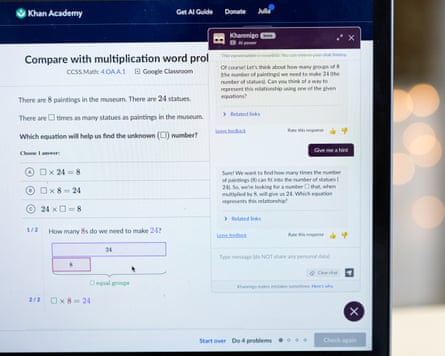
“Imagine if you could give that kind of teacher to every student 24/7 … for free,” Brockman said.
Microsoft believes “AI can help reduce administrative burdens, personalize learning and create more time for students”, Spelhaug said. “But there is no substitute for the role of a teacher.”
OpenAI, which pledged $10m to the academy, and Anthropic, which committed $500,000 to the first year, did not respond to a request for comment.
AI companies are already making their way into classrooms. Over the last two years, Miami-Dade county public schools, one of the largest US districts, began rolling out Google’s Gemini chatbot to teachers and high school students. Last fall, Microsoft announced AI tools for teachers at no additional cost for educational customers. And OpenAI and Anthropic offer K-12 teachers free use of versions of their chatbots designed for educators.
There’s been a longstanding playbook in which tech companies provide free training and resources to teachers in exchange for feedback and product advocacy, said Justin Reich, a Massachusetts Institute of Technology professor and author of Failure to Disrupt: Why Technology Alone Can’t Transform Education.
Google, for example, entrenched itself in schools by offering districts free or low-cost educational software for classroom laptops. It’s also built a corps of Google Certified Educators, teachers trained on the company’s software who promote it to their peers. Last year, Google introduced free Gemini certifications for K-12 teachers and students as young as 13. But the aim is profits, Reich said.
“Their goal is to get people to become lifelong consumers,” he said. Still, “there’s no evidence that the adoption of Google or Microsoft products lead to better outcomes, happier teachers, more efficient school systems or anything”.
The AFT’s new academy seems to echo Google’s approach, Watters said. By offering training through a labor union, viewed as a peer group, tech companies make their AI products seem more credible, she said.
“It feels very different to have your union say, ‘We’re offering a training,’ than it does to have a company say [it],” Watters said.
The concern is “understandable” though not accurate, Spelhaug said.
“This initiative was designed in response to a need our union partners and educators themselves identified,” he said. “Our role is to provide resources and expertise while respecting the independence of the AFT and the professional judgment of teachers.”
The AFT doesn’t allow companies to promote products during the sessions, Weingarten said. And while she doesn’t think “students have to use AI in schools”, she believes educators cannot ignore what’s already here.
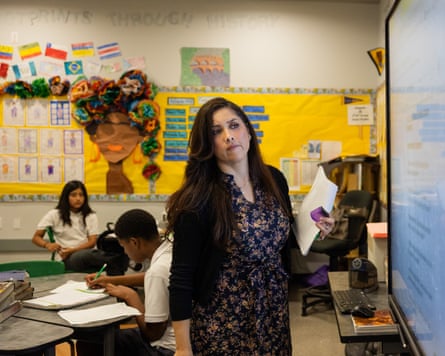
In a May speech at the National Press Club, Weingarten called for a ban on student-facing AI in elementary schools and said the AFT is working with Microsoft, OpenAI and Anthropic on a “gold standard” for AI safety and privacy in schools. If the companies don’t deliver on the promise, the union will walk away from the funding, she added.
“They have agreed in concept,” she said. “But until the Is are dotted and the Ts are crossed, there’s no agreement.”
Microsoft didn’t share any details or timeline about new standards, but Spelhaug said the company shares the AFT’s goal.
Teaching without a guide
There’s no established approach for training teachers on AI. The technology is simply too new. But the academy’s leaders hope to work with teachers to find ways to use the technology without compromising students’ cognitive development, independent thinking, data privacy and mental health.
“The sad thing is there is no map, and the terrain is changing every single day,” John Holleran, an AI academy trainer said to teachers assembled at a May session. “So, it’s going to be difficult for us to sort of figure out where we’re going.”
Demand for the academy’s training is strong. A May training sold out within hours, leaving about 150 people on the waitlist, according to staff. The session focused on two key points: AI can’t replace teachers. And it can’t be blindly trusted because it can be biased or hallucinate, meaning make things up.
For example, ChatGPT generated an image of a white man in a suit and tie when asked to show a successful person – a bias Holleran said teachers need to be aware of when creating prompts.
Several teachers at the training said AI is already helping them tackle classroom challenges.
Phillip Perry, who teaches ninth grade at Bronx High School for Law and Community Service, uses AI to design lessons for students with disabilities.
“Trying to differentiate instruction in a way that can completely target their learning needs has been a massive challenge,” Perry said. “Using AI is helpful in breaking down tasks to the smallest form to help build the students up as they go.”
Tanushree Sengupta, a math teacher at Hillcrest high school in Queens, uses AI to generate practice math problems and, eventually, to analyze student data and flag those needing extra support or a challenge. But she worries that the tech could be a crutch.
“I need to figure out ways where [students are] doing more thinking that they can actually show,” she said, adding that she signed up for the training in part to help students think for themselves.
To that end, AFT trainers advised teachers to redesign their curriculum to favor student-led discussions, journaling and thought exercises that require human judgement and reasoning.
The training filled a void, offering practical strategies for the classroom, said Perry and Sengupta, who were unaware of the academy’s funding prior to speaking to the Guardian.
“As long as what they’re providing is beneficial to the students and the teachers, then I don’t see an issue,” Perry said.
Saczuk, the teacher from Queens, considered the training “necessary”. Still, he left with more questions than answers.
“What is the role of the teacher?” he asked. “It’s a big question mark.”