Rolling coverage of the latest economic and financial news
38s agoAnalyst: the AI bubble has burst
2m agoNasdaq index expected to rise
4m agoTech sell-off eases, but Korea hits 10-month low
5m agoIntroduction: South Korea, Taiwan and China try to stem market sell-off
Ipek Ozkardeskaya, senior analyst at Swissquote, says
For some markets, we could say it now. AI frenzy seemingly created a bubble and the bubble has burst. Last week was a very ugly week for the AI complex, sending many markets into the correction/bear market zone. Among them, the South Korean Kospi, which has been under pressure since mid June, slid another 8%, Taiwanese Taiex – home to TSMC (the builder of the Nvidia chips) slid nearly 18%, while Nasdaq 100 fell more than 10% - hence taking total losses since October peak to more than 20% - the door step of the correction, and very close to the25K psychological mark. And all that despite a set of strong Nvidia earnings and solid forecast, and Anthropic’s IPO – the biggest in history. There are some signs of relief this morning, with authorities in Asia preparing measures to shore up markets, though South Korean shares remain under pressure.
For some markets, we could say it now. AI frenzy seemingly created a bubble and the bubble has burst. Last week was a very ugly week for the AI complex, sending many markets into the correction/bear market zone.
Among them, the South Korean Kospi, which has been under pressure since mid June, slid another 8%, Taiwanese Taiex – home to TSMC (the builder of the Nvidia chips) slid nearly 18%, while Nasdaq 100 fell more than 10% - hence taking total losses since October peak to more than 20% - the door step of the correction, and very close to the25K psychological mark. And all that despite a set of strong Nvidia earnings and solid forecast, and Anthropic’s IPO – the biggest in history.
There are some signs of relief this morning, with authorities in Asia preparing measures to shore up markets, though South Korean shares remain under pressure.
There are signs that the US stock market may recover some of its recent losses today.
Nasdaq 100 futures are up nearly 3%, an indication that the US tech sector may rally when Wall Street opens.
The raft of stock market measures rolled out (or at least talked about) in some Asia-Pacific countries appears to be providing some support today.
China and Taiwan’s markets are now up today, but the sell-off continues in South Korea.
China’s Shenzhen Composite index is up 2% today – although still down 22% for this year!
The Taiwanese TW50 has gained 2.2%.
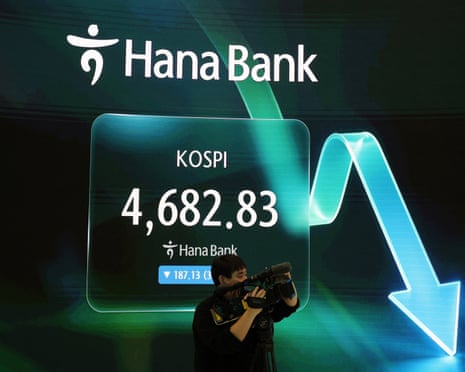
But in Seoul, the Kospi index has fallen 3% – closing at its lowest level since January 13. That’s quite remarkable, as the index nearly doubled in the first half of 2026.
Good morning, and welcome to our rolling coverage of business, the financial markets and the world economy.
After last week’s sharp losses in the markets, some stock market authorities are rolling out support measures to stem the bleeding.
Over the weekend, South Korea’s finance ministry, central bank, and top regulators agreed to prepare to possibly deploy their market stabilization fund.
They’ve not pulled the trigger yet, but it’s a signal to investors that they would do, if necessary.
South Korea’s minister of finance and economy Lee Hyoung-il told a press conference this morning:
“We are reviewing the steps needed in case market conditions warrant activating the fund. We will decide on the details as we assess how the situation evolves.”
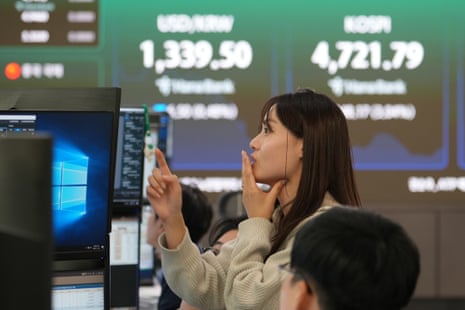
Taiwan is taking action too; its NT$500 billion (£11.5bn) National Financial Stabilization Fund said it has entered the market to support Taiwanese stocks and urged investors to remain confident.
Taiwanese authorities also widened their curbs on short sales of local shares, making it harder to bet against stocks.
China, meanwhile, is making it easier for investors to snap up shares on credit, by lowering the margin requirement for buying securities with borrowed funds. The Shanghai and Shenzhen stock exchanges also introduced a new batch of fee reduction measures, in what state newswire Xinhua called “measures to steady” the stock market.
China’s state-backed funds also poured a record amount of money into the market on Friday, according to Bloomberg.
These measures came after days of losses, especially among companies linked to the AI boom.
Last week, Taiwan’s benchmark index had its worst weekly fall in 35 years.
And in the US, the Nasdaq Composite erased its 2026 gains on Friday.
The agenda
9am GMT: Eurozone flash PMI report for November
9.30am GMT: UK flash PMI report for November
From 9.30am GMT: CBI annual conference in London
Noon GMT: Mexico’s Q3 GDP report
2.45pm GMT: US flash PMI report for November