Telangana is exploring a proposal to make six months of robotic surgery training mandatory for postgraduate medical students, as the State looks to build a trained workforce to expand advanced robotic procedures across its government hospitals.
Health Minister C.
Damodar Raja Narasimha said the government would approach the National Medical Commission (NMC) for permission to introduce the dedicated training period as part of the three-year postgraduate programme.
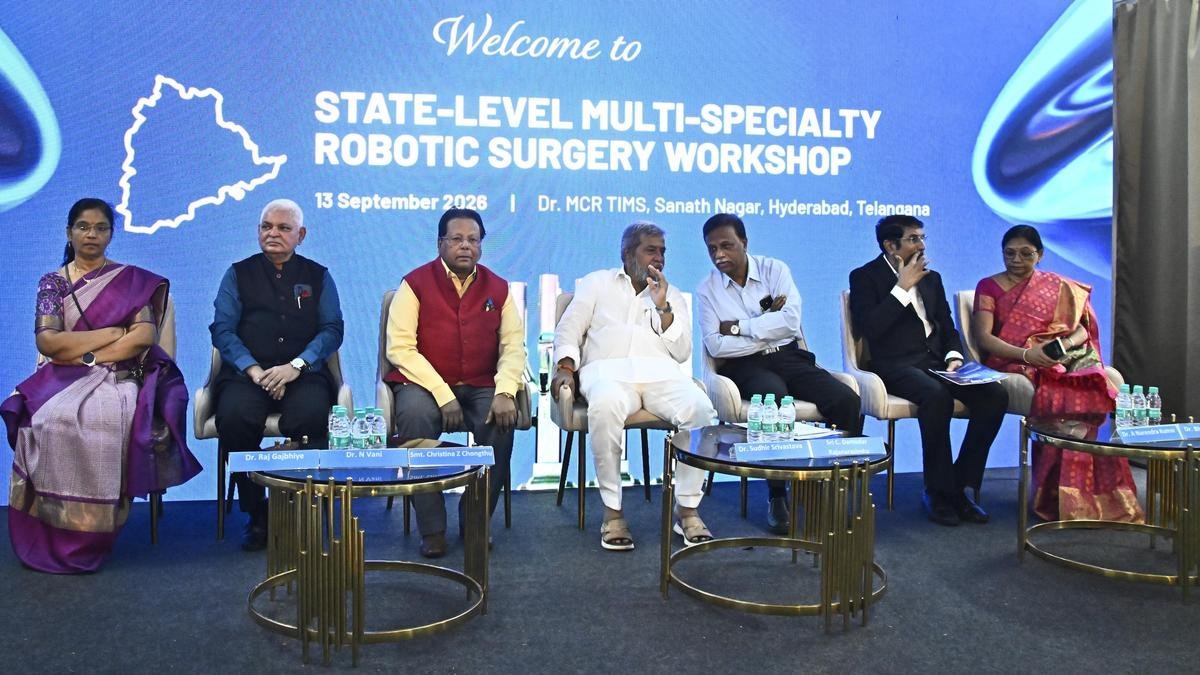
Advanced robotic system aids knee, hip replacement surgery Speaking at the ‘State Level Multi-Specialty Robotic Surgery Workshop’ at the Marri Chenna Reddy Telangana Institute of Medical Sciences (MCR TIMS), Sanathnagar in Hyderabad, the Minister said training would be central to Telangana’s plans to expand robotic surgery, whether through a hub-and-spoke model or dedicated robotic surgery facilities at the district level.
The proposal comes as Telangana is already attempting to build a statewide pool of surgeons trained in robotic procedures.
MCR TIMS Director Dr A.
Narendra Kumar said surgeons from 35 medical colleges and 47 hospitals, excluding speciality hospitals, are being trained in robotic surgery at two government institutions, Nizam’s Institute of Medical Sciences (NIMS) and MNJ Cancer Institute.
Robotic surgery expert Dr.
Sudhir Srivastava said such a model could allow specialist expertise to reach patients without requiring them to travel to major cities.
He pointed to the financial and emotional burden faced by families from rural and smaller communities when they have to leave their homes to access specialised treatment.
NIMS Hyderabad completes 1,000 robotic surgeries in under three years, over 90% performed free Former NIMS Director Dr N.
Bheerappa said NIMS had recently completed nearly 1,000 robotic surgeries and that the government was bearing the cost of such procedures for eligible patients through the Rajiv Aarogyasri health scheme.
Director of Medical Education (DME) Dr N.
Vani said government medical colleges had a dual responsibility of providing patient care while training the next generation of doctors.
Introducing young surgeons to newer technologies, she said, could have a multiplier effect across the government healthcare system.
Surgeon in Wuhan, patient in Hyderabad: How a robotic surgery unfolded in real time She also stressed that young surgeons should not rely solely on the technology, but must combine it with clinical judgement, human touch and compassion.
Experts at the workshop also cautioned that expanding robotic surgery is about considerably more than installing machines.
Government Medical College Nagpur Dean Dr.
Raj Gajbhiye said robotic surgery was no longer merely a technology available at a few high-end private institutions.
Beyond the operating room: the expanding role of robotics in healthcare For government hospitals, however, he said “the real objective should be equitable access to advanced surgical technology.
“Success of robotics is not about purchasing a robot,” Dr.
Gajbhiye said, pointing instead to the need for appropriate infrastructure, trained faculty, structured protocols, multidisciplinary teamwork and institutional support.