There is hope in solar power. As the UN meets, we are urging leaders to pursue a clear goal: clean energy for all by 2030
Our message to global leaders: we need solar power everywhere by the decade’s end
As climate experts from around the world gather in New York for their annual week of talking through the world’s deepest dilemma, the vibes are mostly bad.
Though 2026 seems likely to set a new global temperature record (and 2027, as El Niño gathers steam, is almost certain to break it), and though the planet has careened from one climate disaster to another (European heatwaves that killed tens of thousands, a Nepali flood that wiped out entire communities), and though scientists warn that we’re reaching precisely the global tipping points they’ve long feared (the new research on the faltering great currents of the Atlantic should send a literal chill up your spine), there’s a distinct lack of political momentum.
The host superpower is attacking country after country in search of oily “energy dominance”; even the noblest of its opponents (Canada’s Mark Carney, hope of democratic rebirth in the Americas) is busy building new oil and gas pipelines in the hopes it can bolster his besieged economy. Britain, which finally purged coal power from its energy system last year, now seems poised to start new drilling in the North Sea. If there’s an apocalyptic fear that can still rouse politicians to action, it seems to be AI agents breaking through firewalls, not European nations facing firestorms.
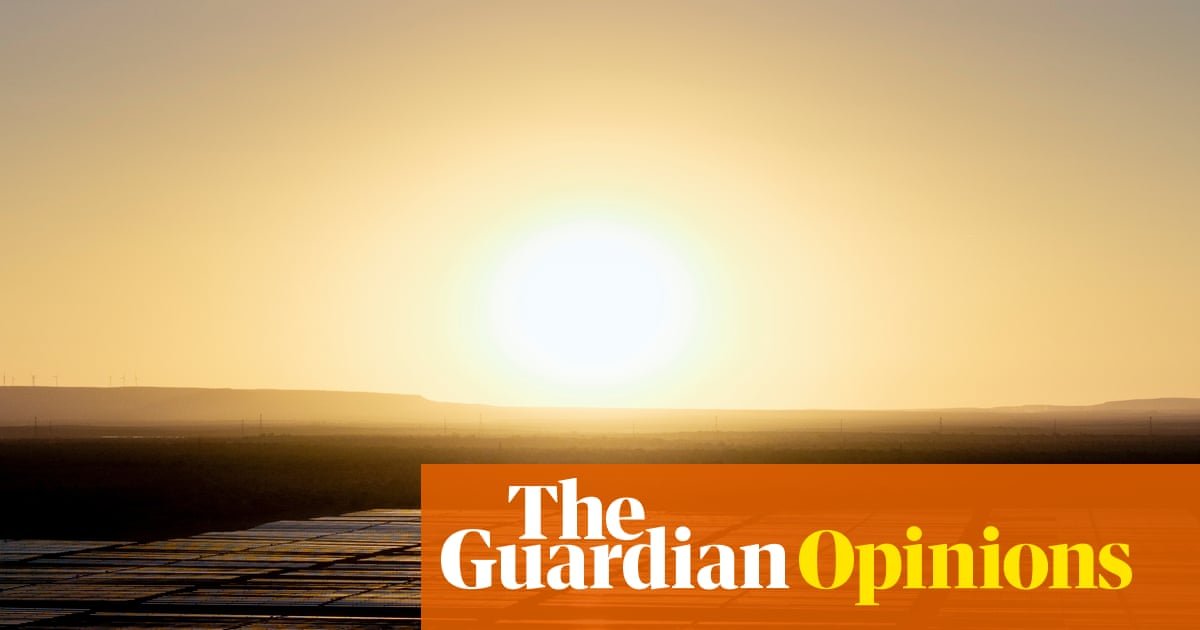
But there is one solitary (and very literal) ray of sunshine amidst this gloom: the steady rise of solar, wind and batteries. That clean energy trinity has broken out of its Chinese base and over the last few years expanded quickly across the planet – from Karachi to California to Cuba, solar panels are going up faster than any energy source has ever grown. It’s even begun to demonstrate that it can drive emissions down: China seems to have started on its downward slope years before most thought it could, and California has cut the use of gas to produce electricity in half in the world’s fourth-largest economy.
None of it is happening fast enough to catch up with the physics of global warming, though – which is precisely why civil society will now try to double down on this one bright spot, and push for a rapid acceleration of clean energy; this transition is going fast, but it needs to go much faster. And it can – China and India are using barely half their solar panel factory capacity, and too many countries are hedging their bets, using clean energy as additional power instead of replacing fossil fuels.
That’s why a group of leading advocates will deliver a letter to the UN this week, urging faster action. The letter offers a clear goal for the entire world to rally around: clean energy access for everyone, everywhere by 2030. And a way to get there: raising funds to bring clean energy to the poorest corners of the world and organizing in our communities, including for a global Sun Day of action next year to kick off what could be the great uniting project of our time.
The signatories range from the most popular active politician in the US (that would be Bernie Sanders) to the most morally grounded spokesperson of the global south (Yeb Saño of the Philippines, say, whose witness after devastating hurricanes helped produce the Paris accords). It comes from great diplomats such as Laurence Tubiana (who helped midwife those Paris agreements) and celebrities and activists such as Jane Fonda. There are leaders from the world of clean energy (Danny Kennedy, for instance, the secretary of the Global Solar Council), and stalwarts from the continents most damaged by rising temperatures (South Africa’s Kumi Naidoo, president of the Fossil Fuel Treaty Initiative). Clean energy entrepreneurs, such as Muhammad Mustafa Amjad of Renewables First in Pakistan, but also the world’s most famous rock climber, Alex Honnold, who runs his own solar non-profit. As they write:
The path forward is difficult, but the way is clear. We want solar for everyone, everywhere, before the decade is out. We know that standing up to the powerful can be scary. But if there is one thing that unites us, it is that we live beneath the same sun. That unity is our strength, and we must use it to act now.
The path forward is difficult, but the way is clear. We want solar for everyone, everywhere, before the decade is out.
We know that standing up to the powerful can be scary. But if there is one thing that unites us, it is that we live beneath the same sun. That unity is our strength, and we must use it to act now.
The letter will be accompanied by the unveiling of a giant mural near the celebrated High Line in New York City. The message is simple, but its three words convey the solution to so many of the interlocking crises we now face: clean energy now.
By the time advocates gather for next year’s New York Climate Week, the landscape may be very different. The physical landscape (there is, I fear, no doubt that El Niño will change the literal map of the world), and the political landscape. If a resurgent movement demands action, we finally have the tools to make that demand matter – a working planet that runs mostly on sun and wind is in tantalizing reach. At the last possible moment, with backs to the wall, we still have our face to the sun.
Bill McKibben is the Schumann distinguished scholar at Middlebury College. He is the founder of Third Act, organizing people over 60 for progressive change