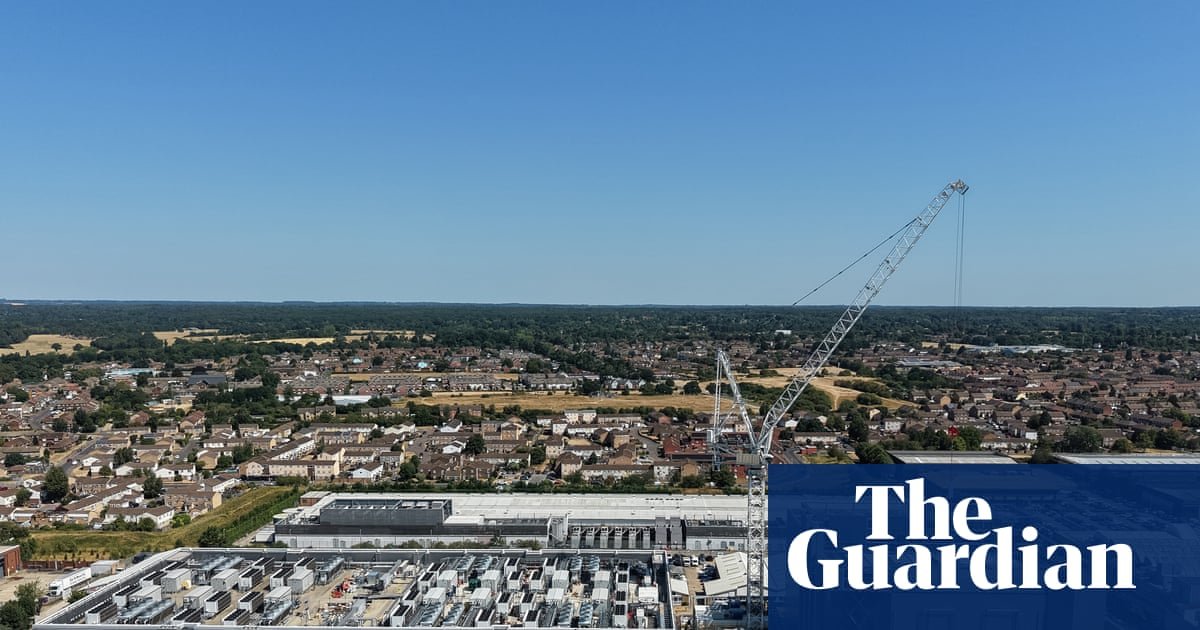
The movement against datacenters are uniting Americans because they perfectly illustrate how a few individuals hold all the power to control decisions that impact our lives

Bryce Gustafson has been knocking on doors in Indiana for more than a decade. The lead organizer with Citizens Action Coalition (CAC), a consumer and environmental organization, he usually encounters a mix of reactions when he’s out canvassing; whatever issue he’s talking about, there’s always at least a few people on the other side. But at a recent festival in the rural town of Monrovia, Indiana, he was struck by an unusual spirit of unity.
He was there about a proposed datacenter, a 550-acre (222-hectare) Google project in this small town of 1,600 people. “I had 50 people I talked to,” Gustafson told me. “Nobody wanted that datacenter in their community. And at least a half a dozen people came up to me to say, ‘Hey, I voted for Trump. What the heck’s he doing, supporting these things?’”
Gustafson said he’s had similar conversations all across the state. If there’s one thing he sees uniting Hoosiers of all stripes – from rural areas such as Morgan county to suburbs such as Franklin Township to the historically African American neighborhood of Martindale-Brightwood in Indianapolis – it’s fury over these water-guzzling, air-polluting behemoths and the tech oligarchs imposing them.
These dynamics are playing out across the US. Over the last year, intensifying waves of local opposition to big tech’s datacenter buildout have surged into a nationwide tsunami of resistance. Elites on both coasts, from leaders of the AI industry in Silicon Valley to leaders of the political establishment in Washington DC, have struggled to make sense of the backlash. First they tried to write it off as business-as-usual nimbyism: just a few local bans passed here and there, maybe some unknown city councilors losing re-election after signing datacenter deals – not such a big deal. Then senator Bernie Sanders and congresswoman Alexandria Ocasio-Cortez began calling for a national moratorium. Pretty soon Utah’s senate president got tossed out of office for supporting hyperscale proposals. And the movement continues to grow.

Today, three-quarters of Americans oppose local datacenter development, a swing of more than 30 points in just a year. More than 500 counties and municipalities have passed datacenter bans or moratoria, while dozens of proposed projects have been killed outright. And the issue has come to define some of the highest-profile political races in the country. In the battle for US Senate in Ohio, populist Democrat Sherrod Brown has made Republican senator Jon Husted’s support of datacenters the centerpiece of his campaign, prompting warnings from the National Republican senatorial committee that “datacenters are the anchor hanging around Husted’s neck”.
Other Republicans are taking notice. The Texas governor, Greg Abbott once touted the state as the “epicenter of AI development”; last week he said datacenters had “dug their own grave”. In Michigan, days after The Lever news outlet revealed that GOP Senate candidate Mike Rogers held millions in AI-related investments, he announced his support for a one-year moratorium on their construction in the state.
Big tech billionaires may finally be beginning to realize that this backlash poses real complications for them. But they still don’t understand the nature of the threat they’ve called down upon themselves, because the movement against datacenters represents more than just a series of local fights against a new kind of infrastructure project. It may, in fact, constitute the best opportunity we’ve had in generations to truly shake up American politics, by redirecting the partisan anger that oligarchic forces have long used to divide regular Americans and channeling that energy instead against the billionaires that are actually the cause of so many of our shared problems.
The political science term for this strategy, coined by Jennifer McCoy and Murat Somer, is “transformative repolarization”. McCoy and Somer argue that authoritarians and oligarchs often stoke what they call “pernicious polarization” – extreme toxic polarization that uses “us versus them” rhetoric, often on social and culture war issues, to divide the public in ways that harm democracy. In the face of such intense suspicion and distrust, depolarizing a society – trying to get people to stop viewing their fellow citizens as an existential danger – may not work on its own, in the absence of a unifying struggle to address underlying grievances. Instead, McCoy and Somer argue that opponents of authoritarianism need to redraw the lines of contestation that define their politics – to shift the “us versus them” struggle from, for example, a left-to-right polarization, to a different axis of conflict that can bring a large majority of the public together against real structural threats.
When you speak to organizers and community leaders on the frontlines of local datacenter campaigns, it immediately becomes clear that they are seeing new configurations of people coming together in precisely this way. “On many issues, people come in with a baked-in partisan lens that influences their thinking,” said Ben Inskeep, program director at CAC. “On datacenters, we don’t have those firm camps formed. And so we’re seeing broad concern from Republicans, Democrats and everyone else on the political spectrum. We’re seeing folks saying, ‘Hey, I might be a Maga Republican and you might be a liberal yahoo from the big city, but if you’re coming to our community to help us fight this datacenter, you’re my best friend.’”
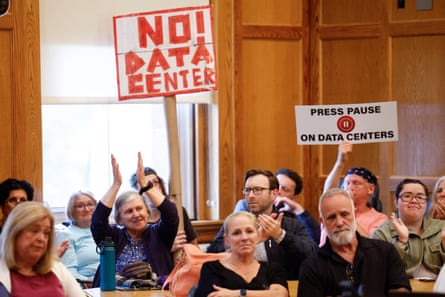
William Lawrence has been seeing the same thing in Michigan. The Sunrise Movement co-founder and congressional candidate made opposition to datacenters a main focus of his successful campaign for the Democratic nomination to represent the Lansing area. He’s now hammering his Republican opponent on the issue – to great apparent effect, according to a recent poll finding Lawrence leading in the district, which is now held by a Republican. “At a time when people are so polarized and isolated from each other, something that brings people together is rare,” he said. “We can all get together to watch the Spartans play at Spartan Stadium, but to get together in a context where you’re also talking about politics? That is a gift, and is not at all to be taken for granted.”
An organizer I spoke with who’s been opposing datacenter construction in Texas (who asked to remain anonymous) noted a similar dynamic playing out in his state. “I’ve never seen anything that mobilizes this many rural Texans before,” he told me. “Folks are starting to get politicized through this work. They’re realizing when they reach out to their state reps, their state senators, that these people are not batting for them. They’re batting for the tech oligarchs. And so people are realizing that the left-to-right divide isn’t as important as the divide between the working class and big corporate interests.”
The electoral implications of this process should be obvious. But for anyone too thick to draw their own conclusions, voters themselves are starting to get quite explicit. When MS Now asked a woman in Hood county, Texas, which is 80% Republican, “you’re willing to forgo every conservative issue and let the Senate fall into the hands of Democrats if that’s what it takes to kill datacenters?”, her response was immediate: “Yep. My entire community’s going to break rank.”
What remains to be seen is whether Democrats will seize this opportunity – or let Republicans regain the initiative.

A manifestation of greed
“I’ve been waiting a long time for people to wake up to how they’re being ripped off,” Gustafson said. So why are datacenters the issue that’s finally waking people up?
For one, they’re essentially unique in the breadth of their odiousness, so everyone has a reason to be offended by them. Hyperscale datacenters are big industrial warehouses that can cover literally dozens of acres, generate debilitating noise pollution, and severely impact local water tables. They use obscene amounts of energy, straining local infrastructure and in many cases causing utility rates to spike. This also has devastating climate and environmental impacts, as AI developers are overwhelmingly meeting their energy needs with dirty fossil fuel generators that spew outrageous amounts of planet-warming emissions and severely impact local air quality.
Then there are the process concerns: use of eminent domain, the provision of taxpayer subsidies, and big tech’s near-ubiquitous practice of pushing local officials to sign nondisclosure agreements (NDAs) that shroud deals in suspicious opacity.

And all of this is for what? Though the development of datacenters creates temporary construction work, once developed, the facilities do not provide communities with significant long-term jobs. The only thing these sites produce (other than many shades of pollution) is added compute for a technology that we’ve all been told will soon put billions of people out of work. In the meantime, as we wait to see whether that dystopian future materializes or it was all an economy-wrecking bubble, AI is largely being experienced as the thing making the internet more annoying, our jobs more stressful, surveillance more terrifying, and big tech billionaires – already widely despised – more powerful than ever. It’s not hard to understand why this doesn’t constitute a very compelling case for datacenters.
What it does provide is a perfect canvas on which to illustrate the broader problems with our political and economic system: how a few individuals have all the money and power to control the decisions that impact our lives. “Datacenters are the physical manifestation of the greed and the hubris and the power of the AI oligarchs,” Gustafson said. “That gets people thinking about why we are allowing these tech billionaires to just run roughshod over our state.”
What emerges from this process is a budding sense of solidarity that can extend far beyond the localized concerns that might have brought someone into a particular fight. Gustafson described how organizers from Evansville, a city in south-west Indiana, began supporting groups across the border in Kentucky when fights started ratcheting up there. Elsewhere, a farmer who became the leader of a datacenter fight in Henry county, Indiana, attended a meeting about a proposed project in a neighboring town. “Next thing you know, she’s helping that community, showing up for them, because it’s so much easier getting through this when you have somebody who’s been there and understands,” he said.
As Inskeep put it: “When one campaign ends, people are saying, ‘Hey, we fought ours, now that it’s done, we’re going to go to the next county and help them.’” And that starts a snowball effect. “People are seeing that they’re stronger together. It’s a beautiful thing.”

A singular opportunity
Clearly, these fights have created an opening for the left. But the politics around datacenters are still very much up for grabs. Democrats should have a strong inherent edge, given that – on this issue, like so many others – Donald Trump has forcefully aligned himself with his buddies in the billionaire class. The president’s aggressive plans to accelerate big tech’s datacenter buildout include opening up federal lands for hyperscaler construction, axing public participation processes in permitting, and even waiving Clean Air Act and Clean Water Act requirements on the radically absurd grounds that datacenter approvals need to be expedited for national security reasons.
But other conservative forces have been ahead of the curve. Steve Bannon has long been working to put Maga’s populist wing out front in opposing both datacenters and AI more broadly. The Texas organizer I spoke with told me he sees a significant number of people coming into datacenter fights casting blame not on big tech oligarchs, but on China or the United Arab Emirates, in ways that can feel decidedly xenophobic or Islamophobic. “This is an opportunity, but it’s a short-lived opportunity and we need to seize it,” said Inskeep. “Because this can also be used against us. If we are not effective at doing the political education and helping folks through that process, I do think you could have a far-right, nationalist, anti-immigrant person use this issue to come to power and then implement horrifying policies.”
Needless to say, for Democrats to seize this opportunity, they first must actually take a unified stance against datacenters. And unfortunately, many Democratic leaders remain just as in-bed with big tech billionaires as their GOP counterparts. Maine’s Democratic governor, Janet Mills vetoed the datacenter moratorium passed by her state legislature. Michigan’s Democratic governor, Gretchen Whitmer was accused of dismissing her constituents’ concerns about the many datacenter projects she has supported. The Democratic minority leader, Hakeem Jeffries opposes a datacenter moratorium and appointed the aggressively corporatist Josh Gottheimer and big tech-backed Zoe Lofgren to help develop House Democrats’ AI platform.

And there are some races where Democrats are squarely on the losing side of the issue. In Wisconsin, the Democratic nominee for governor, David Crowley, is already being blasted in ads by his Republican opponent for having said he wants Wisconsin to “become an AI and a data hub not only for the entire country, but for the entire globe”. Crowley won his gubernatorial primary after the entire Democratic establishment united to oppose the left-leaning candidate in the race, Francesca Hong, on the grounds that old “woke” posts – including a call to “cancel Thanksgiving” – made her unelectable. But Crowley’s troubles demonstrate why Democrats need to update their assumptions regarding what kinds of past statements make for real electoral liabilities. After all, nobody is actually going to cancel Thanksgiving. But making Wisconsin into a hub of hated datacenters? That feels like a very real possibility to a lot of Wisconsin’s swing voters.
When I asked Lawrence what he would want to say to party leadership on this point, his response was simple. “I would say, listen to the people. Nobody wants companies from Silicon Valley coming in, bullying us, making decisions that are going to impact the next century of our communities. Just listen to the people. You’ll be popular.”
So will Democrats take the chance they’ve been given? For the first time in generations, the billionaire class has overreached in a way that Americans of all stripes and ideologies are finding equally repulsive. They’ve created a perfect opening to repolarize the public – not just against Trump, but against the oligarchic and authoritarian systems that produced him in the first place.
The opportunity before us is singular. What a monstrous mistake it would be not to seize it.
Aaron Regunberg is a former Rhode Island state representative and a contributing editor at the New Republic. He is the director of Public Citizen’s Climate Accountability Project, but is writing here in his personal capacity
Spot illustrations by Ben Hickey