Exclusive: Ljubisa Karović tells Guardian the fact that he lived to tell the tale is nothing short of a miracle
It is the explosion just before he was nearly sucked out of the aircraft that Ljubisa Karović remembers. The thunderous noise of the window shattering that roused him from slumber in seat 11F, his window seat on the early morning Ryanair flight from Greece to Germany.
Eleven days and 11 nights later, it remains the prelude “to the chaos, the catastrophe” that keeps him awake at night.
“The explosion is what I remember,” says the Serbian entrepreneur in an interview with the Guardian.
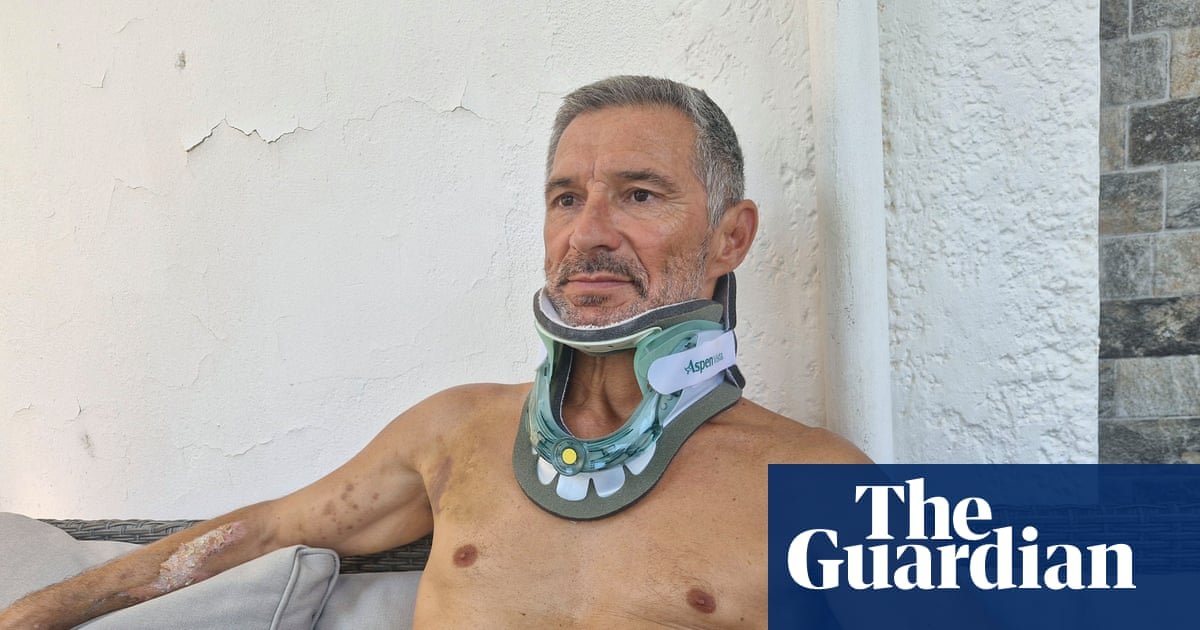
His head supported by a neck brace, his eyes staring into the middle distance, he adds: “Its the noise before the chaos, the noise that is always there when I close my eyes to sleep.”
Pain still haunts Ljubisa Karović, too, and it is easy to understand why. The burns and bruises livid on his right arm, ascending to his armpit and chest, are testimony to a fact that few will forget: that the 61-year-old is the only man to have been sucked out of an aircraft window – dislodged mid-flight in circumstances still under investigation – and survived.
“I am lucky,” he says with some understatement as he swats a fly on the porch of the unassuming villa he has rented in Katerini, the booming coastal resort outside Thessaloniki. “I don’t remember much and my head and neck still hurt but I am still alive. It could have been the seatbelt, the fact that I was still strapped in. But maybe it is fate. I believe in God and I thank him every day.”
Barely 100 hours have elapsed since Karović was discharged from hospital. The shock, he says, was overwhelming but the fact that he can tell the tale at all is nothing short of a miracle. His Greek lawyer, Vasilis Tsiaras, describes the wiry father of two as “being alive by mistake”.
“Ljubisa dipped in and out of death,” he says. “When the cabin lost pressure he was hurled out of the window from his chest up and immediately lost consciousness. He was on that plane heading to Germany to celebrate his brother’s birthday. Instead, at 15,000ft he ended up with his head and right arm outside the aircraft as it moved at a speed of more than 600km/h. Imagine that! He looked at death, that other world, and came back.”
Passengers on flight FR1879, including Karović’s wife, Svetlana, seated in 14C, three rows behind her husband, still have vivid recollections of the moment the window smashed, the oxygen masks coming down, the commotion that ensued as bottles and other objects flew through the air and fellow passengers grabbing Ljubisa, desperately trying to hold him in place.
“I rushed over too. None of the cabin crew helped. It was the passengers,” she says. “One man, I think he was an Albanian, was incredible. He tried to block the window, first with a bag that was immediately sucked out and then with a suitcase, which worked. We are eternally grateful to him.”
The unbearable moments of seeing her husband “half in and out of the plane” are thought to have lasted between one-and-a-half and two minutes.
“They tell me I fainted twice and again inside the plane and that my face was briefly deformed because of the pressure, the rush of air,” says the softly spoken Karović. “My wife reminds me about that.”
Ryanair has defended the performance of its staff saying cabin crew did a “phenomenal job”. Tsiaras, the lawyer, takes issue with this. While Karović’s son, Danjell, who booked the flight, has been contacted by the company, neither Ljubisa nor Svetlana have been called or received any assistance or support, he says.
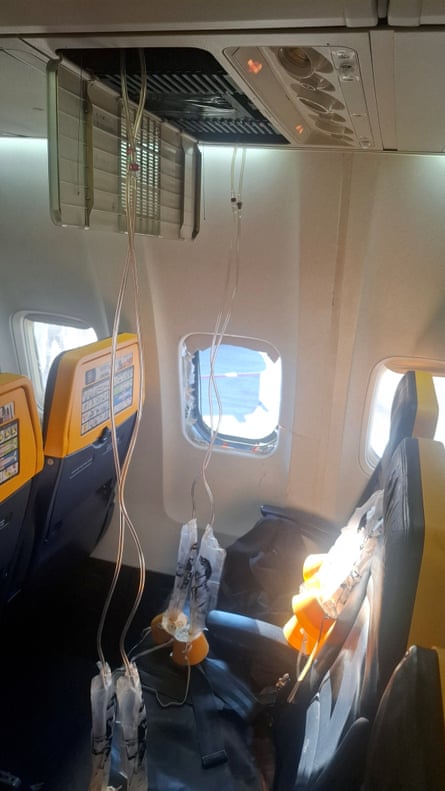
“We have no complaint with the pilot, who followed the safety protocols and dealt with the situation very well,” adds Tsiaras referring to the rapid descent pilots are forced to make in the event of an aircraft losing cabin pressure. “My client fainted two or three times, once outside the aircraft when he was sucked out of the window, and twice inside when, again, he lost consciousness. At no point did the cabin crew offer to help.”
Ryanair disputed this claim, saying that during a depressurisation and rapid decent to lower altitude, all passengers and cabin crew are required to fasten seatbelts and put on oxygen masks. “As soon as the aircraft descended to a safe altitude our cabin crew attended to and assisted Mr Karović, moving him to alternate seats (beside his wife) and arranged for a doctor onboard to sit with them until the aircraft landed safely back in Thessaloniki. They also arranged to have medical assistance standing by on landing in Thessaloniki,” the airline said in a statement to the Guardian.
Citing witness testimony, Tsiaras claimed the cabin crew personnel were paralysed by fear, perhaps brought on by the belief that with the dramatic loss in altitude the aircraft was about to crash.
“Everyone has agreed that the crew was in a state of shock, afraid that the plane was about to crash. It was the other passengers who rallied and gave Ljubisa water,” he says.
The owner of an aluminium factory based in Serbia that for years has exported goods far and wide, Karović, long a frequent flyer, recoils at the thought of travelling by plane again.
Doctors have warned that recovery will be slow, ordering him to wear the neck brace for at least six weeks when they will determine if surgery is necessary. “There are images that come back, the noise of the explosion, the chaos, but I want to recover,” he says. “And, yes, there should be compensation too. Not only emails that have focused on rebooking the flight.”
Asked if there is a message he wants to convey, he allows himself to break into a smile. “Always make sure to wear your seatbelt. I don’t want anyone to suffer what happened to me.”