By Rashid Al-Mohanadi Vice President of the Center for International Policy Research.
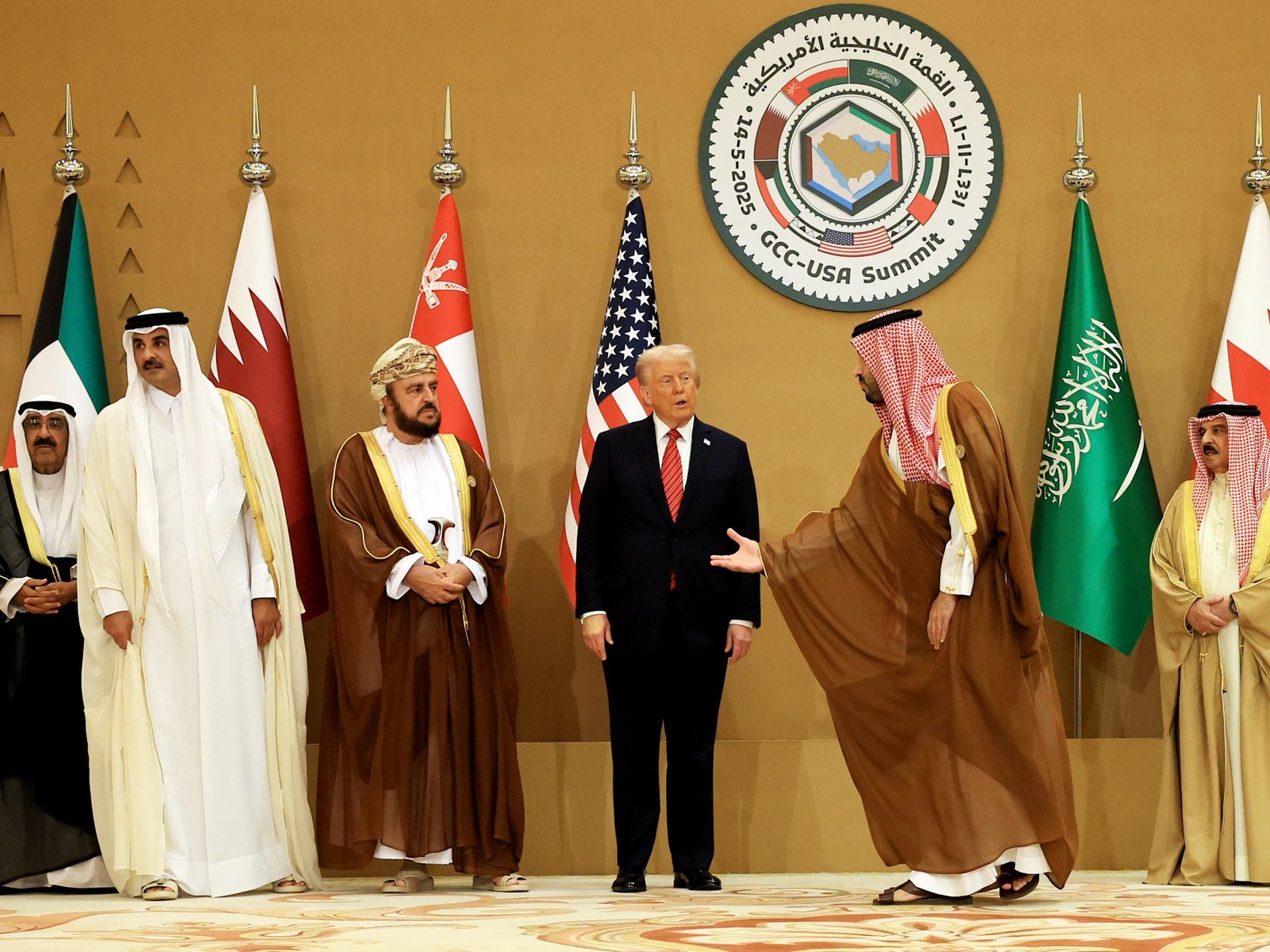
US President Donald Trump (3R) and Saudi Crown Prince Mohammed bin Salman (2R) prepare to pose for photos with leaders during the Gulf Cooperation Council (GCC) Leaders’ Summit at The Ritz-Carlton on May 14, 2025 in Riyadh, Saudi Arabia.
On November 10, Gulf defence ministers approved the establishment of a forward command in Kuwait under the Gulf Cooperation Council’s Unified Military Command, with forces to be allocated to it.
The decision marks another step towards Gulf states taking greater collective responsibility for their security.
One day earlier, after meeting Qatar’s prime minister, US President Donald Trump had said: “Iran militarily is effectively over.” He also said the US blockade would continue and left open further military action.
His remarks fell short of announcing an agreed end to the war.
Any opening for diplomacy deserves support.
But even a lasting agreement would leave the Gulf’s underlying security problems unresolved.
The Kuwait command’s value will depend on implementation and on how it connects with the region’s other security partnerships.
The answer requires abandoning the expectation that one grand security arrangement can resolve every threat facing the region.
That expectation assumes a degree of agreement about enemies, priorities and acceptable risks that does not exist.
Iran’s attacks on Gulf states during this war, together with Israel’s September 2025 strike on Qatar, demonstrate the breadth of the challenge.
A security architecture designed around only one adversary will leave serious gaps.
Armed militias and terrorist groups add other risks, alongside cyberattacks, maritime disruption and the consequences of state failure in the neighbourhood.
The erosion of international restraints on the use of force makes all of these problems harder to manage.
Advertisement The most credible response to this complex set of threats is a security architecture that is both layered and networked.
Gulf states are already moving in this direction.
The task now is to make those arrangements work together and sustain the effort when the immediate pressure of war recedes.
Layering starts with the recognition that different partnerships do different jobs.
National capabilities and cooperation within the Gulf Cooperation Council provide the foundation.
The relationship with the United States remains central, while additional arrangements address needs that a single partner cannot meet.
Cooperation with US Central Command supplies an operational layer.
The air and missile defence coordination cell opened at Al Udeid in January, for example, was designed to improve regional coordination, share threat warnings and prepare for contingencies.
The Mecca Joint Defence Agreement, signed in August by Saudi Arabia, Türkiye and Pakistan, adds a collective defence commitment among its members.
The Badr memorandum, signed in October by Qatar, Turkiye, Pakistan and Indonesia, sets out cooperation in defence manufacturing, research and technical training.
These arrangements should be judged by the gaps they fill.
Collective defence, operational coordination and industrial capacity reinforce one another, but none can substitute for the others.
Buying an interceptor, producing its components and deciding who will use it in a crisis are separate problems.
The next step is to connect these layers so that capabilities developed through one partnership strengthen what countries can do through another.
This is what makes the architecture networked.
Qatar offers a useful example.
It shares GCC membership with Saudi Arabia and participates in Badr alongside Turkiye and Pakistan.
It therefore connects to all three Mecca signatories through other arrangements, despite not being a party to Mecca itself.
Those connections create opportunities.
Stronger production capacity or better coordination among shared partners could improve the capabilities available to Qatar through its own relationships.
A more effective deterrent against attacks on a neighbour could also improve the wider security environment.
Such benefits depend on deliberate cooperation.
Qatar acquires no automatic Mecca guarantee through association.
Information, equipment and expertise travel through a network only when governments agree to make that possible.
The connections need as much attention as the agreements themselves.
Advertisement This is also where the Gulf’s interests converge with those of a wider group of countries.
European states, Japan, South Korea, Singapore, Indonesia and Pakistan all have reasons to resist a world in which force routinely overrides sovereignty and access to trade depends on political coercion.
Energy exporters and importers face different consequences when shipping is disrupted, but both need these routes to remain open.
Countries need not share a political system or an identical relationship with Washington to recognise the costs of an international order becoming less predictable.
There is already a diplomatic basis for cooperation.
The EU and GCC have jointly defended freedom of navigation through Hormuz.
ASEAN and GCC ministers have reaffirmed sovereignty, the protection of civilian infrastructure and the need for diplomacy.
These states should become more active defenders of the basic rules on which their prosperity depends.
They have an opportunity to shape the emerging international order collectively.
Their combined economic, technological and diplomatic resources can give weight to rules that individual states struggle to defend alone.
The same networks that help protect infrastructure can support coordinated diplomacy when those rules are violated.
Credibility will require consistency.
Sovereignty must matter when the aggressor is a partner as well as an adversary.
Civilian protection must apply in Palestine, Ukraine and the Gulf.
Mediation must remain possible even when the parties at the table are politically inconvenient.
At the operational level, the immediate task is to connect existing security arrangements.
Gulf governments and their partners should agree on how warnings can be shared across arrangements, which capabilities can be made available, and who has authority to request assistance.
Joint exercises should test those connections under pressure, including when one partner cannot participate.
The next priority is protecting the systems that allow societies to function.
Energy and water facilities, ports and communications networks deserve sustained cooperation on protection and repair.
A partnership that can restore an essential service quickly contributes directly to security, even if it has no mutual defence clause.
Diplomacy to prevent escalation must form a layer of its own.
Channels with Iran, arrangements to prevent incidents at sea and mechanisms for managing escalation remain necessary alongside stronger defences.
Gulf states should use any opening created by the current talks to pursue reciprocal, verifiable restraint.
This wider security architecture would give Gulf, European and Asian partners practical work around which to organise.
Some can contribute defence technology, others maritime expertise, industrial production, financing or diplomatic access.
Cooperation should allow states to contribute where they have both the capacity and the political willingness to act.
The difficulty is that every participant remains sovereign.
Gulf states themselves do not have identical interests.
Their external partners face different constitutional requirements, domestic pressures and relationships with other powers.
Some constraints are enduring; others reflect political choices that can change.
Advertisement A government willing to provide intelligence may be unwilling to deploy forces.
Another may support maritime protection but oppose an operation on land.
Those limits should be understood before a crisis, when there is still time to plan around them.
Overlapping partnerships also carry risks.
They can duplicate effort, create false expectations or draw countries into disputes they intended to avoid.
Clear responsibilities and consultation procedures are essential.
Adding agreements without clarifying what they deliver would produce more complexity without more security.
Nor should we promise that such an architecture will deliver a long peace.
The rivalries and political grievances shaping this region will not disappear because its governments cooperate more closely.
A more attainable objective is relative peace and security: fewer opportunities for coercion, crises contained before they widen, and civilian life less exposed to each new confrontation.
That means reducing the frequency and consequences of violence while continuing to work towards durable settlements.
Permanent emergency cannot become an acceptable destination.
Gulf states should use this moment to connect their partnerships, strengthen their own capabilities and establish clearer limits on escalation.
The aim is a region with more partners able to act together, and fewer crises capable of dragging everyone into war.
The views expressed in this article are the author’s own and do not necessarily reflect Al Jazeera’s editorial stance.