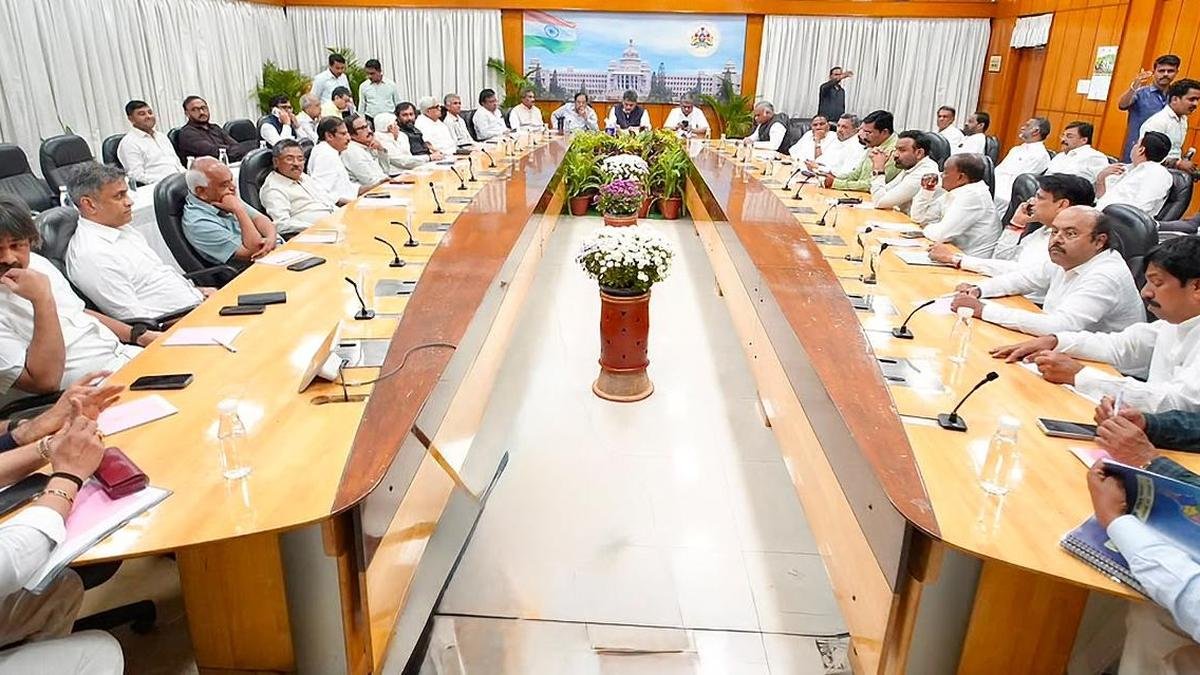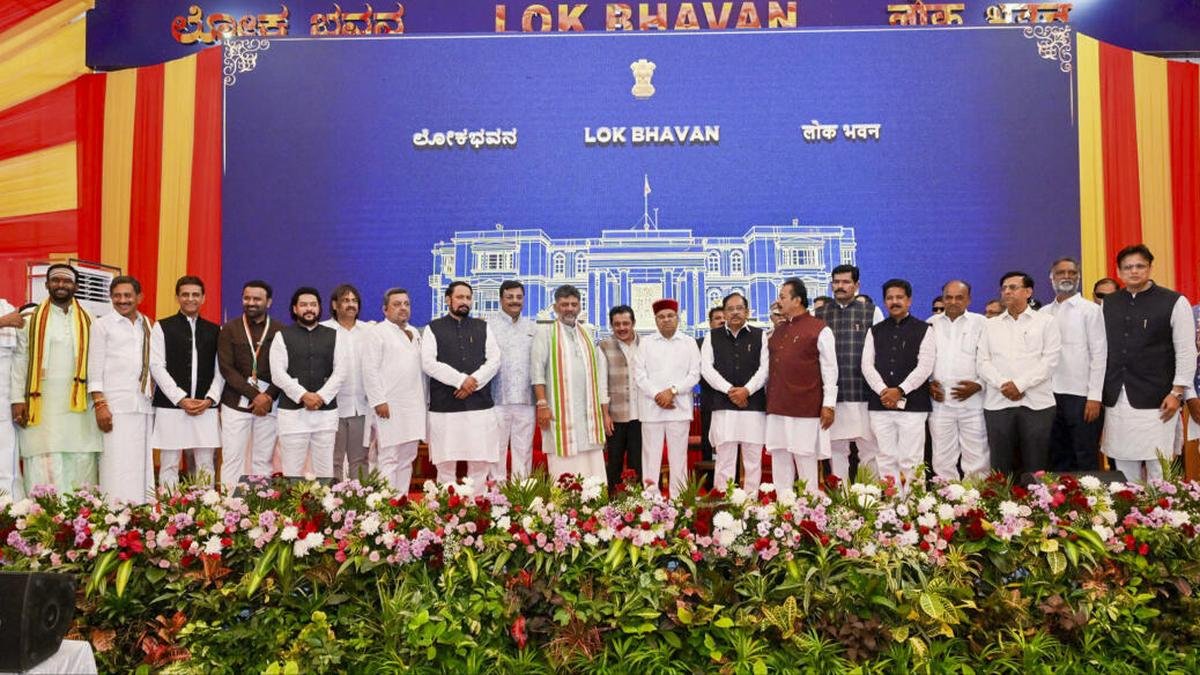
The Karnataka Legislature’s monsoon session will begin on August 13 with an ignominious first in recent history: a Cabinet with not even a symbolic representation of women.
The last fortnight has been marked by endless squabbles over Cabinet expansion and portfolio allocation, with intense arguments on ways to ensure caste and regional representation. Chief Minister D.K. Shivakumar and party functionaries have made multiple trips to New Delhi to consult with the high command, and spent much energy trying to placate “powerful” leaders who are miffed over being denied Cabinet berths or over not getting what are described as “plum portfolios.”
However, women’s representation has clearly not been regarded as an issue worth breaking a sweat over. When asked by the media why not a single woman was included in his 33-member Cabinet, Mr. Shivakumar candidly admitted that there was “no urgency” in the matter, while casually assuring that the one vacant place would be filled by a woman. In fact, it was in an equally casual manner that Gayathri Shanthegowda, the lone woman who was in the Congress high command’s approved first list of Ministers, disappeared before the swearing-in ceremony, as the urgent demands of other powerful interest groups took over.
This situation is nothing short of ironic for two reasons: Congress has nationally been vociferously arguing for 33% women’s reservation, without encumbering it with delimitation or any other riders. At the State level, the Congress government has come to power riding on the back of five guarantees, two of which are specifically aimed at women’s empowerment. While the Gruha Lakshmi scheme promises ₹2,000 a month to women heads of eligible families, Shakti offers free travel to women in select buses.
Symbolic representation
The signalling is that while women are very crucial as voters, they are the last priority when it comes to sharing political power. The final electoral rolls published ahead of the 2023 elections showed that women voters outnumbered men in 17 electoral divisions out of the 34 in Karnataka. Naveddu Nilladiddare, a network of feminists and women’s rights groups, in a letter to the Chief Minister, put it succinctly: “An all-male Cabinet is not an oversight. It is a political choice. It sends an unmistakable message that women and women’s leadership remain dispensable when it comes to the exercise of state power.”
Interestingly, while there have been multiple street protests by supporters of leaders demanding their induction into Cabinet — foregrounding their caste, region, seniority etc. — there were hardly any protests against the non-inclusion of women in the Cabinet. There was some feeble noise in Belagavi in north Karnataka over Lakshmi Hebbalkar, who handled the Women and Child Development portfolio under the Siddaramaiah-led government, being dropped, but none on the larger question of women’s representation. Brahmins not being represented in the Cabinet grabbed more attention than women being denied a place.
The history of electoral politics in Karnataka shows that women’s share in political representation has always been abysmal, much like the rest of the country. In the 2023 Assembly elections, out of a total of 2,613 candidates, 185 were women. Of them, 10 were elected (with one more added in bypolls), which constitutes about 4.5% of the total Assembly strength. In the first two elections in Karnataka in 1957 and 1962, the share of women’s representation stood at 6.25% and 8.65%, respectively, the latter being the highest ever. Since then, the share has fluctuated, with the 1972 election seeing not even a single woman elected to the Assembly out of the 28 who contested. This is all the more striking in a State which was a pioneer in giving 50% reservation to women in local bodies.
The representation of women in Ministry too has been symbolic across parties, with the highest being four when the late S.M. Krishna was the Chief Minister. Women are often given what are regarded as “light weight” portfolios such as Women and Child Development or Kannada and Culture.
No doubt Mr. Shivakumar will stick to his promise of filling the one vacant berth with a woman, but that will not go beyond what it has always been — a symbolic gesture — in the absence of a system that makes representation count.