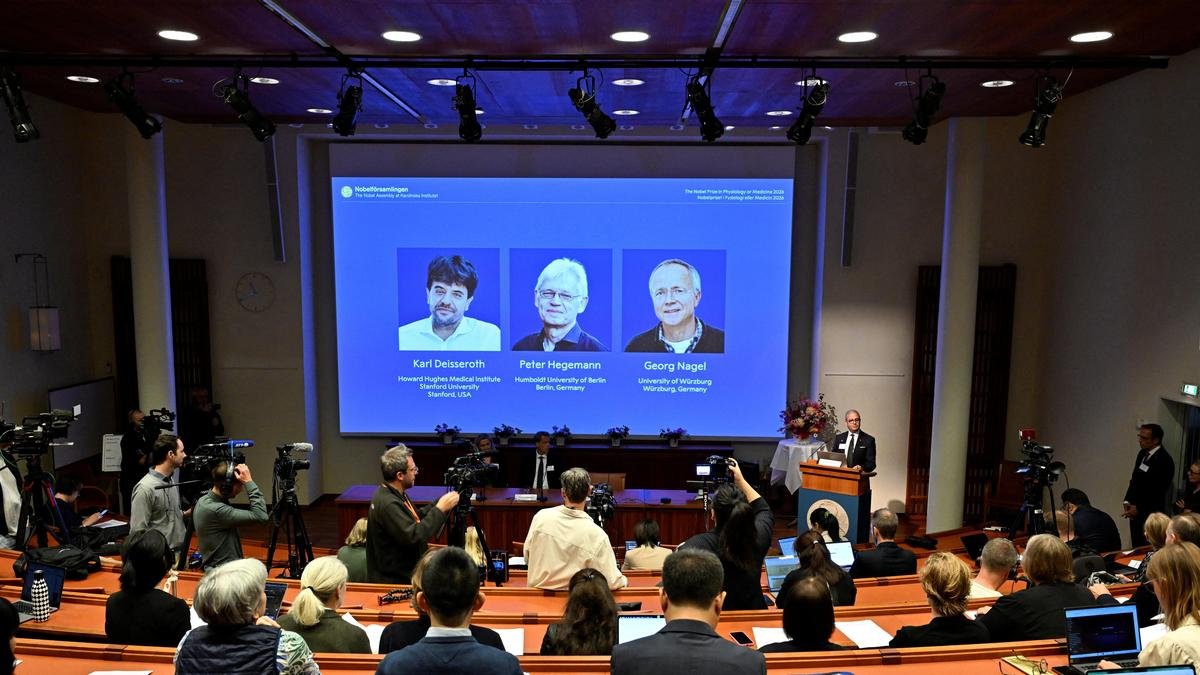
The story so far: The 2026 Nobel Prize in Physiology or Medicine, announced on Monday (October 5, 2026) went jointly to Karl Deisseroth, Peter Hegeman and Georg Nagel “for their discoveries concerning light-gated ion channels and optogenetics.” The prize amount of 12 million Swedish kronor, to be shared equally between the Laureates.
What is Optogenetics?
How the brain functions and pulls the strings to guide feelings, behaviour and bodily functions has long been a mystery. It was in the 20th century, that researchers began to map areas of the brain to related functions, but the methods they used could not prove causal relationships. So, the image they developed of the brain was like a sketch map, full of question marks and unknowns, as the Nobel committee described it. Now all this is changing, thanks to revolutionary techniques including optogenetics.
Optogenetics is a method that makes it possible to show how nerve cells shape memories, feelings and behaviour in the brain. Commenting on this year’s choice for the award, Per Svenningsson, Chair of the Nobel Committee for Physiology or Medicine, said: “Optogenetics provides opportunities for mapping the brain in a way that we could once only dream of”.
Deisseroth and colleagues coined the portmanteau word opto, from optics (meaning the use of light or optical technology) and genetics, referring to the use of genetic engineering. The word first appeared in print in late 2006, in a review article published in the Journal of Neuroscience to describe the fusion of ‘genetic targeting and optical control in neural circuits.’
Using optogenetics, researchers have been able to reveal neural circuits governing specific memories, feelings, and behaviours relevant for neurological and psychiatric disorders. In clinical medicine, researchers are even using the method in attempts to restore sight in people with visual impairment.
The Nobel journey
The 2026 Nobel for Medicine pipped many bookies’ favourites including GLP-1 class of drugs and CART-T to emerge winners.
As per the Nobel Committee’s release, it all began with Peter Hegemann’s curiosity, wondering how Chlamydomonas, a single-celled alga, is able to swim towards a light source. Georg Nagel went on to discover channelrhodopsin, an algal protein with unique properties found on the surface of the cell. When it is illuminated by blue light, a channel opens through the protein. Charged ions then flow into the cell, creating an electrical impulse.
It required the third winner Karl Deisseroth to transform the protein into a light-controlled switch for nerve cells. In the 2000s, Peter Hegemann and Karl Deisseroth introduced the gene for channel- rhodopsin into nerve cells from rats. By illuminating the cells with blue light, he was able to trigger a nerve signal. He published this breakthrough in 2005. Two years later, he made this light-controlled switch for nerve cells work in the brains of living mice.
The process might be understood as fundamentally split into three stages. Firstly, scientists use harmless viral vectors to deliver genes for light-sensitive proteins — called opsins (such as channelrhodopsin from algae) — into specific target cells. Once the cells express these proteins on their membranes, researchers deliver precise pulses of light using tiny fiber-optic cables or LEDs. Finally, depending on the opsin used, light exposure either opens ion channels to excite and activate the cell (turning it “on”) or pumps ions to inhibit and silence it (turning it “off”).
The Nobel laureates
Scientific discoveries seldom come without collaborations, across continents. This one spanned continents too. Karl Deisseroth is an American neuroscientist based at Stanford University and the Howard Hughes Medical Institute, while Peter Hegemann is a German biophysicist based at the Humboldt University of Berlin. Georg Nagel is a German biophysicist based at the University of Würzburg.
What is the future?
. While we are constantly discovering new facets and what we know of the brain is far less than what we don’t, every window into the brain helps advance our knowledge a little more, and for that scientists and neurologists will remain in awe, and grateful.