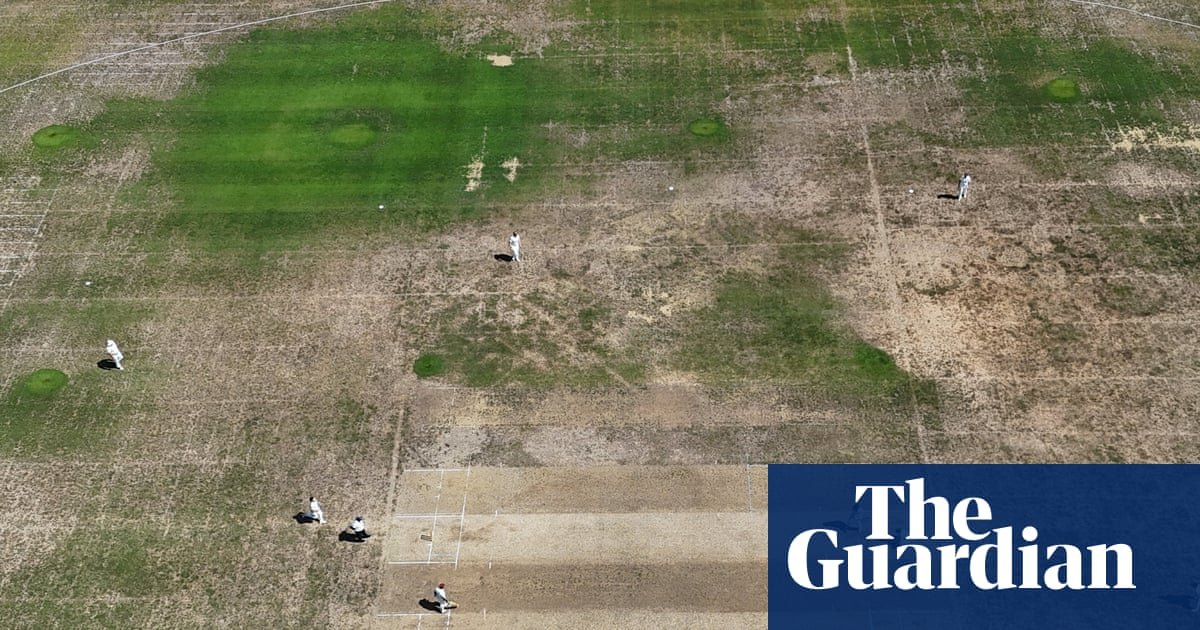
Cricket grounds across the country have been left parched by this summer’s unprecedented conditions.
Heatwaves leave groundstaff high and dry in search of playable wickets A summer of five heatwaves and barely a drop of rain have left groundstaff wrung out as they work all hours to keep packed schedule going On Thursday, the County Championship resumes for its final six-week run, charging towards 27 September with barely a pause for breath.
It’s tight at the top of Division One, with only 11 points between first placed Nottinghamshire and sixth placed Essex, while Kent and Northants prepare to elbow it out for the second Division Two promotion place alongside almost-inked-in Durham.
The players, on the treadmill since 3 April, and switching between competitions, are run ragged.
But no one is as wrung out as the groundstaff, dealing with a summer of fiery extremes, five heatwaves, excruciating temperatures and barely a drop of rain across most of England.
In the words of the Met Office scientist Mike Kendon, “the climate of the 20th century has now gone” but the cricket season is expecting to roll on by as if nothing is happening.
The Spin asked three head groundsmen how they are coping.
Vic Demain (Durham) It’s been incredibly hard for everyone with next to no rain since the middle of June.
We’re fairly lucky in the pro game, in that most of us have got good irrigation so we can keep things reasonably green, but looking at some of the recreational cricket clubs and a few pro grounds who haven’t got irrigation, it is a nightmare – the outfields are so hard and bumpy, it almost becomes dangerous.
Unlike most years we’ve really had no games called off because of weather which has added to an already heavy schedule.
There is a great deal of demand on pitches which are already almost at breaking point.
We are literally hunting for suitable areas of the ground to play the remaining fixtures on.
In a normal year we would have each game mapped out, that has gone out of the window – we’re looking for pitches with a reasonable covering of grass which might hold together for four days.
We’ve got three more Championship games, two women’s one-day matches and the very last game of season is the England v Sri Lanka ODI.
I like to use a brand-new pitch for international cricket but this year it has not been possible.
It is also increasingly difficult to renovate pitches.
I’m putting seed down but we are not getting enough water for it to grow.
Irrigation is fine up to a certain point but it is no substitute for proper rainfall.
We have to accept that the seasons are changing and with that comes different challenges, not necessarily just for the groundstaff but the producers of grass seed, and fertiliser – are we going to be looking at different grass species more tolerant to the warm weather and ground conditions we are getting even up here in the north-east?
It is not just professional grounds that are struggling with the conditions. here is the parched pitch at Lynton & Lynmouth Cricket Club in Devon.
Physically it is slightly easier, you’re not pulling sheets on and off, constantly on duty with the covers, but mentally it is really tough.
I’m not saying it has the pressures of a teacher or a brain surgeon, but the pitches dry out so quickly, it is really tricky to maintain moisture and if we cover up we can scorch the square.
The way things are going, there will be more water restrictions in this country, so we have to be proactive.
There are two or three bits of tech I’ve looked at– rainwater harvesting, irrigating from underground and feeding the roots.
I’ve even thought about putting a brook into our practice ground – sometimes the stupider the idea, the better it is.
We haven’t had rain for months.
The biggest thing is staff welfare, with people working out in extreme heat.
You can do all the due diligence you want but we still have to get stuff done.
I’m thinking of adapting rollers, putting a parasol on the top.
Climate change is there, evident for all to see, and if I didn’t try to protect my staff I wouldn’t be doing my job properly.
Up and down the country groundstaff are having to do what they can.
For limited-over matches there are criteria we have to stick to, basically they want pitches like the M6, but in four-day games they’re looking for a bit more balance between bat and ball.
The team have been doing 14- to 15-hour days to get the pitches ready.
It used to be at its hottest at 2pm, now the peak is 2-6 so we’ve been running around like idiots in the morning then hitting the shade.
I’m glad to see the football season come along because we need a break. skip past newsletter promotion after newsletter promotion When I first started at Leicestershire in 1993 there were about 20 games in a season, which started on 20 April and finished on 10 September.
We will have 48 games at Edgbaston this year plus the 166 training days.
The schedule is a killer.
Stephen Manfield (Worcestershire) This summer has not been conducive to making cricket pitches, it has been challenging keeping the field alive.
I’ve had boys on split shift, working in the dark.
It’s all getting a bit repetitive.
Worcestershire is not suffering a hosepipe ban, but we try to be mindful not to waste water.
The square has to be watered, and we’re trying to keep the important bits alive – but the situation is far bigger than cricket.
But we do have duty of care to make sure fielders can field safely and dive around.
But the far extremities around the boundary edge and the run-up to the practise area and the picnic area are just a desert.
Last year was pretty dry too and it just seems as if we’re having terrible winters mixed with terrible summers.
England is built for moderation but at the moment we’re getting 30 degrees with absolutely no rain.
We’re finding that spin is becoming a big deciding factor, which is certainly not what New Road is known for!
The pitches are definitely changing, though our ground is an outlier because of the flooding and has so many variables.
During the second heatwave the office staff worked at home and we tried to do 20 minutes on and then half an hour off – the club have been really good.
We’re looking into more sustainable ways to store water, rainwater harvesting, but we need it to rain first.
We couldn’t harvest the floodwater because of what is in it.
Everything is a bit harder and it’s a bit harder to motivate yourself, it feels a bit like groundhog day, every day.
This is an extract from the Guardian’s weekly cricket email, The Spin.
To subscribe, just visit this page and follow the instructions.
Explore more on these topicsCricket The Spin newsletter County Championship Durham Warwickshire Worcestershire newsletters Share Reuse this content