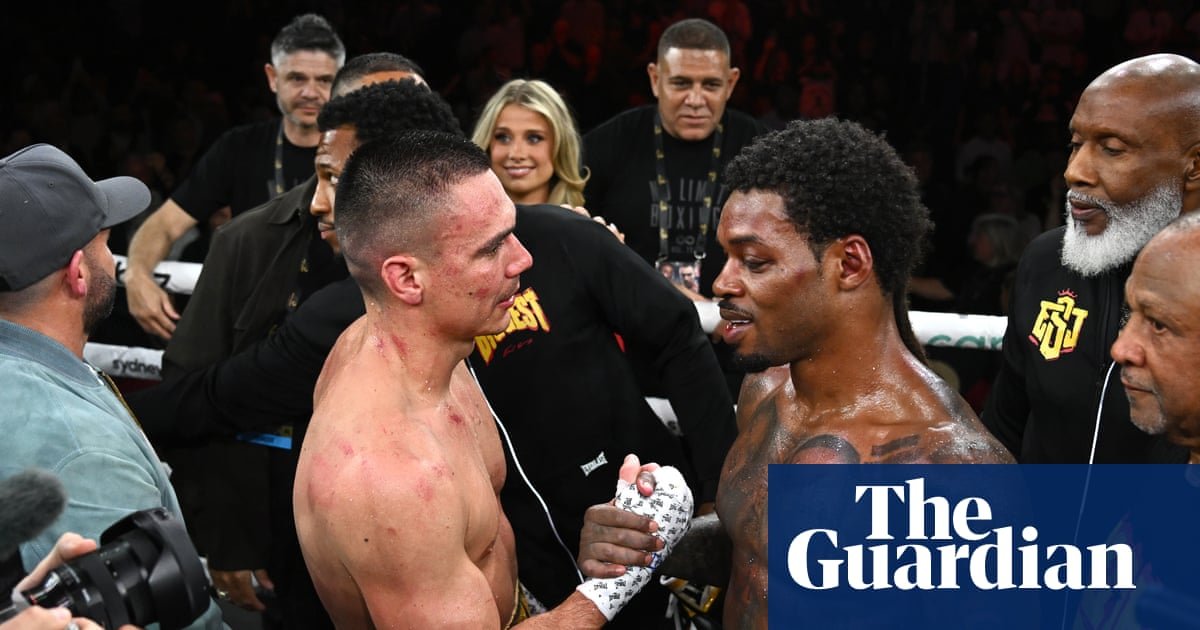
In Sunday’s bout, two boxers past their primes were fighting for the win, yes, but moreso for the chance to break themselves anew
A matchup between post-prime boxers has endless narrative potential, often disguising the ickiness of an already-shot fighter taking a beating. Robbed of their most explosive physical attributes, they try to compensate with wisdom and capacity for suffering. With legs dulled, they’re forced into harsh exchanges they were too defensively sound to allow in their primes. Fans get to enjoy the last gasps of greatness from their favorite fighters, and sportswriters get an excuse to describe them as “weathered veterans”. Afterwards, maybe one or both of them walks into the sunset.
Errol Spence, one of the best boxers of his generation, claimed he’ll do just that after losing a unanimous decision to Tim Tszyu on Sunday in Sydney. After winning the first 28 fights of his career and contributing to ear-splitting hype for a purportedly 50-50 welterweight fight with Terence Crawford, Spence absorbed a surgical, brutal beating from Crawford that showed the two were never really on the same level. As Crawford went on to win a title at junior middleweight and astonishingly defeat the legendary Saul “Canelo” Alvarez at super middleweight, Spence took three years off before returning to face Tszyu at age 36. Believe that he’s really retired at your peril; if the annihilation he suffered at Crawford’s hands wasn’t enough to deter him from boxing again, his initially competitive, eventually one-sided, relatively untraumatic loss to Tszyu may not move the needle either.
Tszyu is one of a few men who might know how Spence felt after that Crawford fight. In 2024, a then-unbeaten Tszyu fought late replacement Sebastian Fundora for the chance to become a unified junior middleweight champion. Tszyu looked sharp and mean and broke Fundora’s nose inside two rounds. In a stroke of freak misfortune, he then sliced his forehead open on the end of one of Fundora’s angular elbows. Tszyu fought the remaining 10 rounds with a flowing sheet of blood often impairing his vision or blinding him entirely, and lost the fight.
Next, Tszyu fought unheralded destroyer Bakhram Murtazaliev with such blind aggression he walked into a beating every bit as concussive as the one Crawford handed Spence, condensed into three rounds instead of nine. After a tune-up, Tszyu took a rematch with an improved Fundora and took another violent loss. Tszyu recently changed his nickname from “the Soul Taker” to “the Phoenix”, surely among the most obvious rebrands in history. He’d left no shortage of ashes to rise from. This fight was billed as USA v AUS, sold alongside a barren undercard for an appalling $79.99 on DAZN and Prime Video, but was most magnetic as a battle of broken soldiers.
Each man had his moments in the first five rounds, but the opening act evoked more of a vacance than a feeling. In his prime, Spence had boundless energy. He’d keep his jab pumping constantly in the opponent’s face, and when they had to pause their counterfire he’d step in with a big overhand left. Eventually, his opponents broke down under the steady onslaught. No one punch would do as much damage as his presence.
In Sydney, that pressure was gone. Spence mostly fought in retreat, cannily sneaking in straight lefts and body shots. Commentators Paulie Malignaggi and Shawn Porter – another former Spence opponent, who, like Crawford, arrived at retirement before Spence – identified Spence’s iffy balance seconds into the fight. He regularly overbalanced over his front foot, leaving his chin hanging in an ocean of space. It was too easy to picture Crawford hammering it with a precise, punishing counterpunch.
Luckily for Spence, Tszyu was mostly too stiff and slow to emulate Crawford. His calling card in his prime was his bloodlust, strong enough to quiet any fear of bleeding himself. He once hit Brian Mendoza with three successive uppercuts so animalistic it’s a wonder Mendoza didn’t run out of the ring in fear. But that version of Tszyu was gone, too. He stalked Spence, throwing isolated right hands that caught and jolted Spence but little else. After five rounds, Spence began to fade. He committed more of his energy to moving than throwing his own, made more difficult by Tszyu beginning to dig vicious shots into his stomach.
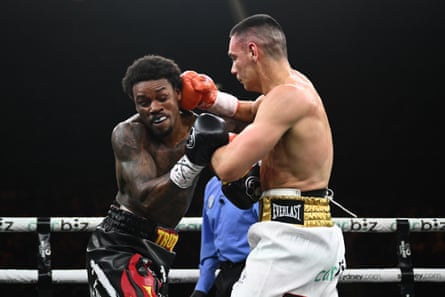
Buoyed up by a pep talk from coach and former boxer Jeff Fenech, Tszyu dominated a larger and larger share of the rounds. In the 12th, he hit Spence with a punch so forceful that the American caromed off the ropes and almost back to the center of the ring. But Tszyu didn’t seem especially interested in pressing his advantage. He had a safe lead, but it was hard not to see the ghosts of Murtazaliev.
Spence looked so weary in the corner before the final round that he was recognizable even to somebody who will never throw a punch in their life as a man who wanted this night to be over. I thought of a moment from the end of an interview Spence did with Andre Ward last month. Ward asked Spence why he was still fighting.
“Uh,” Spence said, scratching his head. “Let me see.” He didn’t pause for long, and eventually gave an answer, but even his momentary uncertainty felt telling. Tszyu fighting after Murtazaliev and Spence fighting after Crawford is illustrative of the dependent relationship many boxers have with this fatal sport; not being fully committed in that relationship only invites disaster.
During fight week, Tszyu declared, “I’m coming for every limb … especially that retina,” referring to Spence injuring his eye in 2021. The comment irked Spence into not shaking hands with Tszyu before the fight. Afterwards, they shook hands, hugged, and posed for a picture together. There wasn’t warmth, exactly – Tszyu was blustery in his postfight interview, and didn’t show anything that figured to impress the once great Spence – but maybe some mutual understanding. What these broken soldiers were fighting for wasn’t so much the merits of a win over the other but the opportunity to break themselves anew against a superior opponent. If only both of them could have lost.