The president’s pressure to reinstate Jensen Huang as CEO is calculated to have increased his personal wealth by $15m
If the Republicans’ thumping rejection in the midterms was meant as a rebuke over voters’ fears about rising corruption, Donald Trump’s brazen actions over Nvidia suggest he was oblivious.
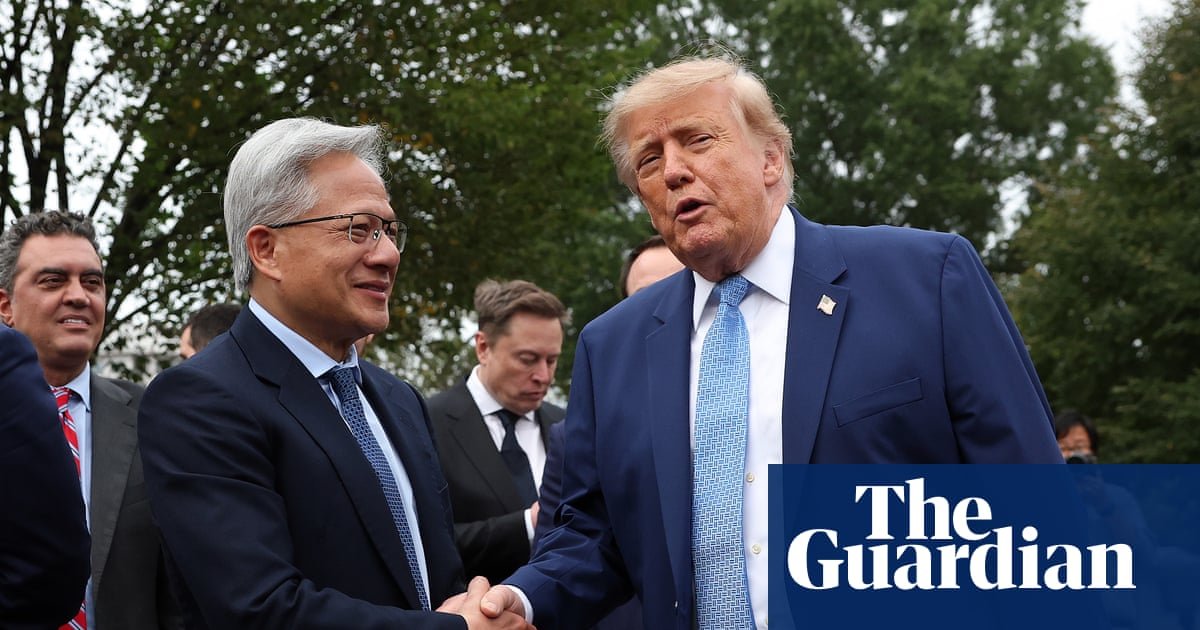
Trump’s dramatic intervention to pressure the company’s board into reinstalling Jensen Huang as chief executive sent Nvidia’s stock market value soaring by 33% – and increased his personal wealth by $15m, according to Democracy Defenders Fund, an ethics watchdog.
The president’s vested interest in the fate of companies whose market value is affected by his administration’s decisions has been seized on by corruption monitors at a time when other observers – including many of Trump’s fellow Republicans – have homed in on the national security impact of Huang’s extramarital relationship with an alleged Chinese intelligence asset.
Newt Gingrich, the former House of Representatives speaker – hitherto a staunch Trump ally – spoke for many Republicans with a social media post after Huang’s reinstatement that appeared to condemn the president’s action without actually naming him and making no mention of corruption concerns.
“There is something profoundly wrong about Jensen Huang having a relationship with a Chinese Communist Spy and helping China get a huge number of very advanced computer chips when that was specifically against the policy of the United States government,” he wrote on X.
“Now he is being reinstated as CEO of the most advanced chip making company in the world. Congress should really dig into this as a national security issue of enormous proportions.”
Yet corruption, rather than national security, is likely to be the prime worry as long as Americans continue to grapple with persistently high living costs. Voters overwhelmingly identified the issue as their No 1 concern in the run-up to polling day on 3 November.
Anxiety over graft in government is fed by the reported increase in Trump’s personal wealth by at least $2.2bn from multiple business ventures, including cryptocurrency, following his return to the White House in January 2025.
Those fears are likely to be rocket-fueled by his extraordinary initiative in pressuring the Nvidia board to reinstate Huang 11 days after he was forced to resign over his affair with Alice Huang – no relation – who US intelligence identified as an asset for China’s ministry of state security. She was also part of a ring to illicitly ship Nvidia semiconductors vital for artificial intelligence to China in violation of US export controls.
“Voters on election day were expressing extreme displeasure with the corruption that’s run rampant in recent years, but it does not appear that President Trump is shifting his approach in any way,” said Brendan Fischer, director of strategic investigation at the Campaign Legal Center.
“This saga really illustrates how corruption and conflicts of interest are warping US policy, and potentially even undermining undermining national security.”
Richard Painter, a former White House ethics lawyer in George W Bush’s administration, suggested the corruption and national security dimensions were likely to be intertwined.
“Determinations were made that the Chinese should not have access to those chips. Well, they got them, and why did they get them?” he said. “Was it that government people knew government were looking out after their either their own financial interests or companies they were personally close to, or what happened? I think Congress is going to investigate.”
Trump owns stock in Nvidia. So too does Cantor Fitzgerald, the investment firm formerly headed by Howard Lutnick, the commerce secretary, before he passed ownership to his sons and who has been accused of taking a soft line on the sale of Nvidia’s chips to China in a manner that has raised suspicions of a conflict of interest.
The value of the president’s Nvidia holdings grew to up to $62m on the eve of the scandal but dropped precipitously as the company’s worth on the stock market plunged following Huang’s resignation. They rebounded immediately this week after his reinstatement.
According to the Democracy Defenders Fund, Nvidia is one among multiple companies whose stock is held in the Trump’s family Revocable Trust. Through the trust, the president’s accounts have trade Nvidia stock more than 100 times since he returned to the White House, with transactions worth up to $97.5m.
“President Trump used the power of his office to intervene in Nvidia’s affairs, brushing aside grave national security warnings to prop up the company’s stock value,” said Norm Eisen, the fund’s executive chair and a former White House ethics “czar” under Barack Obama.
Amid a blossoming relationship between the president and Huang, Nvidia has contributed $25m to Trump’s prized White House ballroom project, having earlier given $1m to his inauguration fund.
But the president’s personal intervention on Huang’s behalf contravenes longstanding US practices of non-intervention towards private businesses, argued Painter, the former Bush administration ethics chief, who said Trump’s actions were worthy of a “socialist” government.
“The president shouldn’t be calling the board of directors of a company and telling them who the CEO should be,” he said. “That’s not the way companies are run in the United States, where we have a strict separation between the government and a company that’s not owned by the government.
“The only time that you’ve had [US] presidents put pressure on companies about their operations is during wartime, such as during world war two, or a crisis, but that’s not what’s happening here. This is what might happen in a socialist system.”
Trump’s naked intervention marks a radical departure from the free market laissez-faire ideology extolled by successive Republican administrations, most notably by Ronald Reagan.
The president had already signaled a shift from that position in 2025, when he reached an arrangement with Nvidia in which the company agreed to give the US government at least 15% of the revenue it generated from the sale of AI chips to China.
Dylan Hedtler-Gaudette, of the Project on Government Oversight, said the administration’s relationship with companies like Nvidia invited troubling comparisons with elements of “corporatist fascism” – widely seen as typified by Italy under Mussolini, or in a more extreme form, Nazi Germany – where the economic and political system merged under mandatory state control.
“That’s absolutely a part of what the National Socialist regime was,” said Hedtler-Gaudette, referring to Germany under Hitler’s dictatorship. “Obviously, we don’t have the genocidal part of that. But as far as specific components like the corrupt relationship between government and industry, with each day and each report that pops up, we’re getting a lot closer to that kind of system.”
“It’s called totalitarian because its the total fusion of the private and pubic spheres into one, usually controlled at the top by an authoritarian sort of dictatorial figurehead.”
It is a verdict echoed by Eisen, of the Democracy Defenders Fund, who said: “This is a corruption scandal unlike anything ever seen in American history, with the appearance of textbook market manipulation and insider trading coming straight from the Oval Office.
“Wealthy political allies are playing by a separate set of rules, but no one, not even the president, is above the law. Congress must investigate and hold everyone involved in this accountable.”