Rolling coverage of the latest economic and financial news
6m agoEnergy bills in Great Britain forecast to jump by £276 a year from January
7m agoUK business investment jumps as 'AI-driven wave' arrives
17m agoUK living standards picked up in April-June
22m agoIntroduction: UK economy bigger than first thought after GDP revised higher

Good morning, and welcome to our rolling coverage of business, the financial markets and the world economy.
The UK economy grew faster than first estimated in the second quarter of the year, despite the disruption caused by the Iran war.
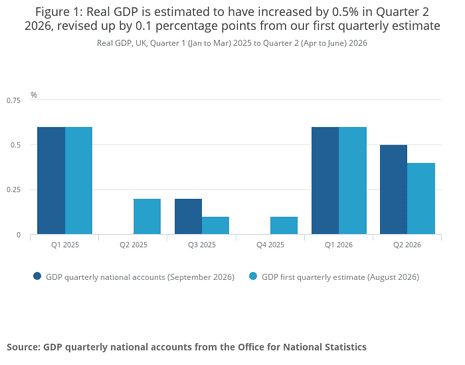
UK growth in April-June has been revised to 0.5%, up from the previous estimate of 0.4%, in the latest National Accounts.
That’s a welcome piece of good news for chancellor John Healey, as he draws up the budget due in four week’s time, and means his predecessor Rachel Reeves handed over a slightly larger economy than previously recognised.
Growth in Q2 2026 was driven by the services sector (where activity increased by 0.6%) and the construction sector (which grew by 0.8%), while the production sector shrank by 0.1%.
However…the Office for National Statistics, which publishes the data, has also revised down its estimate for growth in 2025.
ONS director of economic statistics Liz McKeown said:
“Today’s figures include our annual improvements to the measurement of the economy, incorporating new information that provides a better picture of activity across the UK’s service sector, alongside the usual inclusion of updated and improved data sources. “Growth for 2025 as a whole was a little lower than previously estimated, with the profile of growth across the quarters also revised. “However, stronger services growth in the latest quarter means the economy is now slightly larger than previously estimated.”
The agenda
7am BST: UK national accounts for April-June 2026
7.45am BST: French inflation report for September
10:30am BST: BoE Financial Policy Committee minutes
1.30pm BST: US PCE inflation index for August
Household energy bills in Great Britain are predicted to soar by £276 a year for the typical household from January as the impact of the Middle East war continues through the coldest months of winter.
The government’s cap on energy prices is poised to jump by 16% to the equivalent of £1,999 for the average annual dual-fuel bill in a further blow to struggling households, according to figures from the leading forecaster Cornwall Insight.
The increase for the January to March quarter is well above the consultancy’s previous prediction of a 9% rise, with analysts blaming the uptick on the recent rise in gas market prices to three-year highs.
It would take the cap to its highest level for four years.
The AI boom may have driven UK business investment up in the April-June quarter.
The ONS reports that business investment is estimated to have increased by 1.8% in the quarter, and was 5.2% higher than a year ago.
Gross fixed capital formation (which measures the acquisition of fixed assets by businesses, governments, and households) rose by 0.9% in Q2; the main drivers of the growth are “increases in other buildings and structures”, which would include data centres.
Martin Beck, chief economist at WPI Strategy, says:
“Consumer spending growth remained at the previous estimate of 0.3%, but business investment growth was revised up to 1.8%. That offers at least some evidence that the UK may be starting to catch the AI-driven investment wave very visible in the US.”
Britons also put more money aside for a rainy day in April-June.
The household saving ratio increased by 0.2 percentage points to 8.8% in Quarter 2 2026, driven by a rise in the contribution of non-pension saving, the ONS says.
An important measure of living standards jumped in the second quarter of this year, today’s national accounts show.
Real household disposable income per head increased by 1.0% in April-June, following a decrease of 0.8% in January-March.
That means people had more money left to spend, save, or invest after taxes and deductions, adjusted for inflation.