Blockchain intelligence firm TRM says North Korea’s TraderTraitor hacking unit is responsible for the largest crypto theft on record
9m agoElite North Korean hackers blamed for Binance theft
13m agoBitcoin and crypto firms hit by Binance breach
14m agoBinance freezes withdrawals after $6.3bn security breach
16m agoIntroduction: UK house price growth slowest since January 2024

The crypto industry is reeling from a massive hack at Binance, the world’s largest cryptocurrency exchange.
Digital assets worth more than $6.3bn (£4.7bn) have reportedly been taken from Binance by North Korean hackers, apparently after a laptop belonging to one of its engineers was hacked.
The company said its teams are “working around the clock” to resolve the issue.
“Rest assured that user funds are completely safe,” a Binance spokesperson said in a statement.
Binance said it had worked with partners to freeze the affected assets, with about $3bn located so far. It gave no update on the status of the remaining $3.3bn as Binance co-founder Yi He said the company would cover “all hacking losses”.
Jim Reid, market strategist at Deutsche Bank, reports:
Crypto assets have come under pressure after Binance, the world’s largest crypto exchange, suspended deposits and withdrawals following a suspected hacking incident. Bitcoin is down -0.40% this morning, following a -3.03% slide yesterday.
TRM Labs, a blockchain intelligence firm that tracks the industry, has declared that an elite North Korean hacking unit called TraderTraitor was responsible for the security breach at Binance.
TRM Labs have also calculated that the breach is “the largest crypto theft on record”.
In a report issued this morning, TRM Labs say:
On October 29, 2026, an attacker moved approximately $6.36bn out of Binance wallets on ten blockchains, most of it in about 20 minutes starting at 20:05 UTC. That makes this the largest crypto theft on record, about four times the $1.5bn Bybit hack of February 2025. Binance has confirmed a security incident and suspended withdrawals on several networks.
TRM attributes the attack to TraderTraitor, North Korea’s elite hacking unit, based on robust on and off-chain intelligence. We make this judgment with high confidence. TRM is tracking the funds and alerting partners through the Beacon Network.
News of Binance’s security breach sent bitcoin falling by more than 3% to a six-week low of $76,368 – although it’s since recovered back to $78,335 (-0.6%).
US stocks linked to cryptocurrencies fell in afterhours trading.
Shares in crypto exchange Coinbase Global are down 4.8%, while Strategy, the US company which has been a massive buyer of bitcoin, fell 5.75%.
Good morning, and welcome to our rolling coverage of business, the financial markets and the world economy.
Britain’s housing market is feeling an autumnal chill, as rising mortgage rates hits demand.
UK annual house price growth slowed to 0.5% in October, the slowest pace since January 2024, new data from Nationwide this morning shows. That’s down from 0.8% in the year to September.
On a monthly basis, the average price of a house was unchanged this month.
The jump in fixed-rate mortgages to almost 6%, on average, appears to have dampened buyers’ enthusiasm, pushing up the cost of repaying a mortgage.
Robert Gardner, Nationwide’s chief economist, says:
“Market activity and house price growth have slowed in recent months, in part reflecting the uncertain economic backdrop. Geopolitical tensions remain high, with the conflict in the Middle East exerting upward pressure on energy prices, fanning inflation concerns. “This in turn has led to mounting financial market expectations of Bank Rate increases, which have maintained upward pressure on the market interest rates which underpin mortgage pricing.
“Market activity and house price growth have slowed in recent months, in part reflecting the uncertain economic backdrop. Geopolitical tensions remain high, with the conflict in the Middle East exerting upward pressure on energy prices, fanning inflation concerns.
“This in turn has led to mounting financial market expectations of Bank Rate increases, which have maintained upward pressure on the market interest rates which underpin mortgage pricing.
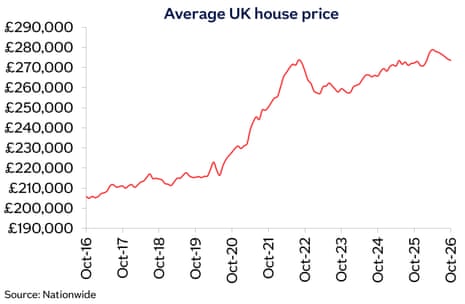
Forward-looking indicators suggest thee could be “further softness in the near term,” Gardner adds:
Surveyors report that new buyer enquiries remain weak. Moreover, consumer sentiment dipped noticeably in October, with households becoming less confident about the outlook for the general economy as well as their own financial situation in the year ahead.
The agenda
7am GMT: Nationwide’s October House Price Index
9.30am GMT: UK GDP quarterly national accounts: April to June 2026
10am GMT: eurozone GDP report for Q3 2026