Salaries will rise 28.3% to 32.4% over four years, an outcome partly shaped by a rank-and-file revolt within the Australian Education Union
Follow our Australia news live blog for latest updates
Get our breaking news email, free app or daily news podcast
Victoria’s school teachers are to become the highest paid in the country, after accepting the state government’s latest pay and conditions offer after a year-long bargaining process.
Australian Education Union (AEU) members voted 79% in favour of the offer on Monday, which will deliver total pay rises of between 28.3% and 32.4% over four years, plus a $2,000 bonus at the start of the agreement. The union also confirmed a planned strike will not go ahead on Wednesday.
Under the new deal, early-career teachers will receive a $12,343 increase by October 2026, bringing their pay in line with their counterparts in New South Wales. An experienced teacher’s salary will rise from $118,063 to $151,419 by 2029, including a $15,393 increase in 2026 that puts them ahead of NSW teachers.
The deal also improves conditions, including fewer after-school meetings, four professional practice days each year and eight student-free days each year from 2027. Existing face-to-face teaching hour maximums of 18.5 hours a week for secondary teachers and 21 hours for primary teachers are also secured in the EBA under the offer.
While the agreement still needs to go to a ballot of all covered employees, the government has already claimed Monday’s result as a win.
The premier, Ben Carroll, who until three weeks ago was the education minister overseeing the negotiations, said the pay rise recognised teachers, principals and education support staff who do “some of the most important work in our state”.
“It makes Victorian teachers the best paid in Australia – with the best conditions. It recognises that great public education starts with valuing the people who deliver it,” he said.
According to government sources, part of Carroll’s pitch to Labor MPs for the leadership was that he could resolve the dispute more quickly than Jacinta Allan. After just three weeks in the top job – and only three months until the Victorian election – he has now done that.
How the government pays for it is another question. The deal will cost more than $5.4bn, with the latest offer costing an additional $700m. Some government sources say that money may have to come from the government’s hard-fought surplus.
Carroll has also indicated he will increase school funding to meet federal Gonski standards before November – another key reason the latest offer was accepted – which may cost billions more.
The political upside, however, may be worth the financial hit. The deal removes the threat of further strikes before the election, allows Labor MPs to return to school events and means the government can campaign on making Victorian teachers the best paid in the country.
For AEU Victorian branch president Justin Mullaly, however, the credit belongs to teachers rather than the government.
“Increases like these are why it pays to be a union member. This outcome has been won through the direct efforts of AEU members, who demanded pay and conditions that reflect the value and importance of their work in Victorian public schools,” he says.
Neither the government nor the union leadership, though, mentioned another force that helped shape the outcome: a rank-and-file rebellion inside the AEU.
Groups such as Socialists in Schools, the Committee for Public Education and Fight the Crisis capitalised on growing frustration among the state’s teachers during the dispute, both towards Victoria’s long-serving Labor government and their own union leadership.
Through social media and workplace organising, the groups – dismissed by many in political circles as “Trots” – argued that the union had historically been too willing to compromise at members’ expense.
It is easy to see why their argument resonated. The last enterprise bargaining agreement, signed in 2022 in the wake of the pandemic, delivered an 8% pay rise over four years – well below inflation.
“We were told that was the best when could get and, as a result, teachers pay went backwards massively,” teacher Liz Walsh from Socialists in Schools says. “It meant this time around, members weren’t prepared to listen to union advice.”
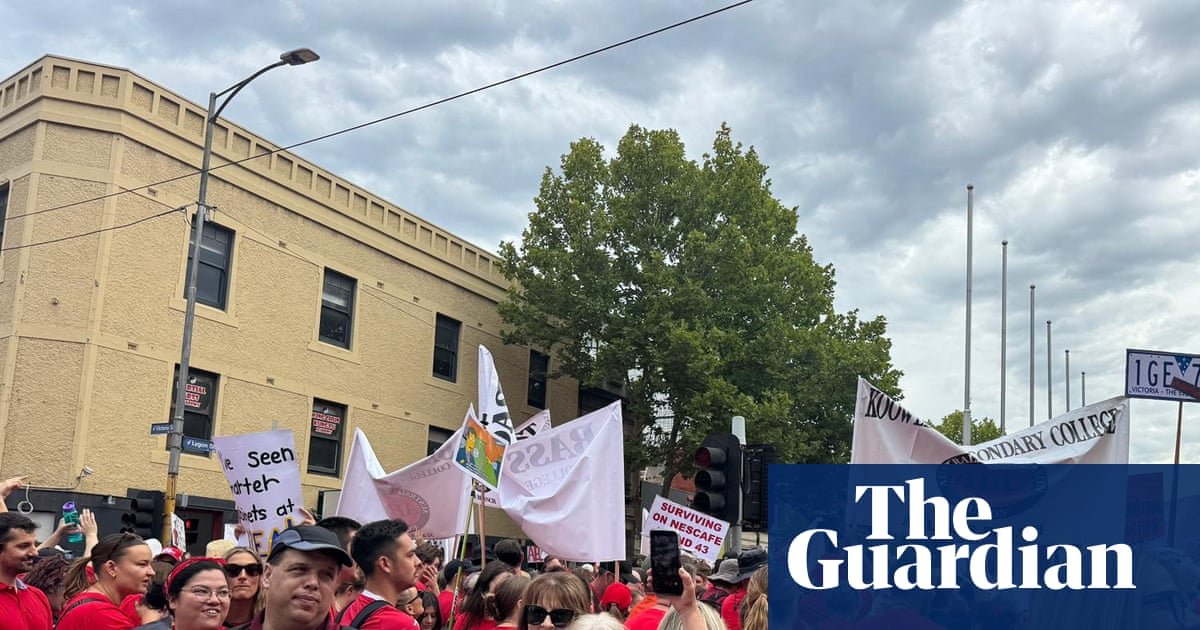
In 2022, the union did not strike. This time, 98% of members voted to strike on 24 March. The action closed or disrupted an estimated 500 schools, while 35,000 teachers filled Melbourne’s CBD in the biggest mobilisation in the union’s history.
The government’s offer in May improved from 18.5% to 28% over four years, but separated out education support staff. Fifty-eight per cent of members voted the agreement down in June.
A second offer followed. Again, the membership rejected it – this time by 51%.
“The reality is that a socialist-led campaign group actually connected with a majority sentiment in our union,” Walsh says.
“It wasn’t just a fringe minority that were prepared to vote no, but we had the majority of our union.”
She is critical, however, of the union for failing to capitalise on that momentum, noting the four-month gap between strike action in March and July.
Members voted again to strike on 19 August. Then came the third offer, the first under Carroll as premier. This time, members voted yes.
Walsh says during the dispute, Socialists in Schools drew on the experience of Victorian nurses and midwives in 2024, when members rejected an offer despite their union leadership recommending it. For the health workers, the government returned with an improved offer – 28.4% over four years – within weeks.
The nurses, Walsh says, showed that rejecting a deal did not mean “going back to square one”.
“It didn’t end in disaster. They weren’t punished for it. In fact, there was only something to gain.”
Walsh says Socialists in Schools respects the result of Monday’s ballot and will continue campaigning to improve conditions through other means, including advocating for full Gonski funding. Thirteen members are also running as Victorian Socialists candidates at the November election, including a challenge to Carroll in his own seat of Niddrie.
But she hopes the main lesson other public sector workers will draw is that collective pressure can change what a government is prepared to offer and what a union is prepared to fight for.
“You don’t have to just accept the crumbs,” she says.