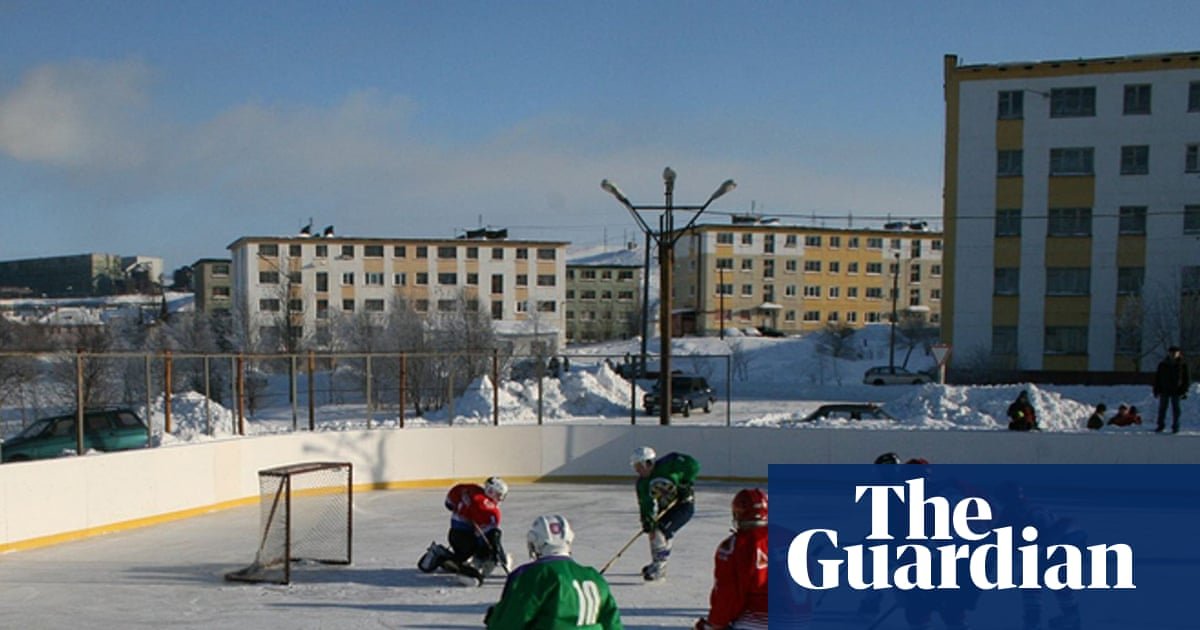
The Tunturi-Kiekko ice hockey team, based in Finland close to its most northerly border crossing with Russia, play against a team in Nikel, Russia, shortly before the Covid pandemic.
Photograph: Juha Valtonen The Tunturi-Kiekko ice hockey team, based in Finland close to its most northerly border crossing with Russia, play against a team in Nikel, Russia, shortly before the Covid pandemic.
Can they ever recover?
Ban on Russian teams competing internationally has been lifted but days of friendly relations between Norwegian, Finnish and Russia players are a distant – if fond – memory For years, playing ice hockey against teams from Russia was a central part of Janne Tervahauta’s social life.
Through his team, Tunturi-Kiekko, based in Ivalo, a rural Arctic town close to Finland’s most northerly border crossing with Russia, he would travel around the Arctic with his teammates.
But the Barents Hockey League went on hold during the pandemic, and after the full-scale invasion of Ukraine, all contact with Russia was stopped.
“This hockey league was amateur, and a kind of old guys league.
But it was very important for us,” said Tervahauta, 51.
Since the war he has not had any contact with Russian teams.
“Of course it is very sad,” he said.
“It was a very important league of Arctic people.
To meet each other – and of course it is a way to see and travel in the north.” Before February 2022, ice hockey diplomacy was a normal part of daily life for people in northern Finland, Norway and Russia.
From the European side, it was a perfect way to help thaw cross-border relations after the cold war.
And Russia’s global prowess at the sport made it an important lever for the country to exert soft power; it is no coincidence that it is Vladimir Putin’s favourite sport.
In North America, Russian players have long been among the best in the National Hockey League (NHL): the Russian star of the Washington Capitals, Alexander Ovechkin, is the league’s all-time leading goalscorer, while also being the founder of a pro-Putin “social movement” called PutinTeam.
Vladimir Putin and the Russian star of the Washington Capitals, Alexander Ovechkin (third from left), in 2015.
RoKi, the official team of Santa Claus, based in Rovaniemi, the capital of Finnish Lapland, and who play in Finland’s second highest league, regularly used to collaborate with Russian teams.
They played pre-season friendlies against them, and hosted summer training camps for Kontinental Hockey League (KHL) teams from across the border.
“There was considerable cooperation between Finnish and Russian ice hockey,” said Mika Toivola, the chief executive of RoKi Hockey.
“Finnish players played in Russia, Russian players played in Finland, and clubs also met in pre-season friendlies.” But all of that came crashing to a halt in February 2022, just four days after Finland beat Russian players to men’s ice hockey gold in the Beijing Winter Olympics.
Since Putin’s invasion of Ukraine, the national sides have not played each other, Finland joined Nato and the long border between the two nations completely closed.
Janne Tervahauta said the Barents Hockey League, which involved teams from Finland, Norway and Russia, was important to Arctic people as a way to meet people and travel.
Photograph: Janne Tervahauta Despite this, in a major coup for Putin, the court of arbitration for sport has ordered the International Ice Hockey Federation to permit Russia to return to international competition before the men’s world championship in Germany in May.
This has left Finland – and much of the ice hockey world – reeling, and underlined the immense pressure that Russia can bring to bear in this arena.
In response, the head of the Finnish ice hockey association said it would boycott games against Russia.
Sweden, Norway, Denmark, the Czech Republic, Austria, Latvia and Canada have followed suit.
Toivola agrees with the boycott.
“At RoKi, we unequivocally condemn Russia’s war of aggression against Ukraine,” he said.
“We believe that allowing Russian national teams to return to major international tournaments is wrong while Russia continues its war of aggression.” While he hopes that “peaceful sporting cooperation” will one day again become possible between Finland and Russia, ending the war in Ukraine is the “first prerequisite” to starting the long journey to rebuilding trust and cooperation.
Finland and Russia play in an ice hockey match in Moscow in December 2021.
“This discussion is about more than who gets to compete for a world championship.” But on a local level, individual connections and friendships that were formed through hockey are still missed.
William Sjøstrand, from the Kirkenes Puckers, a Norwegian team in the Barents Hockey League and the subject of the documentary Puckers, expressed sadness at not playing Russian teams, with whom he maintains contact.
“We wait for the time when we can restart our game,” he said.
With Kirkenes so far from other Norwegian towns, while several Russian towns are comparatively close, ending cooperation with Russian ice hockey teams was a great loss.
Margrethe Alnes, an adviser and project coordinator at Barents Secretariat, which organised the Barents Hockey League, said the project “created something unique”.
“Very good friendships and activities both for grownups and children.
It went on for at least 10 years.” She added: “If you find a joint activity that both sides are interested in and have a passion for it is a good basis to create friendships and networks across borders, to find common ground.” The last four years, she said, had destroyed much of what was created during that time and work that was done to break down prejudice.
“It’s really sad that it’s all ended.
It was inevitable, but still,” she said.
“When the war ends sometime in the future, it will take some time to build up the trust again.” Explore more on these topicsIce hockey Norway Finland Russia Europe Sport politics features Share Reuse this content